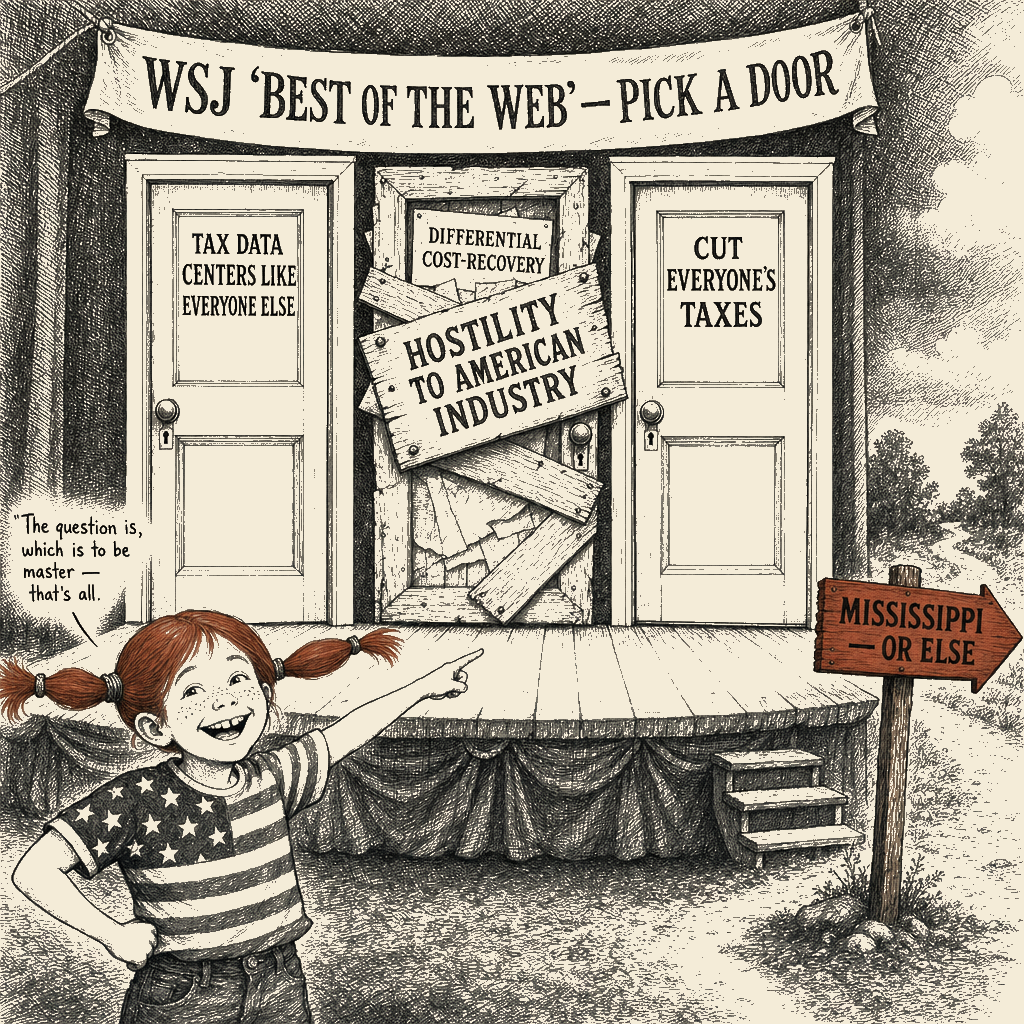
Analyzing: Caterpillar Moved From Illinois to Texas. Now What? — James Freeman · 2026-07-09
What the Editorial Argues
In his July 9, 2026 “Best of the Web” column, James Freeman, the Wall Street Journal’s editorial-page assistant editor, uses Caterpillar’s 2022 headquarters relocation from Illinois to Texas as a parable about state governance. The structure runs: a “sensibly governed, taxpayer-friendly” Texas lured Caterpillar away from a “blue state with expensive and dysfunctional governance”; the firm has thrived in its new home; but Gov. Greg Abbott’s recent willingness to consider new taxes or rules on data centers — major customers for Caterpillar’s power-generation equipment — risks poisoning that success. Any such move is framed as a “huge mistake,” and Freeman warns that AI-industry firms “should take a look at Mississippi” if Texas turns hostile to them. The piece closes by praising Florida local officials for cutting spending. The throughline: low-tax, low-regulation states are the only sensible ones; anything else is anti-growth hostility.
Receipts
The piece opens with a story shaped like a free-market parable and built like a shakedown. The construction is a clean instance of the competitive-federalism shakedown that the WSJ + NR op-ed page has run on states considering union protections, minimum-wage hikes, and consumer-financial regulation for two decades — recoded this time for the AI buildout.
What the framing wants you to believe:
- Caterpillar left “dysfunctional” Illinois for “sensible” Texas and is thriving.
- Texas Gov. Abbott is signaling “hostility” to the data center / AI industry, which is a major Caterpillar customer.
- If Texas imposes new taxes or rules on data centers that don’t apply to other industries, this is a “huge mistake” that will drive firms to Mississippi.
- Florida localities cutting spending is exemplary.
What’s really going on:
- The “sensible governance” / “dysfunctional governance” binary is frame-engineered relabeling (WSJ Editorial Technique Catalogue §4.1; Bad-Faith Techniques Catalog,
frame_engineered_relabeling): “sensible” means “low taxes on Caterpillar’s customers,” and “dysfunctional” means “any taxes on Caterpillar’s customers.” The swap is performed in the first sixty words of the piece. - The fairness clause — “if [data centers] have been given lighter tax burdens than other types of businesses, then by all means cut every company’s taxes down to the same low rate” — is a textbook false dichotomy from the Bad-Faith Techniques Catalog (
false_dichotomy): the choice is presented as “tax data centers like everyone else, or cut everyone’s taxes,” concealing the third option of differential cost-recovery keyed to differential infrastructure impact. - The Mississippi ultimatum is a competitive-federalism shakedown — name a destination jurisdiction, treat the move as the regulator’s choice, and the analysis is over.
- The omitted variable is the load-bearing one: data centers’ electricity draw is the single fastest-growing load on U.S. grids, and the transmission and generation capacity built to serve them is socialized into rate bases that residential and small-commercial ratepayers subsidize. ERCOT’s December 2025 Capacity, Demand, and Reserves report documents the load: the large-load interconnection queue jumped nearly 300% to over 233 GW, dominated by data centers. Water consumption in a Texas under deepening drought is the second omitted variable, documented in Texas Water Development Board projections the column does not engage. The piece’s frame treats any attempt at cost-recovery as “hostility.”
The Operation
Cui bono. The named beneficiaries are Caterpillar, the data-center operators, and the AI industry. The unstated structural beneficiary is the capital that appreciates when the public absorbs the infrastructure cost and the firm captures the upside. The named cost-bearers are Texas residential and small-commercial electricity ratepayers and the Texas water commons; the unstated cost-bearers are the workers and small businesses whose tax base gets raided to fund the incentives data centers received to locate in Texas in the first place — Texas’s Jobs, Energy, Technology & Innovation Act (JETI) and its Chapter 313 predecessor are the documented instruments. The alternative design — the policy that would actually deliver on the page’s stated values of free markets and individual rights — is straightforward: data centers pay the marginal cost of the electricity, water, and grid upgrades they impose, with the revenue recycled as a per-kWh credit on residential bills. The page opposes this in narrator voice while invoking “fairness.” Placement: selfish.
FGL. The framing’s author operates from greed for narrative continuity of the “red state triumph” myth and fear that acknowledging physical limits undermines the ideological premise that deregulation alone solves all problems. The apex beneficiary — the hyperscaler / data-center operator — operates from greed for margin expansion via unpriced infrastructure externalities. The rank-and-file reader (the WSJ subscriber, the informed conservative who already carried a view on tax-and-spend blue states) is captured through laziness in accepting the “blue state bad / red state good” binary without asking what happens when the red state runs out of the physical resources the binary assumes are infinite. The reader’s laziness is real and human; the technique is built to exploit it.
The technique stack, with catalogue cross-references.
Frame-engineered relabeling (WSJ Editorial Technique Catalogue §4.1; Bad-Faith Catalog frame_engineered_relabeling). The textual cue is the lede: “sensibly governed, taxpayer-friendly jurisdiction” against “expensive and dysfunctional governance.” The same referent — a state tax code — is rendered in two value-laden registers depending on whether the taxes land on a page-favored industry. Lineage: this is the Luntz relabeling operation Lakoff documented in Don’t Think of an Elephant! — the substitution of a virtue-word (“sensible,” “fair,” “pro-growth”) for the descriptive referent. We operators used this exact substitution to defend extractive industries for decades: any limit on the extraction is framed as an attack on the extractor.
Blue state failure frame / “Red State Betrayal” mirror (WSJ Editorial Technique Catalogue §4.9). The structure is the WSJ house special — take one firm’s location decision and generalize it to a verdict on blue-state governance, with the implication that any blue state considering similar regulation is next. The opposite generalization — taking one data-center’s complaint and generalizing it to a verdict on Texas’s data-center policy — is structurally available and conspicuously absent. The asymmetry is the technique. The “Red State Betrayal” frame operates the other direction: when a right-wing jurisdiction attempts to govern a physical or infrastructural reality rather than just deregulate it, the governance itself is reframed as an ideological betrayal of “pro-growth” principles. The collapse between ideological deregulation and physical management is the mechanism: the reader is trained to believe any limit, price, or rule on a favored industry is a regression to “Illinois-style” dysfunction rather than a basic response to a maxed-out grid queue and a finite aquifer.
Strawman of progressive positions (WSJ Editorial Technique Catalogue §4.6; Bad-Faith Catalog strawman). The piece treats “considering taxes on data centers” as a coherent policy position called “hostility to this world-leading American industry.” The actual Texas debate — over whether a single industry should pay the marginal cost of the grid strain and water draw it imposes — is the position being strawmanned. The textual cue: “if the governor and legislators intend to impose burdens on AI that are not imposed on other industries, they are heading for a huge mistake.” The “burdens on AI” formulation presupposes that all cost-recovery is differential burden; that the cost-recovery the legislature is actually considering is not differential is the position the piece refuses to engage.
False dichotomy (Bad-Faith Catalog false_dichotomy). The fairness clause is a textbook exhaustiveness denial. “By all means cut every company’s taxes down to the same low rate” presents two options — tax data centers like everyone else, or cut everyone’s taxes — and conceals the third, which is differential cost-recovery keyed to differential infrastructure impact. The Bad-Faith Catalog’s template applies: “The framing presents a false dichotomy. The choice between [X] and [Y] is not exhaustive; [Z] is also available.”
Selective attention / omission of the physical base rate (Bad-Faith Catalog selective_attention). The piece quotes Wermund and Britschgi on taxes and water but never mentions why water or power has become a contentious issue for data centers — the ERCOT 233 GW interconnection queue, the aquifer depletion rate, the JETI abatement structure. You cannot evaluate whether a rule is a “burden” without knowing the physical capacity of the grid and aquifers. By omitting the physical denominator, the piece makes the tech industry’s demand for unlimited resources look like the default.
Threat-inflation closer (WSJ Editorial Technique Catalogue §4.13). The “huge mistake” formulation in the body, the “huge appetite” formulation in the lede, the “world-leading American industry” stakes inflation, the Mississippi-threat coda. The catalogue’s note applies: the closing-line cadence inflates the stakes from concrete-to-civilizational and is engineered for retransmission.
Deficit double standard / selective fiscal discipline (WSJ Editorial Technique Catalogue §4.4). The close praises Florida localities cutting spending — restraint when spending supports a public service; hostility when spending (or, more precisely, revenue-raising) touches a favored industry. The asymmetry tracks the page’s standing posture: deficits matter when produced by Democratic spending; they are an acceptable cost of the page’s preferred policy; and now, the principle extends to revenue-raising on a favored industry.
Audience-management function. The piece executes on three of the four audiences the WSJ page addresses (per WSJ Catalogue §4.3, the multiple-audience-targeting analytic). The wealthy reader gets confirmation that the firm did the right thing and that states chasing capital must compete on the firm’s terms. The political class gets the talking point that any data-center tax is anti-growth hostility, in a register respectable enough to recirculate. The populist base gets the parable of the Caterpillar and the move-the-factories rhetoric. The technocratic class is the audience the piece does not address — the documented grid-strain data, the water-consumption data, the rate-base socialization data, the JETI abatement structure are nowhere in the column.
The operator’s-eye-view. We drafted memos in this register. The blue-state cautionary tale as the spine of a state-policy op-ed; the competitive-federalism ultimatum as the leverage point; the “hostile to business” trope deployed on any cost-recovery measure — the structure recurs across the WSJ + NR op-ed page across decades and across industries. The Mississippi-as-ultimatum naming convention is a particular subgenre. The state is given two choices — capitulate on the regulation or lose the firm — and the choice is framed as the state’s to make. The piece is a clean instance of the form.
Bandura eight, in concert. The paradigm cluster for this archetype runs: moral justification — the data-center industry’s contribution to “American industry” and “the AI future” licenses the cost socialization; euphemistic labeling — the cost socialization is “fairness,” the cost-recovery is “hostility”; displacement of responsibility — the costs the data centers impose on residential ratepayers and the water commons disappear from the frame, and the responsibility for any action against the industry lands on the governor and legislators; distortion of consequences — the documented rate-base socialization, the documented water-commons drawdown, and the documented incentive-package costs to Texas taxpayers are nowhere in the piece; attribution of blame — the framing positions the host community as the agent of harm and the data center as the victim. The Bandura framework (Albert Bandura, Moral Disengagement, 2016) treats these as a cluster: naming one mechanism in isolation misses the conscience-soothing effect the operations produce in concert.
The Record
What the piece supplies. The 2022 Caterpillar headquarters relocation from Peoria, Illinois, to Irving, Texas, is a documented public-record event. Caterpillar’s stock performance and the data-center buildout’s demand for power-generation equipment are documented. The Texas legislative debate over data-center tax treatment and electricity-cost allocation in 2025–2026 is a documented record. Gov. Greg Abbott’s public posture on the data-center industry is on the record. Florida local-government spending restraint in 2026 is on the record. Nick Wooten (Dallas Morning News), Benjamin Wermund (Houston Chronicle), Christian Britschgi (Reason), and Arian Campo-Flores (WSJ) are documented journalists at the cited outlets; their underlying reporting is on the public record and not in dispute here.
Tier-1 receipts are not the problem here; the omission is. The piece’s load-bearing claims — that Texas governance is “sensible,” that Illinois governance is “dysfunctional,” that data centers are being singled out for “burdens not imposed on other industries” — are presented without citations because the page’s house voice treats them as the reasonable reader’s priors. The WSJ Catalogue §3.2, the dek-as-thesis pattern, is operative here: the lede carries the editorial’s claim, and the body quotes selected reporting that is consistent with the frame. The reporting the piece does not cite is the reporting that would complicate the frame.
Anchor receipt. The ERCOT December 2025 Capacity, Demand, and Reserves report — a Tier-1 primary document — documents the load growth the piece refuses to engage: the large-load interconnection queue jumped nearly 300% to over 233 GW, dominated by data centers.
The load-bearing omissions.
- The actual text of the Texas legislation Abbott has signaled support for. The piece assumes a particular shape for the policy and attacks the assumed shape; the actual policy text is not in the piece. The piece’s framing depends on the specific policy remaining unspecified.
- The ERCOT grid-impact data above; the Texas Water Development Board’s drawdown figures; the rate-case filings before the Public Utility Commission of Texas.
- The actual mechanism by which “lighter tax burdens” for data centers are currently paid for — i.e., subsidized by other ratepayers and by the Texas property-tax base through JETI and its Chapter 313 predecessor. The “burdens” Abbott might impose are, in significant part, the cessation of a subsidy, not a new penalty. The piece does not engage this distinction.
- The specific reasons Illinois’s tax code and regulatory environment differ from Texas’s, beyond the page’s standing “blue state failure” characterization. The “expensive and dysfunctional” framing is the page’s standing posture (WSJ Catalogue §4.9) rather than a documented analysis.
- The actual tax-and-service profile of Mississippi, the named destination. The piece names Mississippi as the alternative jurisdiction; the reader is given nothing about Mississippi’s tax structure, regulatory environment, infrastructure, workforce, or capacity to absorb a major data-center buildout. The naming is the analysis.
Per-citation accuracy. The piece attributes its case-study material to Wooten, Wermund, Britschgi, and Campo-Flores. The attribution pattern is consistent with the page’s house preference for in-coalition sourcing (WSJ Catalogue §3.6): Reason and the Journal are page-aligned outlets, and the framework’s note on asymmetric source citation applies. The piece does not cite any source contradicting the frame. The Bad-Faith Techniques Catalog’s principle on symmetric sourcing across coalitions is the relevant discipline; this piece does not meet it.
The symmetric-application test. A structurally identical piece could be written about a state imposing new taxes on a disfavored industry — say, a hypothetical progressive state’s tariff on low-wage employers — and the page would correctly identify the cost-shift and the externalization. The page does not apply the analysis here. The asymmetry is the news.
A missing-information declaration. The specific text of the Texas legislation remains in the shadows; what the column attacks is the ghost of a policy, not the law itself. ERCOT’s grid-impact data, the Texas Water Development Board’s drawdown figures, the rate-case filings before the Public Utility Commission of Texas — none of it enters the column’s “receipts.” We drafted memos in this register. We know which way the analysis runs when the operator engages the data, and we know why the column does not engage it. The documentary record for this specific 2025–2026 intervention is held in the page’s editorial archive, in the Texas Legislature’s online record, and in the PUCT’s docket — repositories owned by parties with skin in the frame, not by the reader. The piece’s framing depends on the policy remaining unspecified, because the specified policy does not survive the operator’s-eye-view.
The complicity disclosure. We drafted memos in this register. The reader is on notice that the analyst naming the techniques is the operator who helped build versions of them. That is the credibility the column trades on.
How to Recognize This
The pattern is the interstate competitive-federalism shakedown, recoded as a free-market parable. The mechanism: a favored industry is treated as the protagonist of a cautionary tale, the host jurisdiction is treated as the antagonist whose “mistake” is considering any cost-recovery, and the threat of capital flight to a more compliant jurisdiction is held over the policy process. The reader absorbs the frame that any cost-recovery on a favored industry is anti-growth hostility, and that the only “fair” outcome is no cost-recovery at all.
Concrete textual signals to watch for:
- “Sensibly governed” applied to a low-tax state and “dysfunctional” applied to a higher-tax state, with the differential characterization standing in for the actual policy analysis. The watch-word is “uncharacteristically” or “disturbing plot twist” when the favored jurisdiction attempts to govern.
- “Burden” or “hostility” applied to any cost-recovery measure on a favored industry. “Impose burdens on AI”; “saddling server farms with rules”; “become hostile to this world-leading American industry.”
- A competitive-federalism ultimatum naming a destination jurisdiction — Mississippi in this case, but the pattern is the same: a worse-or-more-desperate state is held up as the alternative.
- A fairness clause that frames the only “fair” outcome as cutting all taxes to the level of the favored industry’s.
- The omitted denominator. The article will say an industry “uses” a resource or “creates” growth, but will never state the total capacity of the resource or the marginal cost of the next unit.
- A closing pivot to a different state’s fiscal restraint, with the implication that the moral of the original story applies to the home jurisdiction too.
Why it works. The frame gives the reader a protagonist to root for (the firm, the favored industry, the job-creator) and an antagonist to oppose (the politician considering the cost-recovery). The reader’s prior skepticism of the antagonist’s tax appetite is enlisted in the frame, and the specific policy content is never engaged. The competitive-federalism threat adds a coercive weight: the reader is told the antagonist’s policy will fail on its own terms, because the firm will leave. The reader does not need to engage the cost-recovery question; the frame has already answered it. It exploits the reader’s genuine affection for the “red state triumph” narrative and weaponizes it to defend the next wave of concentrated corporate extraction. The reader doesn’t want to believe Texas is flawed, so they accept the framing that any attempt to manage the tech boom is a flaw in the governor, not a feature of the physical world.
What to do when you see it. When an editorial frames resource management as “hostility,” ask for the denominator. What is the total capacity of the grid queue? What is the aquifer depletion rate? Find the cost the favored industry is not paying. Ask who is paying it. Ask whether the host jurisdiction’s cost-recovery proposal is keyed to the differential infrastructure impact, or whether it is the maximalist version the editorial is attacking. Trace the subsidy: is the industry currently paying the marginal cost of its infrastructure under JETI, or is it receiving a tax abatement? Ask who financed the editorial’s framing memo. Ask what the destination jurisdiction’s tax-and-service profile actually looks like, beyond “lower.” Reduce the frame’s automatic activation: the next time you see a “sensible governance” / “dysfunctional governance” binary, substitute “low taxes on [X]” for “sensible” and see whether the editorial still says what it says. The moment you restore the physical denominator, the “anti-growth plot twist” vanishes and is replaced by simple arithmetic.
A close on witness. We operators spent years building the reflex that equates “regulation” with “ruin.” It takes a different kind of work to look at a governor trying to keep the lights on from actually turning off, and recognize it as governance rather than betrayal. You, the subscriber who absorbed the frame and is being asked to act on it — write the congressman, share the column, vote against the cost-recovery — have been captured by the technique. You are no fool; the technique is built to capture the informed reader, the WSJ subscriber, the person who already knew Caterpillar moved to Texas and already carried a view on tax-and-spend blue states. The technique works on you because the priors it activates are priors you already held. The work the column does for you is to convert those priors into a policy position, without the policy analysis that would, if engaged, dissolve the frame. The recognition belongs to you; the arithmetic is just the record. When the next column arrives in this register, the structural cues are visible. You do not need to be persuaded of the policy on the merits from the column; you need to recognize that the column is not engaging the policy on the merits. That is the recognition the column is in service of — and the recognition the operator’s-eye-view is built to return to you, the captured reader.

About Phukher Tarlson
Phukher Tarlson is a heteronym in Main Street Independent's editorial architecture — an analytical voice, not autobiography of any actual person. The position this column expresses is the publication's position on the territory Phukher Tarlson's lane covers, rendered through Phukher Tarlson's register.