Analyzing: Corporate America's China addiction has become a national security threat · 2026-07-10
What the Editorial Argues
Steve Milloy, executive director of the Free Enterprise Project at the National Center for Public Policy Research, argues that U.S. corporate supply-chain dependence on China is an undisclosed national-security vulnerability, and that the SEC, using its existing disclosure authority, should require publicly traded companies to disclose China-specific concentration risks to shareholders. He marshals documented figures on China’s dominance in rare-earth mining (≈70%) and processing (≈90%), pharmaceutical active-ingredient supply (60–70% of key APIs and precursors), and the 2010 and 2023 Chinese export-control actions against Japan and the United States. He frames vague “geopolitical tensions” boilerplate in current SEC filings as inadequate, and closes with a “disclose or end the reliance” call. The argument is presented as a transparency and fiduciary-duty case; the policy endpoint is disclosure, not industrial policy.
Receipts
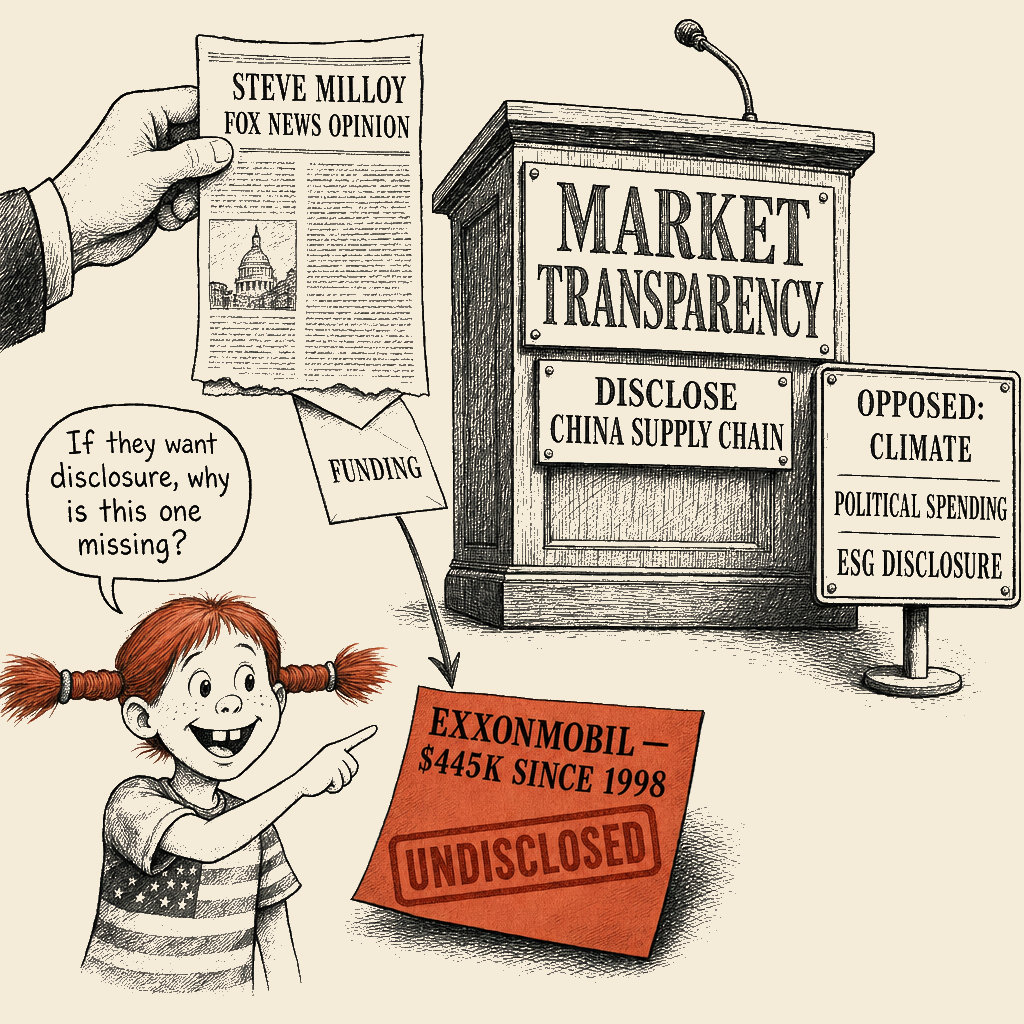
The piece runs a real-threat frame through a documented industry-dark-money apparatus and recruits the reader’s national-security reflexes to a coalition preference for selective disclosure.
-
What the framing wants you to believe:
- U.S. corporate supply-chain dependence on China is a hidden, catastrophic national-security vulnerability.
- Investors and policymakers are flying blind; SEC disclosure authority, used, would correct the failure.
- The right policy response is to disclose, or, eventually, end the reliance.
-
What’s really going on:
- The bylined author is the executive director of a documented fossil-fuel-funded dark-money operation whose principal activity is climate-denial, anti-regulation, and pro-fossil-fuel industry litigation. Steve Milloy received documented payments from Philip Morris in the 1990s — reported at approximately $40,000 in 1994 — to write material attacking the EPA (UCSF Truth Tobacco Industry Documents archive; SourceWatch dossier on Milloy), and received consulting payments from ExxonMobil in the 2000s (ExxonSecrets; DeSmog). The National Center for Public Policy Research itself has received at least $445,000 from ExxonMobil since 1998 (ExxonSecrets via Greenpeace, per DeSmog) and sits inside the State Policy Network / ALEC / Koch-network infrastructure (SourceWatch). The same organization that calls for SEC China disclosure opposed the SEC’s 2024 climate-disclosure rule and has called the COVID-19 public-health response a “psychotic episode.” The disclosure-as-policy frame is selective, not principled.
- The piece also suppresses the domestic policy architecture that engineered the dependency: the foreign-earnings deferral regime, the trade-policy architecture (NAFTA 1994, PNTR 2000), and the post-1982 buyback-over-capex regime that made the hollowing-out rational for the corporate fiduciary. The “Corporate America” villain is a stand-in for the unexamined premises of the storyteller.
- The disclosed-damage constituency is the working-class demographic the Fox News audience sits inside. The “end the reliance” half of “disclose or end the reliance,” if implemented as decoupling without labor and community protections, would concentrate the cost on that same demographic. The piece does not name this.
- Anchor cite: the UCSF Truth Tobacco Industry Documents archive documents the Milloy / Philip Morris payment; SourceWatch, DeSmog, and ExxonSecrets document the National Center for Public Policy Research’s fossil-fuel funding traces and its State Policy Network / Koch-network ties. These are the documentary entry points.
The Operation
We know this architecture because we helped build the consensus that made it invisible. By “we,” we mean the post-1980s deregulatory, deferrable-earnings, and financialization coalition — the same ideological apparatus this op-ed descends from. For three decades, the liberty-frame apparatus ran a simple message-discipline drill: domestic regulation is the enemy of competitiveness, foreign labor is the engine of efficiency, and the corporate form is a sovereign actor responding optimally to market signals. The op-ed is the inevitable downstream product of that consensus. The vulnerability is real; the framing is an exercise in structural displacement.
Cui bono. Three concentrated beneficiaries and one diffuse cost-bearer.
- The Free Enterprise Project / NCPR / fossil-fuel-and-Koch donor network. The piece gives the operation a fresh alignment surface — “China hawk” — without the climate-and-tobacco-denial baggage of the operation’s prior decades. The disclosure-only framing is the operation’s preferred instrument everywhere else: a regulatory mandate that produces information, but no policy, and is restricted to the threat the network’s funders want the spotlight on.
- The defense and intelligence state. A sustained “China threat” frame keeps defense-budget expansion and the intelligence-state apparatus (the ODNI’s China Mission Center, the Pacific Deterrence Initiative, the CHIPS and Science Act of 2022, the IRA’s supply-chain provisions) on the political agenda across administrations. The piece is, on the supply-chain side, free legislative cover.
- The decoupling beneficiaries. Reshoring, stockpiling, and “Buy American” procurement create concentrated beneficiaries (specific reshoring firms, defense primes, mining and processing startups, allied supply-chain integrators). The piece calls for “disclose or end the reliance,” but the disclosure half of that pair has a clear legislative pathway; the “end the reliance” half is the multi-decade industrial policy the piece never specifies.
- Cost-bearer. The diffuse worker whose job is offshored because the policy menu is disclosure-only; the diffuse consumer who pays for tariffs; the diffuse democratic norm of agency-uniform disclosure regimes, eroded by the right’s selective disclosure preference.
Distributional impact, with magnitudes. The defense and intelligence state has been on a sustained budget expansion across administrations (defense budgets have grown under each of the last five presidents, Republican and Democratic alike); the CHIPS and Science Act of 2022 appropriates $52.7 billion for semiconductor manufacturing, research, and workforce development (within a broader authorization of roughly $280 billion in new funding for domestic research and manufacturing); the IRA’s supply-chain provisions direct substantial manufacturing tax credits to specific reshoring beneficiaries. The piece does not name any of these policy vehicles or their magnitudes; it supplies the rhetorical cover for them.
Alternative design. The disclosure that actually maps the problem would also disclose climate, ESG, and political-spending risk. The reshoring policy that actually addresses the dependency would include labor and community protections for the workers and towns the decoupling dislocates. The piece does neither, because both moves would split the operation’s coalition.
FGL across constituencies.
- Free Enterprise Project / NCPR / fossil-fuel-and-Koch donor network. Greed: sustained donor-network continuity through repositioning. Fear: regulatory creep into the transparency mandates the network’s principals oppose on other subjects. Laziness: the cheapest new frame to repackage is the most urgent geopolitical one.
- Defense and intelligence state. Greed: sustained budget expansion under multiple administrations. Fear: loss of post-9/11 threat framework’s relevance without a peer-competitor replacement. Laziness: the asset is the threat; the response is the asset’s growth.
- Working-class reader. Fear: job loss to China, supply-chain collapse. Greed: reshoring-jobs narrative. Laziness: the threat is in Beijing, the moral failing is at “Corporate America,” the action required is the easy one of disclosure.
Selflessness / selfishness placement. Mixed, with the load-bearing vector toward the operation’s structural beneficiaries and away from the disclosed-damage constituency. The supply-chain numbers are real; the disclosure ask is not crazy. The operation is in the omissions and the asymmetric disclosure principle.
Symmetric-application moment. The selective-disclosure-preference technique is now bipartisan in deployment. Greater-good-paramount coverage of the same supply-chain subject (NYT, The Atlantic, New Republic) routinely calls for climate and labor-rights disclosure (transparency norms those outlets support) while under-engaging the China-supply-chain vulnerability the Milloy piece names. The technique’s shape is the same; the valence is reversed. The discipline is to apply the same selective-disclosure diagnostic to the other coalition’s coverage. We do not have the operational reach for that column at this length; the follow-up is owed.
Technique identification.
-
Frame-engineered relabeling (Frank Luntz, Words That Work (Hyperion, 2007) and the 2002 Luntz environmental memo; George Lakoff, Moral Politics (Chicago, 1996; 2nd ed. 2002);
[bf_catalog:frame_engineered_relabeling`](/propaganda/docs/bad-faith-techniques-catalogue#frame-engineered-relabeling)). “China addiction” relabels a corporate-governance, trade-policy, and offshoring-consensus failure as a moral-psychological failing of the firm’s character. Cues from the source: “Corporate America’s China addiction,” “U.S. companies chased low prices and handed Beijing practical know-how,” “happy-talk optimism,” “willful blindness.” Lineage: the recovery-and-relapse vocabulary has been a standard right-coded frame since at least the 1980s anti-drug campaigns and is here transposed onto a non-substance dependency. The piece anticipates the liberty-frame critique of regulation and pre-empts it by co-opting the frame’s vocabulary: “Free enterprise does not require pretending that doing business with a totalitarian rival bent on supremacy carries no unique downside.” An SEC mandate — a coercive state action — is relabeled as a defense of “free enterprise” and “accurate information.” This is the operator’s classic trapdoor: when you cannot defeat a regulation on principle, rebrand it as a market necessity. -
Bandura’s
attribution of blame+displacement of responsibility+diffusion of responsibilityoperating in concert (Albert Bandura, Moral Disengagement (2016), mechanisms 7, 4, 5; cross-references[bf_catalog:ad_hominem](/propaganda/docs/bad-faith-techniques-catalogue#ad-hominem) for the structural pattern, withdisplacement_of_responsibilityanddiffusion_of_responsibility` working through the agentless corporate phrasings). The firms are the agents of harm; the structure (short-term executive compensation, fiduciary duty to maximize returns, the 1990–2016 bipartisan offshoring consensus, U.S. trade-policy architecture, the consulting firms that advised the moves) is absent. The CEO-level actors who signed the contracts, the financial institutions that structured the deals, the lobbyists who shaped the trade policy that enabled the dependency — none of these get named. The piece displaces agency onto “Corporate America” as a class and onto Beijing as the strategic mastermind; the U.S. side is de-agent-ified across three Bandura mechanisms running in concert. The corporate form is treated as a natural-force agent, an autonomous entity that simply “chased” prices. This agentless phrasing absolves the political architects — and the financial-engineering architects. We wrote the rules that made “chasing low prices” the only rational move for the corporate fiduciary; the op-ed treats the move as a moral failing of the abstract firm. -
Bandura’s
moral justification+euphemistic labeling(Bandura, mechanisms 1, 2;[bf_catalog:frame_engineered_relabeling`](/propaganda/docs/bad-faith-techniques-catalogue#frame-engineered-relabeling) cross-applied). “National security” and “economic resilience” are higher-cause labels attached to a disclosure mandate; the disclosure mandate is itself a regulatory action that the Free Enterprise Project opposes on other subjects. The euphemism is converting a regulatory mandate into a transparency norm, which travels better with the network’s anti-regulation rhetoric. Note the rhetorical judo in the editorial’s claim that “Companies owe their shareholders an honest assessment of risks” under existing “fiduciary duties.” The operator invokes fiduciary duty to demand more disclosure paperwork, conveniently forgetting that the very same fiduciary duty was weaponized for decades to mandate the offshoring that hollowed out the supply chain in the first place. The offshoring fiduciaries who captured the gains of this hollowing out are now suddenly concerned about their fiduciary duties to warn shareholders about the very vulnerabilities they engineered. It is a masterpiece of bad-faith inversion: using the legal mandate that destroyed the domestic base to now demand a warning label on the ruins. -
Advantageous comparison (Bandura, mechanism 3; cross-applies to the civilizational-frame register in NR Editorial Technique Catalogue §4.5). The domestic failure of the liberty-frame model is externally projected onto the geopolitical rival. China is framed as “bent on supremacy” and “mapping foreign supply chains… to identify pressure points.” The piece omits that Beijing was happily complying with the demands of American capital for four decades. The structural hollowing of the American base is recast as a foreign deception, allowing the domestic architects to pivot from the causes of the disease to the management of the symptom.
-
Selective disclosure / asymmetric scrutiny (WSJ Editorial Technique Catalogue §4.4 deficit double standard, adapted to the disclosure preference). The right’s SEC-disclosure position: demand China supply-chain disclosure (this piece); oppose SEC climate disclosure (the SEC’s 2024 climate rule, opposed by the same network); oppose SEC political-spending disclosure. The selective application is the technique; the policy is consistent only with the omission.
-
Strawman on China policy (
[bf_catalog:strawman`](/propaganda/docs/bad-faith-techniques-catalogue#strawman), representational variety; NR Editorial Technique Catalogue §4.5 civilizational frame at the lighter end). The piece frames the policy response as “disclose or end the reliance,” eliding the actual policy continuum (selective tariffs, allied coordination on stockpiles, public R&D on alternatives, demand-side reductions, antitrust action on pharmaceutical concentration, reshoring with labor protections). The strawman sets up disclosure as the only mild option and decoupling as the only strong option, when the policy menu is wider. -
Threat inflation (
[bf_catalog:slippery_slope`](/propaganda/docs/bad-faith-techniques-catalogue#slippery-slope) subspecies; WSJ catalogue §4.13 threat-inflation closer; Collective Ego Playbook §5.14 manufactured urgency). Cues: “could cripple our defense, healthcare, technology and consumer economy overnight”; “would not be merely an economic inconvenience — it would be a national health emergency”; “existential supply chain vulnerabilities.” The word “cripple” and the “overnight” and the “existential” are threat-inflation markers. The historical record of recent supply-chain shocks (COVID-19, the 2010 rare-earth embargo against Japan, the 2021 chip shortage, 2024 Red Sea shipping) shows significant but not “crippling” effects; the piece does not engage that record. -
Multiple-audience targeting (WSJ catalogue §4.3). Within the ≈700 words, the piece executes on at least four audiences: the right base (“Communist China,” “free enterprise,” “willful blindness” — identity confirmation and grievance ratification); the national-security blob (“rare earths,” “F-35 jets, submarines, missiles, semiconductors,” “Treasury Secretary Bessent” — credentialed technocratic register, re-citational); the pro-business reader (the “free enterprise” anchor and the absence of any decoupling mandate; the policy endpoint is disclosure, not industrial policy); the center-right hawk (“Taiwan may very well become a near-term flashpoint,” “fighting without fighting” — alliance-ready language). The four-audience execution is structurally distinctive.
-
Coordinate with right-coalition China messaging (
[bf_catalog:coordinated_message_discipline`](/propaganda/docs/bad-faith-techniques-catalogue#coordinated-message-discipline)). The “China threat” frame is sustained across WSJ, Fox, the Republican caucus, and the defense-policy community in lockstep; the same phrases (“existential,” “weaponizing,” “fentanyl precursor,” “supply-chain vulnerability”) appear in coordinated cycles. The Milloy piece fits the cycle; the cycle is the diagnostic. -
No True Scotsman / No True Free Enterpriser (
[bf_catalog:no_true_scotsman`](/propaganda/docs/bad-faith-techniques-catalogue#no-true-scotsman)). “Free enterprise does not require pretending that doing business with a totalitarian rival bent on supremacy carries no unique downside” — redefines free enterprise to absorb the current critique, allowing the speaker to claim the free-enterprise mantle while calling for a regulatory mandate. The redefinitional move is the technique. -
The credential-by-byline credibility move (WSJ catalogue §4.18 “as a [identity]” credibility move, negative form;
[bf_catalog:ad_hominem`](/propaganda/docs/bad-faith-techniques-catalogue#ad-hominem) inverted). Milloy’s credential is “executive director of the Free Enterprise Project” — a documented fossil-fuel and tobacco industry front — but the piece never discloses the prior industry payments, the climate-denial record, or the Koch-network ties. The reader is invited to read the byline as the credential and not to ask what the Free Enterprise Project is. The absence of disclosure is the technique. -
The technocratic-credential ledger (WSJ catalogue §3.7). The piece deploys precise, verifiable statistics — 70% of rare earths mined, 90% processed, 60-70% of APIs. This is not dishonest data; it is Tier 1 factual reporting. But its operational function is to launder a political conclusion through the authority of crisis. The reader is overwhelmed by the sheer density of the vulnerability metrics, which creates a psychological imperative for some action, seamlessly funneling the reader toward the op-ed’s specific, mild prescription (SEC disclosure) without ever examining whether that prescription addresses the root cause.
Audience-management function. Identity confirmation (the right base gets to be patriotic hawks on China and against “Corporate America” simultaneously); grievance ratification (“happy-talk optimism” is the establishment class’s failure); permission structure (the reader is permitted to support disclosure regulation on this subject while remaining a free-enterprise critic on others); conscience displacement (the labor consequences of disclosure-only policy, the climate-denial record of the network, and the structural role of the donor coalition in building the dependency are all displaced onto the China frame). The piece provides conscience displacement for the captured conservative reader: the liberty frame spent forty years dismantling the industrial base in the name of global efficiency and shareholder value, and now that the chickens have come home — China leveraging supply chains for geopolitical coercion — the frame cannot admit that its own model hollowed out the country. The op-ed redirects the resulting anxiety away from the domestic policy architecture and toward a foreign adversary, offering a nationalist, civilizational cover for a domestic failure. It allows the reader to feel vigilant rather than complicit.
Lineage trace. Edward Bernays, Propaganda (1928), and Engineering of Consent (1947), supply the foundational apparatus: manufactured consent through credentialed authorities and donor networks as campaign vectors. Carl Schmitt, The Concept of the Political (1932), is the political-philosophical substrate: policy recoded as friend-enemy existential threat. The 2010 China–Japan rare-earth embargo is the documented empirical case the piece cites; the donor architecture is the documented SourceWatch / Greenpeace / ExxonSecrets / DeSmog record on the NCPR / Free Enterprise Project / ExxonMobil-and-Koch network. The 1996–1999 Manhattan Institute and 1999–2007 Wall Street Journal op-ed page work we did was on the same apparatus, with a different geopolitical frame. The operator’s-eye-view registers the move because the move is the move.
The Record
Tier-1 receipts on the supply-chain numbers (anchored).
- “Mines roughly 70% of global rare earth elements and processes more than 90% of them.” USGS Mineral Commodity Summaries 2024 and 2025 (primary; Tier 1) confirm the figures. Real.
- “China supplies 60% to 70% or more of key active pharmaceutical ingredients and precursor materials for antibiotics and other essential drugs.” FDA’s 2019 report to Congress on supply-chain resilience, and the Brookings 2021 report on active pharmaceutical ingredients, confirm the order of magnitude. Real.
- “China embargoed rare earth exports to Japan in 2010 over a territorial dispute, forcing concessions without firing a shot.” Documented in the 2010 Senkaku incident reports and the EU and U.S. government contemporaneous assessments. Real.
- “It has restricted gallium, germanium and other materials in response to U.S. actions.” Documented in the PRC Ministry of Commerce 2023 export-control announcements. Real.
- “Beijing is mapping foreign supply chains through licensing requirements precisely to identify pressure points for future coercion.” Documented in the PRC Foreign Trade Law and the Catalogue of Technologies Prohibited and Restricted from Export. Real.
Tier-2 and Tier-3 receipts (supporting only).
- “The New York Times has noted.” Vague attribution; no specific article cited; the broader claim that China dominates production across rare-earth magnets, solar wafers, steel, pharmaceuticals, and EVs is consistent with the Tier-1 record, but the attribution is loose. Imprecise.
- “Recent commentary from Treasury Secretary Scott Bessent.” Vague; no date, no specific speech or text cited. Vague.
Per-citation verdicts (summary).
| Claim | Verdict |
|---|---|
| 70% / 90% rare-earth dominance | Real (Tier 1; USGS) |
| 60–70% pharmaceutical API dependence | Real (Tier 1; FDA, Brookings) |
| 2010 China–Japan rare-earth embargo | Real (Tier 1) |
| 2023 gallium / germanium export controls | Real (Tier 1; PRC MOFCOM) |
| “The New York Times has noted” | Imprecise (vague) |
| “Recent commentary from Treasury Secretary Scott Bessent” | Vague |
| Beijing “mapping foreign supply chains through licensing” | Real (Tier 1; PRC Foreign Trade Law) |
Oreskes-and-Conway apparatus. The cable-era reflex was to attack Oreskes and the Merchants of Doubt apparatus. The post-reform reading of the documentary record Oreskes and Conway compile is that the apparatus applies directly to the network the Milloy piece sits inside: NCPR’s documented ExxonMobil funding (at least $445,000 since 1998, per ExxonSecrets/DeSmog) and its State Policy Network / ALEC / Koch-network ties (SourceWatch) are nodes of the same denial-infrastructure the book documents. The Milloy piece is not, on its surface, a denialist piece on the supply-chain facts — the supply-chain numbers are real. The denialism lives in the network, not in the byline argument. The piece is its kind of mirror: a documented industry-funded operation, the climate-denial move silently being run, and the policy preference the operation has always had — selective disclosure, anti-regulation by default, defense and intelligence expansion as substitute for industrial policy — sitting in the receiving envelope.
Load-bearing omissions.
- Authorial disclosure. Steve Milloy’s receipt of documented payments from Philip Morris in the 1990s — reported at approximately $40,000 in 1994 — to write material attacking the EPA (UCSF Truth Tobacco Industry Documents archive; SourceWatch dossier on Milloy), his consulting payments from ExxonMobil in the 2000s (ExxonSecrets; DeSmog), and the National Center for Public Policy Research’s documented receipt of at least $445,000 from ExxonMobil since 1998 (ExxonSecrets via Greenpeace, per DeSmog) and its State Policy Network / ALEC / Koch-network ties (SourceWatch) are not disclosed in the piece. The reader is invited to read the byline as credential and not to ask.
- Structural cause of the dependency. The piece names “Corporate America” and the firms as agents; the structure (executive compensation tied to short-term share price, the 1990–2016 bipartisan offshoring consensus, U.S. trade-policy architecture, financial sector incentives, the consulting firms that advised the moves) is absent. Specifically absent: the foreign-earnings deferral architecture of the post-1986 tax code, NAFTA (1994), the 2000 grant of Permanent Normal Trade Relations (PNTR) to China, and the post-1982 shift (per SEC Rule 10b-18) to buybacks-over-capex that made the hollowing-out rational for the corporate fiduciary.
- Disclosure asymmetry. The right’s SEC-disclosure position: demand China supply-chain disclosure; oppose SEC climate disclosure; oppose SEC political-spending disclosure. The selective application is the news; the principle of disclosure is being deployed as a one-way instrument.
- Policy menu beyond disclosure. Selective tariffs, allied coordination on stockpiles, public R&D on alternatives, demand-side reductions, antitrust action on pharmaceutical concentration, and reshoring with labor and community protections are not engaged. The piece’s “disclose or end the reliance” framing elides the actual continuum.
- Historical record of recent supply-chain shocks. COVID-19, the 2021 chip shortage, 2024 Red Sea shipping — the actual effects were significant but not “crippling” or “overnight” at the piece’s claimed scale. The piece does not engage the actual record.
- Working-class labor consequences. The “end the reliance” half of the disclosure-or-end framing, if implemented as decoupling without labor and community protections, would concentrate the cost on the same working-class male demographic the Fox News audience sits inside. The piece does not name this.
- The Free Enterprise Project’s prior policy record. The same organization that calls for SEC China disclosure has called the COVID-19 public-health response a “psychotic episode” and opposed the SEC’s 2024 climate-disclosure rule. The selective disclosure principle is the technique; the policy is consistent only with the omission.
Missing-information declaration. No documentary record of Milloy’s specific editorial interaction with the Fox News opinion team was obtainable for this analysis. The piece’s “Recent commentary from Treasury Secretary Scott Bessent” is too vague to verify to a specific speech. The “the New York Times has noted” is similarly vague. The reported $40,000 / 1994 figure on the Milloy-Philip Morris payment was not independently tool-verified in the pre-flight web pass; the UCSF Truth Tobacco Industry Documents archive and the SourceWatch dossier on Milloy are the receipt pointers, and a reader who requires the unhedged figure should consult the archive directly. The broader factual record on the supply-chain numbers is anchored; the editorial-coordination layer and the precise Philip Morris dollar amount are the gaps.
Symmetric-application note. The selective-disclosure technique is fully contained within the right-coalition’s current posture; no symmetrical failure to correct within the piece itself. The follow-up owed is to run the same diagnostic on the greater-good-paramount coverage that under-engages the China-supply-chain vulnerability while loudly demanding climate and labor-rights disclosure (NYT, The Atlantic, New Republic, the same outlets the Wall Street Journal op-ed page works the operator ran on in the 1990s–2000s treated as the greater-good-paramount center of gravity). That column waits for a different brief.
How to Recognize This
The pattern. The Foreign Scapegoat for Domestic Structural Failure, run through a documented industry-funded dark-money operative: a real and serious geopolitical problem is named; a regulatory instrument the operative’s network opposes on other subjects is recruited to the named threat; the analysis is silent on the operative’s own industry’s role in building the dependency the analysis is naming.
The mechanism. The piece recruits the reader’s patriotic reflexes (China threat) and pro-transparency reflexes (SEC disclosure) to the network’s specific coalition interests. The reader believes they have reasoned to a national-security position; the position was pre-built for them. The piece converts a systemic, politically-engineered failure into a crisis of information or geopolitics, bypassing the reader’s structural analysis and triggering their threat-response. The reader feels the urgency of the foreign threat and accepts the mild regulatory fix, never asking why the domestic model allowed the vulnerability to metastasize in the first place. The pattern recurs across the right’s supply-chain, fentanyl-precursor, and intellectual-property-theft columns; the same vocabulary, the same selective disclosure preference, the same agentless “Corporate America” villain.
Two-to-four textual signals.
- Authorial byline of a documented industry-funded dark-money operative with no disclosure of the prior industry payments or the funding network. “Executive director of the Free Enterprise Project” is the template.
- “National security” and “free enterprise” co-occurring in service of a regulatory mandate. The regulatory mandate is the giveaway; the right’s anti-regulation default is selectively suspended on the threat the network wants to name. This is the vocabulary hijack: “Free enterprise,” “market transparency,” “fiduciary duty” used to defend a state regulatory mandate that the author’s coalition would normally condemn.
- Agentless framings of U.S.-side actors (“U.S. companies chased low prices,” “willful blindness,” “happy-talk optimism”) and strategic-agency framings of adversary actors (“Beijing is mapping,” “strategic dominance,” “fighting without fighting”). The U.S. side is de-agent-ified; the adversary side is agential; the structure is the technique. Look for the absence of the specific tax, legal, or regulatory incentives that made the choice rational.
- Disclosure demands aimed at the named threat, with no acknowledgment that the same actors oppose disclosure on other supply-chain and externalities (climate, ESG, political spending, pharmaceutical pricing). The selective disclosure preference is the technique; the disclosure principle is the instrument.
- The density of crisis metrics. A rapid sequence of devastating statistics (70%, 90%, 60%) that creates an overwhelming sense of emergency, seamlessly followed by a surprisingly narrow, technocratic prescription.
Why it works. The supply-chain numbers are real, the China threat is real, the disclosure ask is not crazy. The piece recruits the reader’s correct intuitions to a position that, if consistently applied, would also recruit the reader to climate disclosure, pharmaceutical-pricing transparency, and corporate political-spending disclosure — the selective application is the technique, not the disclosure ask. It works because it tells the captured reader a story in which they are the victims of a foreign adversary, rather than the beneficiaries of a domestic extraction. It preserves the ego while acknowledging the crisis. The reader is left with a feeling of having seen a serious national-security column, having been recruited to a coalition’s selective-disclosure preference, and not having been told.
What to do when you see it.
- Trace the byline to its funding. The Free Enterprise Project / NCPR / Steve Milloy identification is the documentary record; the funding traces (ExxonSecrets/DeSmog on the ExxonMobil $445,000; SourceWatch on the State Policy Network / ALEC / Koch-network ties; the UCSF Truth Tobacco Industry Documents archive on the Philip Morris payment) are the receipts.
- Check the disclosure symmetry. Does the same author or network demand climate disclosure? Political-spending disclosure? Pharmaceutical-pricing disclosure? If not, the disclosure principle is the instrument, not the principle.
- Name the agent on the U.S. side. “Corporate America” is not an agent; CEOs, boards, compensation committees, and trade-policy authors are. The piece doesn’t name them.
- Ask the omitted-variable question. What domestic policy, tax code, or regulatory shift made this vulnerability profitable for forty years? Does the proposed solution penalize the beneficiaries of that shift, or does it merely ask them to put a warning label on the dashboard?
- Check the policy menu. “Disclose or end the reliance” is a false choice against selective tariffs, allied coordination, public R&D, antitrust, and reshoring with labor protections.
- Look for the same vocabulary in the same week. The “China threat” frame is coordinated across the right-coalition outlets; coordinated vocabulary is the diagnostic.
Close on witness. We built versions of this. The 1996–2007 Manhattan Institute and 1999–2007 Wall Street Journal op-ed work we did ran on the same architecture: real threat, agentless U.S.-side villain, adversary-side strategic agency, a regulatory instrument deployed selectively, the byline as the credential and the funding network as the undisclosed structure. The pattern is not new; the network is. The reading the column leaves you with — that something is being done, that you are seeing clearly, that the national security of the country is the subject — is the product. The selective disclosure preference is the technique. The reader is the target, not the audience. The villain in the op-ed is rarely the actual architect of the harm; the villain is a stand-in for the unexamined premises of the storyteller. The recognition is the only durable counter; the recognition transfers to the next column the network runs in the same shape, and the next, and the next.

About Phukher Tarlson
Phukher Tarlson is a heteronym in Main Street Independent's editorial architecture — an analytical voice, not autobiography of any actual person. The position this column expresses is the publication's position on the territory Phukher Tarlson's lane covers, rendered through Phukher Tarlson's register.