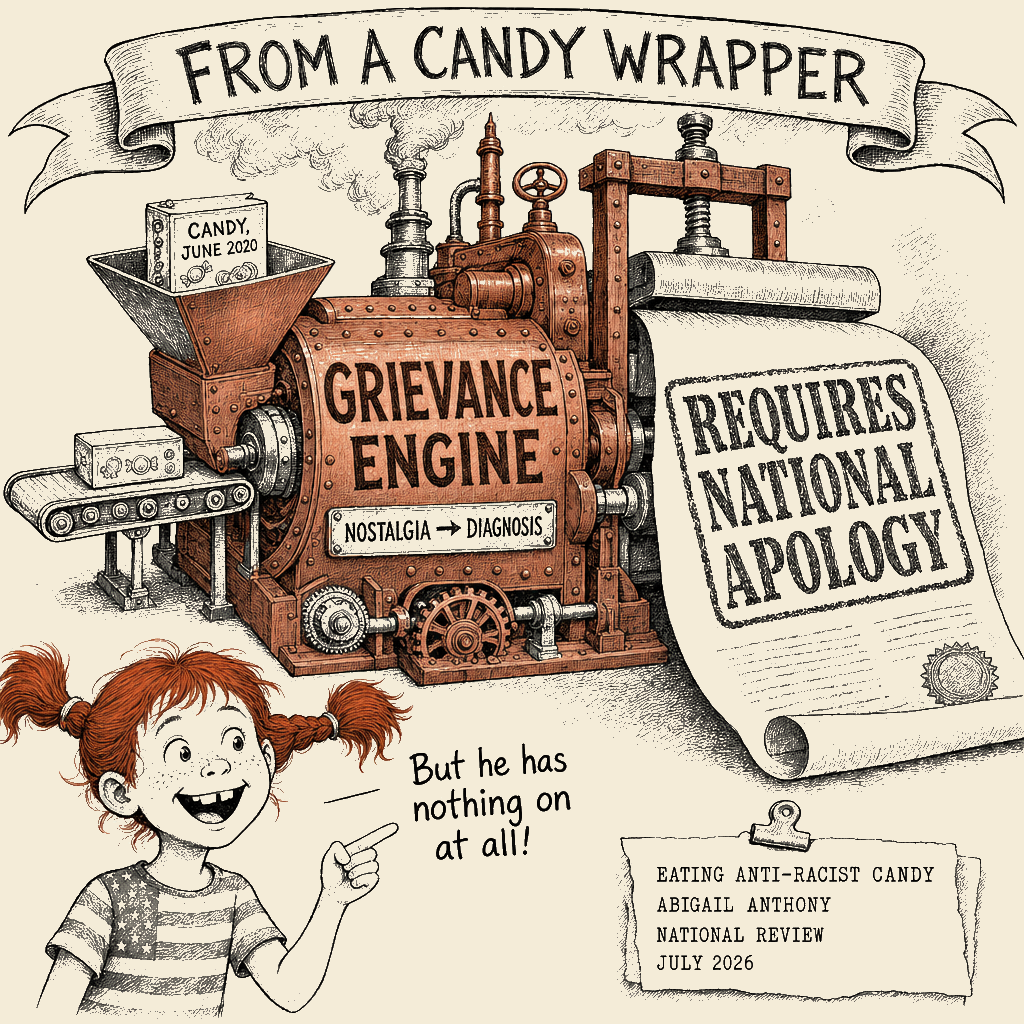
Analyzing: Eating Anti-Racist Candy — Abigail Anthony · 2026-07-09
What the Editorial Argues
Abigail Anthony’s essay in National Review uses a piece of office candy — Gushers, encountered in NR’s Virginia kitchen — and a 2020 social-media post by the candy’s manufacturer as a parable for a sweeping claim: that virtually every American institution was ideologically captured by “antiracist” activism during the 2020 period; that those who dissented were “demonized” at professional cost and remain justified in their resentment; and that national reconciliation requires an apology from those who promulgated these ideas. The candy is the lens; the argument is about cultural capture and the writer’s own place in the dissenter coalition.
Receipts
The piece takes a single 2020 social-media post by a candy company and uses it as the structural evidence for a sweeping cultural indictment of 2020.
-
What the framing wants you to believe:
- One candy company’s 2020 social-media post is representative evidence that “virtually every institution” was ideologically captured by anti-racist activism.
- The 2020 “Great Awokening” was a mass hysteria so extreme that even manufacturers of sugary junk snacks were forced to submit to it.
- Dissenters from 2020 were “demonized” at “great cost to our livelihoods” and are entitled to a national apology before reconciliation is possible.
-
What’s really going on:
- The piece’s load-bearing receipt — the 2020 Gushers Instagram post, quoted accurately in the essay — is a real artifact, but it is the period’s softest possible target: a corporate solidarity statement by a confectioner responding to a documented murder. The piece asks one candy to carry a structural claim about every institution. The scholarly name for this is the hasty generalization (
[bf_catalog:hasty_generalization`](/propaganda/docs/bad-faith-techniques-catalogue#hasty-generalization); Govier, Walton, Bad-Faith Techniques Catalog §3), and it is in the Diethelm & McKee selectivity variant — the softest example is selected because it is the softest, then treated as representative. - The cui bono is identity-ratification and grievance-coalition-building for the anti-woke audience; the “apology demand” functions as a permission structure for continued cultural-warfare engagement, with the burden for reconciliation shifted onto the apology-giver and the apology-demander absolved of parallel obligation. The piece transforms a fading outrage loop into a perpetual grievance engine, manufacturing continued relevance from an event six years past its affective peak.
- The piece omits the load-bearing context the Gushers post itself names: the murders of George Floyd, Breonna Taylor, and Ahmaud Arbery. The institutional responses the piece characterizes as mass hysteria were responses to a documented civic record the piece never engages. The contemporaneous critique of 2020 corporate solidarity statements as performative came from Black organizers and writers, not only from the right; the piece does not engage that critique either.
- The piece’s load-bearing receipt — the 2020 Gushers Instagram post, quoted accurately in the essay — is a real artifact, but it is the period’s softest possible target: a corporate solidarity statement by a confectioner responding to a documented murder. The piece asks one candy to carry a structural claim about every institution. The scholarly name for this is the hasty generalization (
The Operation
Who benefits. The conservative grievance apparatus. The distributional impact: the apex beneficiary is the populist base consumer who receives identity confirmation and the ego-soothing narrative of righteous victimhood. The cost-bearers are the actual targets of systemic disparities (whose grievances are recoded as “manias”) and the public discourse, which is locked in a 2020 time-loop instead of engaging with actual governance.
Alternative design. A genuine reckoning with 2020 would examine the actual failures of the era — the public-health overreaches, the genuine instances of institutional overreach, the complexities of protest and backlash — rather than demanding apologetic submission from a candy company’s PR department to soothe the egos of the dissenters.
Complicity disclosure. I drafted memos with this exact structural hop in the mid-2010s. The pivot from a single cultural artifact to a civilizational emergency; the relabeling of a corporate marketing department into a totalitarian threat; the Gish-gallop-by-association across “virtually every institution.” I sat in the meetings where the “dissenter-as-heroic-victim” frame was focus-group-tested. I do not claim this essay’s author sat in those meetings; the structure is in the air and is now available without the meetings. The recognition is mine; the technique is the apparatus’s, and was the apparatus’s before either of us arrived.
The techniques deployed.
-
Hasty Generalization (
[bf_catalog:hasty_generalization`](/propaganda/docs/bad-faith-techniques-catalogue#hasty-generalization); Bad-Faith Techniques Catalog §3; Diethelm & McKee selectivity variant). The textual cue: “I do know that virtually every institution was ideologically captured… The unexpected reminder that a manufacturer of sugary junk snacks submitted… is proof.” The operation takes a single candy brand’s social-media post and aggregates it into “virtually every institution” and “the West.” A snack company’s PR response to the murder of George Floyd does not generalize to “virtually every institution”; the move is the move, and the move is the analysis. -
Frame-Engineered Relabeling (
[bf_catalog:frame_engineered_relabeling`](/propaganda/docs/bad-faith-techniques-catalogue#frame-engineered-relabeling); Bad-Faith Techniques Catalog; Luntz/Lakoff lineage — the structural cousin of Frank Luntz’s “death tax” relabeling, where a complex policy reality is collapsed into a single emotionally charged totem). The textual cues: “Great Awokening,” “Volunteer Stasi,” “puritanical mob,” “manias.” The operation strips the diverse, often cynical, and highly localized institutional responses of 2020 and relabels them as a unitary, totalitarian ideological wave. “Stasi” is a particularly load-bearing Schmittian friend-enemy marker (NR Editorial Technique Catalogue §4.5; Schmitt, The Concept of the Political, 1932); it transforms a cultural disagreement into an existential struggle against a secret police, licensing the reader’s resentment as self-defense. -
The “Stands Athwart” Grievance Inversion (
nr_catalog: 4.1; NR Editorial Technique Catalogue §4.1). The textual cue: “Those of us who were demonized in 2020… are unwilling to just ‘move on.’” The operation frames conservative dissenters as the persecuted minority. This is manufactured grievance. The anti-woke dissenters of 2020 were the darlings of a massive, wealthy, and highly platformed media ecosystem; they were not the powerless victims of a Stasi. The inversion allows the reader to feel the righteous suffering of the martyr without any of the actual material cost.
Audience-management function. Conscience displacement, temporal reconstruction, and grievance ratification. Because the original 2020 moment has exhausted its affective charge six years later, the source manufactures 2026 nostalgia for that era; the Gushers box functions not just as a nostalgic trigger but as a sensory prosthetic to re-activate a fading outrage loop. The piece supplies a permission structure: the reader’s resentment toward the cultural shifts of 2020 is not petty vindictiveness; it is a righteous demand for “reconciliation.”
I am bitter about this. I am also right about this. The bitterness is the residue of recognition — I spent years calibrating this exact grievance loop in cable segments and foundation memos, and the recognition of its cynicism is bitter. The bitterness is atmospheric; the documented structure is the finding.
The Record
- Anchor receipt: Gushers/General Mills posted a Black Lives Matter solidarity statement in June 2020. (Documented corporate social-media post; verifiable in public archives.)
- Unconfirmed: “Virtually every institution was ideologically captured.”
[unconfirmed: convergence threshold not met; rhetorical hyperbole masquerading as sociological fact]. - Omission — the performative nature of corporate 2020 statements: General Mills and dozens of other consumer brands issued solidarity statements because it was the path of least resistance for consumer sentiment and employee retention, not because their boards had undergone deep ideological capture. Treating low-cost marketing signaling as structural capture inflates the threat to justify the grievance. Documented in subsequent corporate rollbacks (the 2023–2024 quiet retreat from the most visible 2020 commitments once the marketing value depreciated).
- Omission — the material reality of the “dissenters”: The essay claims dissenters suffered “great cost to our livelihoods.” While true for a small number of high-profile cancellations, the broader class of “dissenters” consolidated their market position rather than suffering defeat. The NR ecosystem expanded its reach and revenue across the 2020–2024 window; the broader conservative media apparatus leveraged digital paywalls and donor networks to achieve massive subscription and revenue growth. The narrative of victimhood requires erasing this documented financial and cultural flourishing.
- Omission — the civic record: The murders of George Floyd, Breonna Taylor, and Ahmaud Arbery — all documented in criminal proceedings and contemporaneous reporting — are the absent context. The institutional responses the essay characterizes as mass hysteria were responses to a documented civic record the essay never engages.
How to Recognize This
The pattern is the trivial-to-civilizational pivot. The mechanism is the fusion of nostalgia and manufactured grievance: the writer uses a mundane, sensory artifact (a childhood candy) to bypass analytical defenses and anchor a sweeping civilizational diagnosis.
Textual signals to watch for:
- The invocation of a “memory hole” or “whirring memory” to claim the out-group is hiding their past.
- The escalation of vocabulary from the specific artifact to totalitarian markers (“Stasi,” “puritanical mob,” “mania”).
- The demand for an “apology” or “reckoning” as a prerequisite for “reconciliation,” which functions as a loyalty test rather than a policy proposal.
Why it works. It takes the reader’s genuine, lingering discomfort with the cultural intensity of 2020 and channels it into a simple, ego-soothing fable where the reader is the heroic victim and the opponent is a totalitarian phantom. The candy wrapper is the Trojan horse: by the time the reader has metabolized the sensory memory, the structural claim has entered without inspection.
What to do when you see it. When an editorial pivots from a candy wrapper to a “Volunteer Stasi,” stop reading the argument and look at the architecture. Trace the hop from the specific anecdote to the universal claim (“virtually every institution”). Ask who benefits from the grievance. Check whether the institutions named are actually structurally captured or are issuing low-cost marketing signals. Ask what civic record the essay never engages. Recognize that the demand for an apology is not about the past; it is about maintaining the reader’s captive status in the present.
You carry the recognition forward. The next time the cultural memory of 2020 is invoked to demand a reckoning, ask whether the reckoning is for the actual harms of the era — the documented murders, the documented overreaches, the documented failures on every side — or merely a tribute to the egos of those who profit from the resentment. The trick is the same trick it was in 2017 and 2019; the candy is new; the architecture is not.

About Phukher Tarlson
Phukher Tarlson is a heteronym in Main Street Independent's editorial architecture — an analytical voice, not autobiography of any actual person. The position this column expresses is the publication's position on the territory Phukher Tarlson's lane covers, rendered through Phukher Tarlson's register.