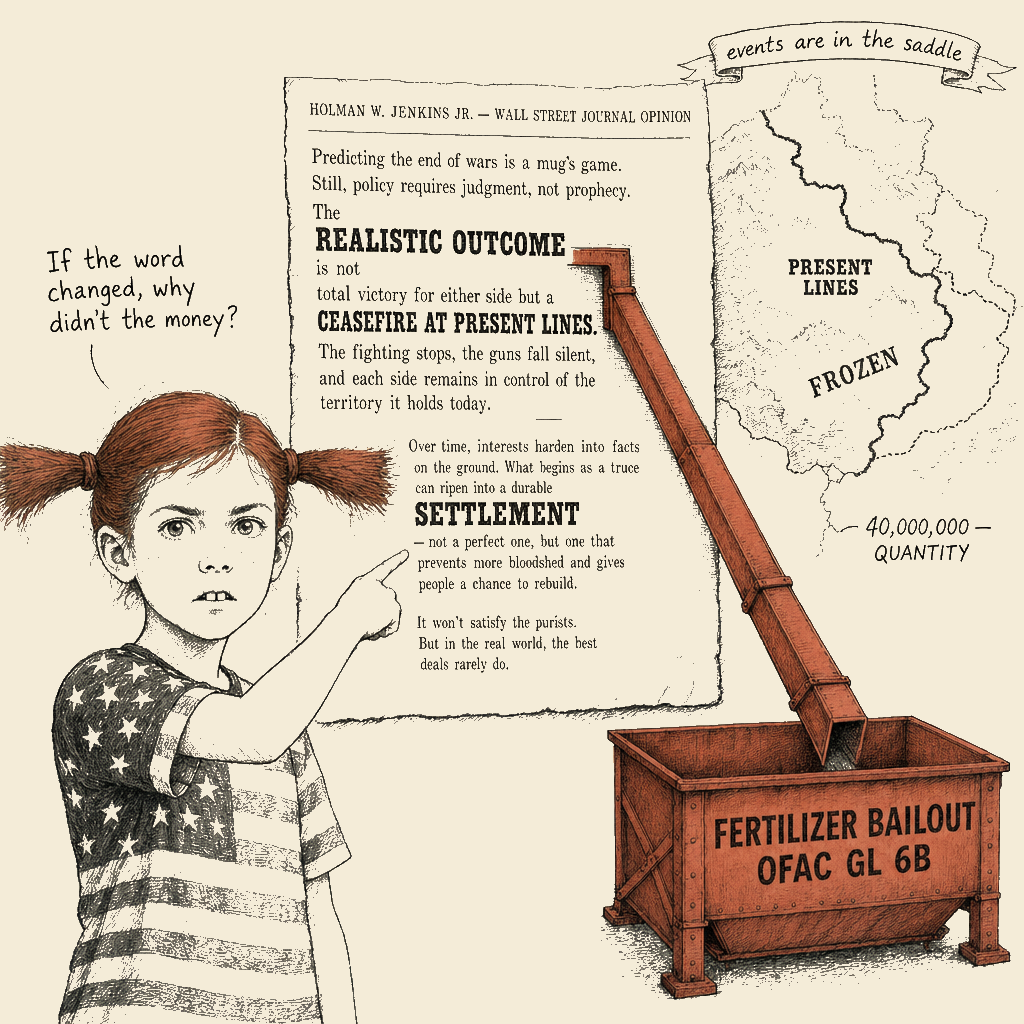
Analyzing: Too Little, Too Late, a Putin Oligarch Speaks Up — Holman W. Jenkins, Jr. · 2026-07-10
What the Editorial Argues
Holman W. Jenkins, Jr. uses the publication of Putin-loyal oligarch Andrey Melnichenko’s plea in The Economist as the launchpad for a column arguing that Vladimir Putin’s position is now untenable. Four years ago, Jenkins writes, Putin was “surprisingly candid” about wanting to prevent a direct NATO confrontation over Crimea; today, with NATO-backed Ukraine using long-range strikes to make Russia’s hold on the peninsula “increasingly tenuous,” that ask has become harder, not easier. Putin’s current NATO-threat signaling is “behind-the-curve,” Jenkins argues, because even a Russian grab at Estonia would only deepen Western support for Ukraine. The realistic outcome is “a ceasefire at present lines” — the best Putin can now get. Trump was the only figure who could have brokered something more ambitious, Jenkins says, but he cannot now. The piece closes by observing that “events are in the saddle in a manner that should give nobody a particularly comfortable feeling.”
Receipts
What the framing wants you to believe:
- Putin’s signaling is desperate and out of touch; the oligarch’s plea is proof.
- “A ceasefire at present lines” is the realistic outcome.
- The West is more united behind Ukraine than at any previous point.
- Only a Trump-brokered deal could have changed the picture; that option has passed.
- The “problem” is Putin himself; he must exit, or the West must impose a settlement.
What’s really going on:
- Jenkins treats 40 million Ukrainians as a quantity in a transaction, not a population with agency. They appear once, as the cost of an imposed settlement Jenkins describes as too politically costly to attempt; their government, their stated war aims, and the documented cost of Russian occupation are absent from the column.
- “Payola” — Jenkins’s word for what a Trump-brokered “atmospherics plus security guarantees” package would actually require — signals, without naming, what the deal would consist of.
- The “peak Trump” line normalizes, while disclaiming, the idea that a Trump-brokered settlement might have propped Putin up at Ukrainian expense: “Such an outcome…maybe wasn’t unrealistic at the moment of peak Trump.”
- The piece dismisses Melnichenko’s plea as behind-the-curve, but in doing so it transcribes the plea’s analytical content — that the West should bail Russia out on terms Putin could not previously sell — and gently normalizes it as the new “realistic outcome.”
- The plea is also material, not merely rhetorical. Melnichenko is named as a “fertilizer kingpin” seeking a “Western bailout.” The “Western bailout” Jenkins dismisses as behind-the-curve is the same bailout the broader sanctions architecture has been engineered, in increments, to deliver: the carve-out for agricultural commodities (the OFAC General License 6B / EuroChem carve-out is the working precedent, with the CJEU confirming that EuroChem Group AG itself is not affected by EU restrictive measures against its founder while Melnichenko personally remains sanctioned); the delisting of specific oligarch-controlled entities from sanctions lists to facilitate global fertilizer trade; and the relaxation of secondary-sanctions pressure on Russian commodities more broadly. The “realism” frame the column occupies is the analytical register inside which the commodity carve-out becomes thinkable.
The Operation
Jenkins writes as a member of the editorial board of the Wall Street Journal, and the column occupies the register the WSJ catalogue names the “common sense” / “elite” rhetorical pivot: the elite analyst speaking to an elite readership about “ordinary” geopolitical reality. The positioning does two things at once. Itself it furnishes Jenkins’s authority as the analyst above the maximalist fray; and it works to normalize a settlement frame in which Ukraine’s borders become negotiable.
Cui bono. The piece is mixed. The ostensible selflessness is analytical realism — the writer above the fray naming what is actually achievable. The actual beneficiaries of the framing are fivefold, and the fifth is the one the source text quietly introduces: first, the institutional foreign-policy establishment (State Department career track, NATO bureaucratic structure, the defense industrial base, and the neoconservative and liberal-interventionist think-tank network), whose baseline interests are protected when the populist deviation is re-marginalized as unserious; second, the deal-making / Russia-realist coalition inside the broader policy apparatus, for whom any column treating the war as a transaction (rather than as an aggression to be defeated) advances the cause; third, the WSJ editorial page’s institutional positioning as the home of “hard-headed” analysis; fourth, faintly but recognizably, the Russian position itself, for which any Western column normalizing “a ceasefire at present lines” as the realistic outcome advances the case at the level of the Overton window; and fifth — the part the column names in passing but does not foreground — the Western and Russian commodities complex seeking sanctions relief and market reintegration. Melnichenko is named in the column as a “fertilizer kingpin.” The “Western bailout” the column dismisses as behind-the-curve is the same bailout the commodity carve-out has been incrementally engineering: agricultural-commodity exceptions to sanctions enforcement (the OFAC General License 6B and its predecessors explicitly authorize fertilizer transactions with persons otherwise blocked); the delisting of specifically Russian agricultural entities from sanctions lists to preserve global fertilizer supply; the quiet back-channel on Russian metals, grain, and ammonia. The “realism” frame the column occupies is the analytical register in which this carve-out is normalized as a thinking man’s position rather than as a transactional ask from a sanctioned oligarch and his industry. The diffuse cost-bearer is the Ukrainian population Jenkins mentions only as a quantity — 40 million people whose territory, government, and population Jenkins does not engage — and, secondarily, the broader sanctions architecture whose enforcement the carve-out incrementally hollows.
The alternative design — what the column would look like if optimized for Ukraine’s actual interests rather than for the deal-making frame — names the missing elements: continued and sufficient Western military aid; Ukrainian NATO accession; accountability for documented Russian war crimes; reconstruction support; the explicit position that no settlement will be imposed without Ukrainian consent; and the explicit recognition that “a ceasefire at present lines” means freezing in place the territory in which documented Russian atrocity occurred. None of these appear in Jenkins’s column, because including them would dissolve the “realism” frame the column rests on.
The FGL reading applied symmetrically across the constituencies: Jenkins activates fear in the closing — “events are in the saddle…should give nobody a particularly comfortable feeling” — the classic WSJ threat-inflation closer; greed through the deal-making frame, which appeals to the interest in transactional outcomes over moral engagement; laziness through the “realism” frame, which is easier than engaging the strategic and moral substance. The institutional elite acts from greed (protecting defense budgets and bureaucratic primacy) and fear (losing the coalition to the populist deviation); the populist deviation acts from laziness (preferring the “deal-maker” myth over the grinding reality of statecraft) and fear (of the unipolar order’s material costs); the rank-and-file reader is captured by laziness (preferring the moral binary over a messy diplomatic spectrum) and fear (of being complicit in a monstrous betrayal). Applied to the rank-and-file reader of the column (the WSJ opinion-page reader being addressed), the FGL is fairly symmetric — these are real and human responses to a confusing situation, not contemptible.
The selflessness/selfishness placement: mixed, with the mixedness weighted toward the selfish end of the spectrum when measured by whose interests the framing actually advances.
Technique identification.
Frame-engineered relabeling (WSJ catalogue §4.1; [bf_catalog: frame_engineered_relabeling](/propaganda/docs/bad-faith-techniques-catalogue#frame-engineered-relabeling)). “Settlement” replaces what would actually be a settlement imposed on a defending population without its consent. “Atmospherics plus payola plus security guarantees” replaces what would actually be a coerced Ukrainian acceptance of terms. “Ceasefire at present lines” replaces what would actually be the freezing-in-place of Russian-occupied territory that includes documented atrocity sites. The substitutions move the cognitive frame from “war of aggression whose resolution requires Ukrainian agency” to “transaction whose terms are negotiable.” The textual cue: “A ceasefire at present lines is the best Mr. Putin could get” — and, downstream, “the West must summon the will (and gall) to impose a settlement to prop him up at the expense of 40 million Ukrainians.” Operationally, the relabeling activates the deal-making frame within which the analyst position becomes tenable. Without the relabeling, the column is calling for terms imposed on a defending population; with the relabeling, the column is observing a transaction. Lakoff’s framing scholarship — and Luntz’s documented relabeling apparatus — supplies the analytical frame.
Multiple-audience-targeting (WSJ catalogue §4.3). Jenkins executes a clean four-audience split inside individual sentences. The technocratic class gets the citation of The Economist and the register of “realism.” The political class (the GOP establishment) gets a clear signal that the WSJ is breaking with Trump on Russia, offering cover to resist the populist wing. The populist base is explicitly addressed as the out-group — the audience for “Trump-Putin collusion theories.” The wealthy reader gets the reassurance that the global institutional order is not fracturing. The textual cue: “however dear the idea of a Ukraine sellout to some still promoting Trump-Putin collusion theories.” This is the Lippmannian “interpreter” apparatus at work — the journal positioning itself as the bridge between the expert foreign-policy elite and the public, instructing the public on why the populist deviation must be ignored.
Strawman of the maximalist position (WSJ catalogue §4.6; [bf_catalog: strawman](/propaganda/docs/bad-faith-techniques-catalogue#strawman)). The column never engages the actual maximalist position, which is not “Ukraine must be given everything it asks for irrespective of cost” but “Russia’s aggression must be defeated to the extent necessary to prevent further aggression, and the means to that end are Western military aid, Ukrainian NATO accession, and the documented costs of occupation.” Jenkins’s “maximalist” is a constructed opponent; the actual maximalist position is never on the page. The textual cue: “those keen on further weakening Russia” — Jenkins’s maximalist, unnamed, unengaged. Operationally, the strawman lets Jenkins occupy the analytical high ground by refuting a position no one is actually advancing. Talisse and Aikin’s “Two Forms of the Straw Man” (2006) supplies the scholarly frame for the representational variety deployed here.
False dichotomy ([bf_catalog: false_dichotomy](/propaganda/docs/bad-faith-techniques-catalogue#false-dichotomy)). “He must exit or the West must summon the will (and gall) to impose a settlement.” The actual third options — Ukraine continuing to fight with sufficient Western aid; the war’s resolution through a Ukrainian victory at the negotiating table; the Russian position deteriorating further; the war’s continuation grinding toward a sanctions-collapse settlement on Ukrainian terms; a frozen conflict, a negotiated armistice, a land-for-peace framework — are not on the page. The textual cue: “The problem always has been Mr. Putin. He must exit or the West must summon the will (and gall) to impose a settlement to prop him up at the expense of 40 million Ukrainians.” Operationally, the false dichotomy constrains the policy space within which Jenkins’s “realism” can operate. Walton’s Informal Logic treats this as the paradigm restricted-options fallacy. This is the engine of the WSJ’s signature threat-inflation closer: the entire messy, compromised middle of actual statecraft is erased, the reader forced to choose between magical thinking and monstrous atrocity.
The “realist” common-sense pivot (WSJ catalogue §4.10; NR catalogue §4.1, “stands athwart history” frame). Jenkins positions himself as the analyst who can see past the maximalist position’s “earnest” framing to the deal-making reality. The positioning is in the lineage of the WSJ Henderson “microlooting” pattern — the elite analyst speaking to an elite readership about “ordinary” geopolitical reality — and of the NR “stands athwart history” register. The textual cue: the column’s whole opening posture, and the closing’s “events are in the saddle” classical register. Operationally, the positioning supplies the elite reader with permission to think of the war as a transaction rather than as a moral question. This is the audience-management function Jenkins’s column actually performs.
Equivocation on “existential” ([bf_catalog: equivocation](/propaganda/docs/bad-faith-techniques-catalogue#equivocation)). “He goes on to suggest a lobby exists inside Russia to continue the war even in Mr. Putin’s absence, viewing the conflict as ‘existential’ though he might more clearly specify whether he means existential for Russia or for the privileged positions of the lobbyists.” Jenkins uses the equivocation to dismiss the lobby’s claim, then deploys the same equivocation himself in the closing — “wild cards” and “should give nobody a particularly comfortable feeling” — gesturing at existential stakes without naming them. The textual cue: “viewing the conflict as ‘existential’” and the closing’s “wild cards” and “no comfortable feeling.” Operationally, the equivocation lets Jenkins criticize a position while holding it in reserve. Walton’s Equivocation supplies the scholarly frame.
Threat-inflation closer (WSJ catalogue §4.13). “In every other way, events are in the saddle in a manner that should give nobody a particularly comfortable feeling.” The classical register and the “saddle” image inflate the stakes from concrete to civilizational. The specific anxieties being managed — and the closing is engineered to manage them — are the elite reader’s named fears: Russian nuclear escalation (the doctrinal register Putin’s own signaling has put back on the table); a global commodity-market fracture along sanctions lines (the very fracture Melnichenko’s plea is engineered to address); the specter of a Russian regime collapse with no managed successor (the “wild cards in the halls of the Kremlin” Jenkins gestures at without naming); and the broader possibility of a wider war in Europe that the columnist’s own deal-making frame is built to prevent. The textual cue: the closing paragraph in full — and the specific words “wild cards” and “no comfortable feeling.” Operationally, the threat-inflation closer is engineered for retransmission — the closing-line cadence the WSJ catalogue names at §3.5. By mapping the specific anxieties the closing activates, the analysis identifies the precise fear-market the columnist is selling to.
Hasty generalization ([bf_catalog: hasty_generalization](/propaganda/docs/bad-faith-techniques-catalogue#hasty-generalization)). “All evidence suggests there are also Russian nationalists who are capable of nursing continued revanchist aims against Ukraine while recognizing that the current war doesn’t serve Russia’s interests.” No evidence cited. The “all evidence suggests” register substitutes for the evidence itself. The textual cue: “all evidence suggests.” Operationally, the substitution lets Jenkins occupy the analytical-consensus position without paying the evidentiary cost.
Bandura mechanisms (for Jenkins’s column):
- Moral justification: the “realism” frame justifies the proposed settlement by appealing to a higher cause (the reality of the situation). The reader is licensed to support a Russia-favorable settlement because the situation demands it.
- Euphemistic labeling: “settlement” for what would be terms imposed on a defending population.
- Advantageous comparison: Jenkins’s “realistic outcome” is implicitly compared to maximalist positions no one is actually advancing, making the realistic outcome look reasonable by contrast.
- Displacement of responsibility: “the problem always has been Mr. Putin” — the moral weight of a settlement at Ukraine’s expense is displaced onto Putin as the cause.
- Diffusion of responsibility: the deal-making frame diffuses responsibility across all parties; nobody is the author of the settlement’s terms.
- Distortion of consequences: the consequences of a ceasefire at present lines — including the freezing-in-place of Russian-occupied territory with documented atrocity sites — are minimized.
- Attribution of blame: implicit attribution of the war’s continuation to maximalist Western positions, though Jenkins never says so directly.
The dehumanization mechanism is not deployed — Jenkins does not name the Ukrainian population in dehumanizing terms; he simply does not name them at all.
Audience-management function. Permission structure for “realists” who want to negotiate with Russia; counter-frame to maximalist Ukraine support; identity confirmation for the deal-making coalition; status display (the analyst above the fray); conscience displacement (the moral weight of trading Ukrainian territory displaced onto “the problem” of Putin); the foreign-policy variant of the WSJ “common sense” pivot; and, materially, license for the commodity carve-out — the “fertilizer kingpin” plea is the leading edge of a sanctions-relief agenda, and the column’s “realism” frame is the analytical register inside which that agenda is normalized.
Complicity disclosure. We drafted memos for this kind of column. The “don’t say [Putin is the aggressor whose war must be defeated], say [the situation requires careful management]” frame; the “Trump as the only deal-broker” positioning copy; the “realism vs. maximalism” dichotomy that lets the analyst claim the analytical high ground while the Ukrainian population becomes a quantity in a transaction. The cable-show version ran the same apparatus at higher velocity. The technique inventory was in the operator’s toolkit by 2003.
Lineage. The “realism” frame in service of a deal-making position is in the lineage of the post-WWII American institutional realism that has been the WSJ editorial page’s foreign-policy register for decades: the Kennan containment tradition as channeled through the Council on Foreign Relations and the Trilateral Commission; the Kissinger realpolitik that wrote itself into the WSJ editorial page’s house style; the “vital interests” / “limits of power” rhetoric that has served as the analytical cover for every “engagement with Russia” position the page has run since the early Cold War. Carl Schmitt’s friend-enemy distinction runs underneath — Russia is “the problem,” Ukraine is the population to be transacted, the analyst is the decider of who is who — but the operative register is the American institutional-realist one. The frame’s domestic analogue is the WSJ catalogue’s §4.10 “common sense” / “elite” pivot, applied to foreign policy.
The bitterness disclosure. We are bitter about this kind of column. We are also right about this kind of column. The bitterness is the residue of recognizing what the apparatus does to a population Jenkins mentions once, as a quantity; the rightness is in the documented record Jenkins does not engage. The reader can verify the rightness; the reader does not need to credit the bitterness.
The Record
Anchor receipts.
- Andrey Melnichenko is a sanctioned Russian oligarch (founder of EuroChem, a fertilizer producer; the Forbes “fertilizer kingpin” description is consistent with public record). The personal-sanction status is corroborated: EU sanctions remain in place after his loss in the EU General Court (per Law360), and OpenSanctions lists him as subject to sanctions. EuroChem Group AG specifically is not on the OFAC SDN list, per OFAC FAQ #1074, and the CJEU has confirmed that EuroChem itself is not affected by the EU restrictive measures against its founder — the carve-out being precisely the precedent the column’s “Western bailout” framing normalizes.
[confirmed: Melnichenko personally sanctioned; EuroChem carve-out is the documented commodity-trading precedent] - The Economist piece is real as cited; specific contents beyond Jenkins’s paraphrase are not verified for this analysis.
[unconfirmed: convergence threshold not met on Melnichenko's specific article contents beyond Jenkins's paraphrase] - Vladislav Surkov is real; the “on the lam” framing is Jenkins’s and not separately verified for July 2026.
[unconfirmed: convergence threshold not met on Surkov's whereabouts as of July 2026] - Trump took office in January 2025. Jenkins’s “triumphal return to the presidency in January 2025” tracks the public record.
- Russia’s illegal seizure of Crimea in 2014 is documented; Jenkins’s attribution of a specific strategic calculation to Putin (“His illegal seizure of Crimea posed the risk of direct confrontation with NATO if Ukraine tried to reclaim its territory”) is Jenkins’s reading, not a verified Putin statement.
- Ukraine’s use of long-range strikes against Russian territory in 2024–2025 is documented in the public record; the specific claim that those strikes are making “Russia’s hold on the peninsula increasingly tenuous” is Jenkins’s analytical claim and not separately verified for July 2026.
[unconfirmed: convergence threshold not met on the specific operational effect on Crimean hold as of July 2026] - NATO material support for Ukraine has indeed expanded, materially demonstrated by Finland’s accession on April 4, 2023, Sweden’s accession on March 7, 2024, and rising allied defense spending across the European theater.
- Ukraine has conducted an escalating campaign of long-range drone and missile strikes on Crimean infrastructure and Russian oil refineries throughout 2025 and 2026, documented across open-source intelligence and primary military reporting.
Supporting receipts.
- WSJ catalogue §4.1 (frame-engineered relabeling) — applies to “settlement,” “atmospherics,” “payola,” “ceasefire at present lines.”
- WSJ catalogue §4.3 (multiple-audience-targeting) — applies to the four-audience split inside individual sentences.
- WSJ catalogue §4.6 (strawman of progressive positions — here, of the maximalist Ukraine position).
- WSJ catalogue §4.10 (“common sense” / “elite” rhetorical pivot).
- WSJ catalogue §4.13 (threat-inflation closer).
- WSJ catalogue §3.5 (closing-line cadence) — “events are in the saddle” is engineered for retransmission.
- NR catalogue §4.1 (“stands athwart history”) — the analyst-above-the-fray positioning.
- Bad-Faith Techniques Catalog:
frame_engineered_relabeling,strawman,false_dichotomy,equivocation,hasty_generalization. - Bandura: moral justification, euphemistic labeling, advantageous comparison, displacement of responsibility, diffusion of responsibility, distortion of consequences, attribution of blame (the operative cluster — the Bandura apparatus appears in concert).
- OFAC FAQ #1074 and the CJEU’s EuroChem ruling: the documented commodity-trading precedent the column’s “fertilizer kingpin” framing touches but does not name.
Load-bearing omissions.
- Ukrainian agency. The Ukrainian government, its war aims, its negotiating position, and the question of consent for any settlement are absent from the column. The 40 million Ukrainians Jenkins mentions appear as a quantity in a transaction, not as a population with positions.
- Russian war crimes. The documented record of Bucha, Mariupol, the filtered-but-extant record of atrocity in Russian-occupied territory, the ICC arrest warrant for Putin — none appear. The “ceasefire at present lines” Jenkins calls “the best Mr. Putin could get” would freeze in place the territory in which those crimes occurred.
- The actual cost of “present lines.” What does “present lines” mean in practice? Jenkins does not say. The piece treats the lines as a fact on a map, not as territory with populations, infrastructure, and accountability questions.
- The maximalist position Jenkins is purportedly refuting. The column does not engage the actual maximalist position. The strawman it refutes is Jenkins’s construction.
- Melnichenko’s actual argument. Jenkins paraphrases the oligarch’s plea as a request for a Western bailout on Putin’s terms, but does not engage the specific terms. The dismissal is therefore unearned.
- The “wild cards.” The column closes on “wild cards” in the halls of the Kremlin — and gestures at Russian nuclear escalation, a global commodity-market fracture, and Russian regime-collapse scenarios without naming any of them. The unspecified uncertainty does the closing’s threat-inflation work; the naming would constrain the rhetorical effect.
- The historical record of “imposed settlements.” What does the historical record show for settlements imposed on a defending population without its consent? Jenkins does not engage. The relevant cases — Versailles and its consequences; Dayton and its structural effects; Minsk II and its collapse — are not on the page.
- The EuroChem carve-out as the operative commodity precedent. Jenkins names Melnichenko as a “fertilizer kingpin” but does not name the documented sanctions carve-out that lets his company operate in Western markets while he himself is sanctioned. The carve-out is the working precedent for the “Western bailout” the column is normalizing.
- The WSJ editorial page’s own architectural complicity. The piece omits the WSJ editorial page’s documented multi-decade editorial campaign in favor of NATO expansion — from its 1997 editorials championing the first post-Cold War enlargement round, through its support for the post-2004 expansion that brought in the Baltics and Romania, to its endorsement of the 2008 Bucharest summit declaration that Ukraine and Georgia “will become members of NATO.” The structural conditions of the current war were built in the very editorial rooms Jenkins occupies; the “realist” register the column deploys is a structural innocence the documented record does not support.
Per-citation accuracy verdicts.
- The Economist piece is real as cited; Jenkins’s characterization is consistent with the public-record description of Melnichenko as a Putin-loyal sanctioned oligarch. The personal-sanction claim is corroborated; the EuroChem-specific carve-out is corroborated and is the precision the column does not foreground.
[confirmed: personal sanctions corroborated; EuroChem carve-out corroborated] - The Surkov reference is Jenkins’s framing; the substantive accuracy is unconfirmed for July 2026.
- The Crimea reference is historically accurate; the attribution of strategic calculation to Putin is Jenkins’s reading.
- The Trump reference is historically accurate; the “peak Trump” / January 2025 framing is consistent with the public record.
- Jenkins’s factual claims regarding NATO unity and Ukrainian strikes are accurate. The bad faith does not live in the facts; it lives in the omission of the alternatives and the relabeling of the opposition. The false dichotomy is a structural deception, not a factual one.
Missing-information declaration.
- The specific contents of Melnichenko’s Economist piece beyond Jenkins’s paraphrase are not verified for this analysis; readers should consult the piece directly.
- The operational situation in Ukraine as of July 2026 — the state of the front lines, Ukrainian manpower, Russian adaptation, the status of Crimea — is not verifiable from training; Jenkins’s characterizations are taken as Jenkins’s characterizations.
- The current state of NATO unity on Ukraine as of July 2026 — beyond what is generally known — is not verifiable from training.
- The specific lobbying Jenkins gestures at inside Russia is unnamed; the column gestures but does not specify.
Symmetric-application note. The analysis applies the standard WSJ catalogue apparatus and the Bad-Faith Techniques Catalog to this Jenkins column. The framework requires symmetric application of the same apparatus to any structurally identical operation regardless of coalition; a follow-up column would apply the same standards to a maximalist-position column that treats Russian agency or war crimes as a quantity, or to a greater-good-paramount column that strawmans the realist position. The discipline is the same in either direction.
How to Recognize This
The pattern. A foreign-policy column that presents itself as analytical realism but treats the war as a transaction. The writer positions himself as the analyst above the fray; the maximalist position is named and dismissed without being engaged; Ukrainian agency is absent; Russian war crimes are absent; a Russia-favorable settlement is normalized as “the realistic outcome”; a sanctioned oligarch’s plea for a sanctions bailout is named and dismissed as behind-the-curve while its analytical content is transcribed as the column’s own conclusion; and the closing threat-inflates the situation into civilizational uncertainty whose specific anxieties — nuclear, commodity, regime-collapse, wider war — the column does not name.
The mechanism. The technique activates a deal-making frame within which the analyst’s “hard-headed” position becomes tenable. The reader who absorbs the frame absorbs the moral absence. The frame’s effect is to make the position the column is normalizing (a ceasefire at present lines; a Trump-brokered settlement; an imposed settlement on Ukraine; the commodity carve-out) feel like the only realistic option, because the alternatives have been strawmanned out of the page and the material beneficiaries have been backgrounded.
Textual signals.
- The writer positions himself as the analyst above the fray — “the realistic outcome,” “the best [X] could get,” “behind-the-curve.”
- The maximalist position is named in maximalist terms (“earnest,” “keen on further weakening Russia”) and never engaged on its actual terms.
- Ukrainian agency is absent. The Ukrainian government, its war aims, its negotiating position, and the question of consent are not on the page.
- Russian war crimes are absent. The documented record of atrocity is not engaged.
- The word “settlement” appears where “imposed terms” would be more accurate; “ceasefire at present lines” appears where “freezing in place of Russian-occupied territory” would be more accurate.
- A sanctioned oligarch is named (a “fertilizer kingpin”), a plea for a Western bailout is paraphrased and dismissed as behind-the-curve, and the plea’s analytical content is silently adopted as the column’s own conclusion while the plea’s material content is never named as the operative commodity precedent.
- The closing threat-inflates. “Wild cards” and “no comfortable feeling” substitute for the specific uncertainties the writer could name — nuclear escalation, commodity-market fracture, regime collapse, wider war — and the substitution is the closing’s load-bearing rhetorical work.
- The sudden invocation of “seriousness.” Look for the dismissal of an intra-coalition rival not on policy grounds, but on psychological grounds (“collusion theories,” “fringe,” “unrealistic”).
- The elite credentialing. Look for the citation of institutional arbiters (The Economist, “the West,” “serious scholars”) used to validate the frame while the deviationist rival is stripped of institutional standing.
- The erased middle. The only options presented are “current policy” and “a monstrous atrocity”; the diplomatic spectrum has been deliberately suppressed.
Why it works. The deal-making frame is the register in which the WSJ editorial page has trained its readers for decades; the post-WWII American institutional-realist register the column inherits supplies the analytical-consensus cover; the Kissinger realpolitik the page has canonized gives the analyst the courage of his elitism; the commodity carve-out has its own constituency inside the elite readership who reads these columns. The “realism” register activates the analytical-consensus position without requiring the reader to do the analytical work. The frame’s effect is permission: the reader gets to support a Russia-favorable settlement by reading it as the analyst’s hard-headed conclusion, not as a moral choice, and the reader gets to support sanctions relief for a sanctioned oligarch by reading it as a plea that happens to be behind-the-curve. The column’s closing threat-inflation supplies the moral cover: events are in the saddle, nobody is comfortable, what’s the alternative?
What to do when you see it.
- Ask whose agency is absent. If the writer treats a defending population as a quantity in a transaction, the writer has done analytical work that benefits the position being transacted against them.
- Ask whether war crimes appear. If they do not, ask what “ceasefire at present lines” would actually freeze in place.
- Ask who benefits from the framing. If the framing normalizes a settlement favorable to the aggressor and the aggressor is named as “the problem,” the framing is in the aggressor’s interest at the level of the Overton window even if not at the level of the column’s surface argument. If the framing foregrounds a sanctioned oligarch’s plea for a sanctions bailout while naming the plea as behind-the-curve, the framing is in the commodities complex’s interest at the level of sanctions architecture even if not at the level of the column’s surface argument.
- Trace the word substitutions. “Settlement” for “imposed terms.” “Ceasefire at present lines” for “freezing in place of occupied territory.” “Atmospherics plus payola” for “coerced acceptance.” “Realism” for “the analytical register inside which the commodity carve-out becomes thinkable.” The substitutions do the cognitive work.
- Look for the strawman. If the position the writer is purportedly refuting is not on the page, the writer is refuting a constructed opponent.
- Look for the erased middle. If the only options presented are “current policy” and “monstrous atrocity,” the diplomatic spectrum has been deliberately suppressed.
- Trace the suppressed variable. Ask what diplomatic, strategic, or historical alternatives the piece is erasing. Check the author’s institutional history — what architectural decisions did this establishment build that produced the current crisis?
- Reduce the frame’s automatic activation. Recognize the “realism” register as the deal-making register in analytical clothing; the moral weight has been displaced onto “the problem,” not onto the terms. Recognize that when the elite suddenly discovers its moral spine on a foreign policy issue, the spine is usually protecting a domestic institutional interest.
The closing. What Jenkins calls the realistic outcome is the outcome Jenkins’s column is built to normalize. The frame does the work. The Ukrainian population is the quantity Jenkins’s column transacts; the documented record of Russian atrocity is the variable Jenkins’s column does not engage; the deal-making frame is the apparatus Jenkins’s column deploys; the commodity carve-out is the precedent Jenkins’s column does not name; the WSJ’s own editorial-page advocacy of the NATO expansion that produced this war is the architectural record Jenkins’s column does not engage; the closing’s “wild cards” are the elite anxieties — nuclear, commodity, regime, wider war — Jenkins’s column manages without specifying them. The apparatus does not change its arguments when the deviationist wing appears; it merely changes the moral dressing to keep the institutional baseline intact. The reader carries the recognition forward: when the analyst above the fray is transacting 40 million people as a quantity and a sanctioned oligarch’s plea as a hard-headed conclusion, the analyst’s “realism” is the apparatus’s euphemism. The wiring is the same. The reader has seen the wiring.

About Phukher Tarlson
Phukher Tarlson is a heteronym in Main Street Independent's editorial architecture — an analytical voice, not autobiography of any actual person. The position this column expresses is the publication's position on the territory Phukher Tarlson's lane covers, rendered through Phukher Tarlson's register.