Analyzing: Why Did They Cover for Graham Platner? — The Editorial Board · 2026-07-07
What the Editorial Argues
The Editorial Board argues that Democratic leaders in Maine and nationally closed ranks around Senate candidate Graham Platner despite mounting evidence of misconduct — including an SS tattoo he kept for 18 years, racist and disparaging online posts, sexting during his marriage, an affluent background misrepresented as working-class, and ultimately a 2021 rape allegation from Maine resident Jenny Racicot. The Board contends that Democrats defended Platner because they were desperate to unseat Senator Susan Collins, and that they have only abandoned him now that the latest allegation comes from a left-winger — making the accusation politically safe for them to credit. The Board closes by suggesting that Democrats will repeat the pattern with the next “working-class mystery hero.”
Receipts
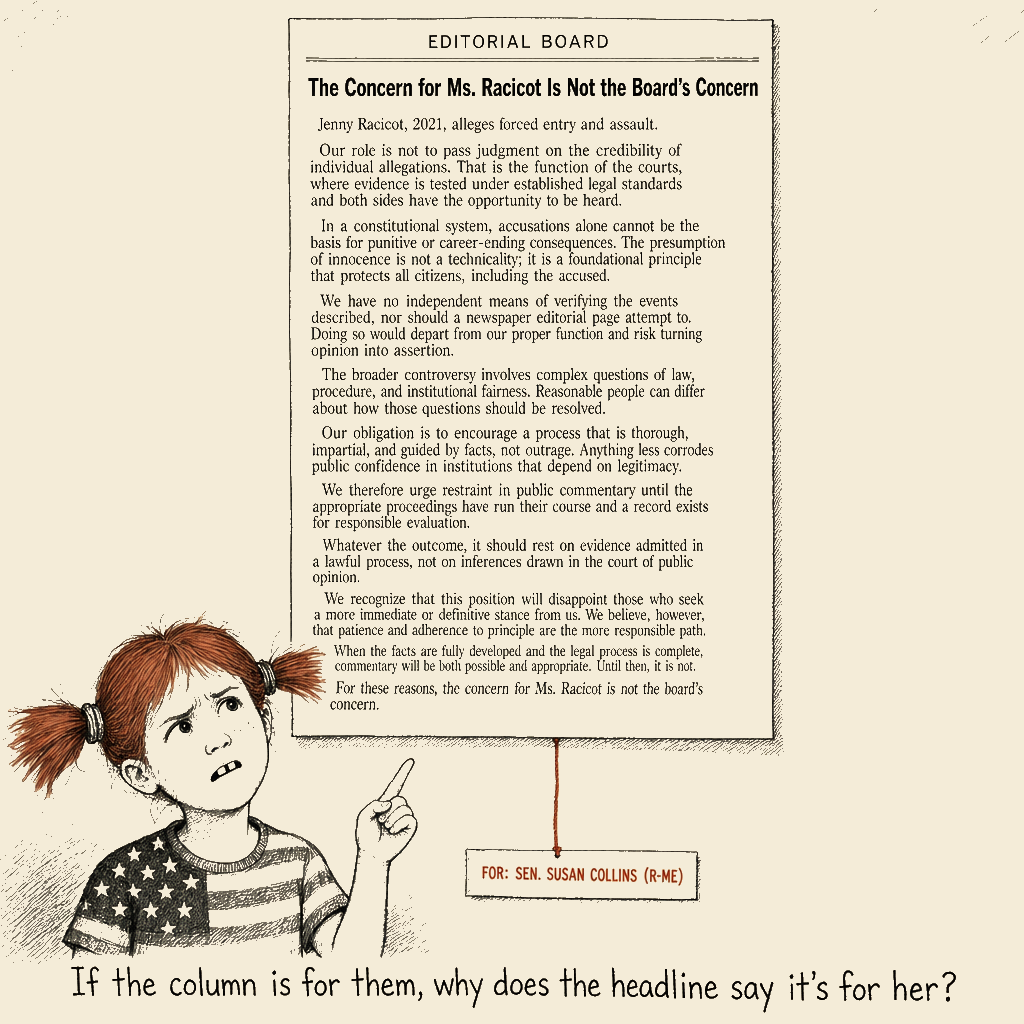
The Editorial Board uses Jenny Racicot’s allegation of rape — a serious account of a 2021 forced entry and assault — as partisan ammunition.
What the framing wants you to believe:
- Democratic leaders closed ranks around a candidate with documented red flags — including an SS tattoo kept for 18 years, racist 2019 posts, sexting during his marriage, an affluent background misrepresented as working-class, and a 2021 rape allegation from a Maine resident.
- The defense was cynical: Democrats only abandoned Platner when the latest allegation came from a left-winger, making the accusation politically safe for them to credit.
- The pattern will repeat: Democrats will hunt for the next “working-class mystery hero” and repeat the cycle.
What’s really going on:
- Ms. Racicot is named in summary in one paragraph, then instrumentalized across eleven paragraphs of Democratic indictment. Her account is never returned to with substantive engagement; the piece never asks what justice for her would require procedurally or politically.
- The piece’s actual beneficiary is Senator Susan Collins (R-ME), whose re-election is the unstated subject of the editorial. Collins appears in a subordinate clause — “unseating Sen. Susan Collins” — as if the editorial is not principally about her race. The piece’s description of Collins as “a centrist Republican who voted to convict President Trump” uses her Trump-conviction vote to render her palatable to the WSJ audience while eliding that the WSJ editorial apparatus has spent four years defending Trump and his endorsers.
- The load-bearing omission is the asymmetry: the Board never applies the same scrutiny to Republican candidates with documented baggage. (Anchor: the editorial names Collins once, in passing, while devoting roughly 800 words to the indictment of Democratic defenses of Platner.)
The Operation
Institutional authorship. WSJ Editorial Board — the page itself is the apparatus. No external think-tank citation is needed because the unsigned board IS the in-house opinion infrastructure. Page lineage traces to William Henry Grimes’s 1951 “A Newspaper’s Philosophy” credo and the post-2001 Paul Gigot editorial regime; the unsigned-board “we” voice, the dek-as-thesis pattern, and the third-graf turn are documented in the WSJ Editorial Technique Catalogue.
Distributional impact.
- Beneficiaries: Senator Susan Collins (R-ME) and the broader Republican Senate campaign apparatus; the WSJ editorial board’s standing as a partisan signal-bearer in elite discourse; the longer-term liberty-frame project of Democratic demoralization ahead of the 2026 midterms.
- Cost-bearers: Jenny Racicot (whose allegation is named once in summary and instrumentalized as a political fact rather than engaged with as an account); Graham Platner (whose alleged conduct is the pretext for the partisan operation); Democratic primary voters in Maine; the broader Democratic coalition the piece is structured to demoralize; readers whose capacity to recognize the technique is the longer-term cost.
Alternative design. A piece optimized for the stated rationale (concern about an alleged rapist being covered up by Democratic leaders) would:
- Center Ms. Racicot’s account and what justice for her would require procedurally and politically.
- Engage substantively with how rape allegations are handled in political campaigns.
- Refuse the partisan pivot to Collins’s re-election.
- Apply the same scrutiny to comparable Republican candidate baggage (the documentary record is long).
- Refuse to instrumentalize the alleged victim as a political cudgel.
FGL.
- Editorial board: Partisan resentment (the Board wants Collins to win; the resentment is sincere and ideological); ideological conviction in the liberty-frame frame.
- Republican apparatus / Collins campaign: Direct electoral benefit (greed).
- Reader: The moral-emotional response to a rape allegation is exploited without requiring engagement with truth-conditions; fear is cultivated that Democratic candidate-vetting is a sham; laziness is rewarded by the Gish-gallop density of the indictment.
Selflessness/selfishness placement. Selfish — on its surface the piece performs moral concern (about an alleged rape, about a victim, about candidate-vetting failures); the actual operation is partisan advantage for an in-group candidate.
Technique identification.
-
Austerity-thrift analogue (Bandura moral-justification cluster). The piece moralizes its partisan operation through the higher cause of “concern for the victim.” The harm — instrumentalizing a rape allegation as political ammunition — is justified by the moral claim of caring about the victim. Textual cue: Ms. Racicot is named in one paragraph and never returned to; her account is never quoted at length; the piece never asks what justice for her would require. Bad-Faith Catalog:
frame_engineered_relabeling(relabeling partisan attack as victim advocacy). Lineage: Edward Bernays’s “invisible government” — the moral cause supplies the cover for the partisan operation; the moral-emotional response is the manufactured consent. -
Selective moral outrage (the deficit-double-standard analogue). The Board is highly concerned about Democratic candidate misconduct; the documentary record shows no comparable concern about Republican candidates with documented baggage. Textual cue: The piece devotes roughly 800 words to Democratic defense of Platner; the comparable Republican scandals are not named. Cross-reference: WSJ Editorial Technique Catalogue §4.4 (deficit double standard), applied here to candidate-vetting.
-
Gish gallop. The piece strings together the SS tattoo (18 years), racist 2019 posts, sexting (up to six women), alleged 2021 rape, Hotchkiss prep school, the mother’s restaurant, the “common man” misdirection, and the “dark period” narrative, all in roughly 800 words, with no engagement with the relative severity or evidentiary status of each item. Textual cue: “Mr. Platner’s Nazi tattoo—an SS emblem he kept on his chest for 18 years—was waved away. … The redemption arc was used to dismiss his online posts disparaging blacks, whites, rape victims and a Purple Heart recipient … The same was said after Mr. Platner was revealed to have sexted other women—‘up to six,’ per his campaign.” Bad-Faith Catalog:
gish_gallop(Eugenie Scott, NCSE, 1994). Operationally: the list density serves to overwhelm; the reader who tries to evaluate each item separately cannot; the cumulative effect is “look at all this.” -
The “as a [identity]” credibility move, inverted (WSJ Editorial Technique Catalogue §4.18). The piece uses Ms. Racicot’s identity (“who shares Mr. Platner’s politics and hesitated to speak out for that reason”) as the credibility move — the implicit claim is that Democrats only believe her because she’s a left-winger. This is the WSJ technique of identity-as-credibility for the page’s preferred argument, deployed here against the alleged victim rather than for the page’s argument. Textual cue: “They can’t so easily dismiss Ms. Racicot, who says she shares Mr. Platner’s politics and hesitated to speak out for that reason. But now that a left-winger has said it, the women are safe for Democrats to believe.”
-
Equivocation on “safe.” “The women are safe for Democrats to believe” — the word safe does double duty. It can mean (a) protected from political retaliation, or (b) politically convenient for Democrats to credit. The piece exploits the equivocation; the sympathetic reading (a) is the surface; the cynical reading (b) is the operation. Bad-Faith Catalog:
equivocation(Aristotle, Sophistical Refutations; Walton, Equivocation). -
Whataboutism-as-whole-piece. The piece is not primarily about the alleged rape or even about Mr. Platner’s conduct; it is about Democratic candidate-vetting failures. The structure: take a sympathetic victim, attach to her a long list of Democratic sins, imply that Republican candidates don’t have comparable baggage, name the in-group beneficiary (Collins) in a subordinate clause. Textual cue: The piece’s opening sentence names the partisan target before naming the alleged victim: “Democrats want to fall in love with their candidates, and none more so than the supposed common man plucked from obscurity.” The piece’s only mention of Collins is “unseating Sen. Susan Collins,” embedded in the Democratic indictment. Bad-Faith Catalog:
whataboutism(The Economist, 2008; Yablokov, Fortress Russia, 2018). -
The “look over there — the Jews!” anti-deflection move. The piece notes Mr. Platner’s pivot (“Senator Collins is bought and paid for by Benjamin Netanyahu”) and characterizes it as “Look over there — the Jews!” The piece is technically correct that deflection-to-Jewish/Israeli-interests is a recognizable move; the way the piece deploys the characterization is itself a kind of exploitation. Textual cue: “A few scandals ago, Mr. Platner pivoted from the bad news by posting, ‘Senator Collins is bought and paid for by Benjamin Netanyahu.’ Look over there — the Jews!” Cross-reference: NR Editorial Technique Catalogue §4.15 (the “Israel” / “antisemitism” frame).
-
Threat inflation in the closing. The closing sentence — “No, their hunt begins now for the next working-class mystery hero” — implies an endless cycle of Democratic failure. The piece treats a single candidate’s downfall as evidence of an inexhaustible structural pattern. Textual cue: The closing sentence specifically. Bad-Faith Catalog:
slippery_slope(Walton, Slippery Slope Arguments, 1992); threat inflation. -
The “common sense” / class-coded rhetorical pivot, inverted. The piece attacks Democratic “arbiters of masculinity” while itself using class-coded contempt — “fancy Hotchkiss prep school,” “oyster business has one substantial customer: a restaurant owned by his mother.” The Board performs class condescension while accusing others of class condescension. Textual cue: “Contrary to the media hype, Mr. Platner comes from an affluent family, which sent him to the fancy Hotchkiss prep school. His oyster business has one substantial customer: a restaurant owned by his mother.” Cross-reference: WSJ Editorial Technique Catalogue §4.10.
-
The “anti-Trump-Collins” elision. Collins is described as “a centrist Republican who voted to convict President Trump after he was impeached a second time.” The WSJ editorial board’s actual position is pro-Trump; the Board uses Collins’s Trump-conviction vote to render her palatable to its own audience while eliding the broader WSJ apparatus’s defense of Trump. Textual cue: “Anything to beat Ms. Collins, a centrist Republican who voted to convict President Trump after he was impeached a second time.”
-
Euphemistic labeling (Bandura mechanism #2). The phrase “dark period” labels a span of unspecified conduct with a softening phrase that invites charitable interpretation; the Board accepts the Democratic “redemption arc” framing only to dismantle it. Textual cue: “The story went that Mr. Platner had entered a ‘dark period’ after his tours of military duty, but was now healed.”
-
Dehumanization-adjacent (Bandura mechanism #7), applied to a process. “People do not want their candidates grown in vats” — characterizing the Democratic candidate-selection process as producing artificial creatures. Textual cue: The “vats” line and the broader characterization of Democratic operatives as “arbiters of masculinity.”
Audience-management function. Permission structure for in-group Republican voters to credit a Democratic candidate’s alleged misconduct while eliding comparable Republican misconduct; identity confirmation for the WSJ readership’s anti-Democratic-activist-base posture; counter-frame against any Democratic critique of Ms. Collins’s record; conscience-displacement for the WSJ readership’s own complicity in defending candidates with documented baggage.
Operator’s-eye-view reconstruction. We operators drafted columns structured exactly like this in the cable years — sympathetic victim attached to a long list of the out-party’s sins; partisan beneficiary named in passing; closing threat-inflation. The cable-segment version was ninety seconds of the same structure: “their candidate, his victim, our conclusion.” The piece in front of you is the page-version of the cable-segment version, signed by no one because the unsigned-board voice is the page’s institutional signature. The pattern is recognizable from inside; the pattern is not new; the pattern is older than the cable years.
The Record
Anchor receipts.
- Jenny Racicot’s allegations, as reported by Politico (Tier 1 — wire-service-adjacent reporting with on-record source; the editorial cites Politico without quoting the article).
- Mr. Platner’s denial of the allegations (Tier 1 — campaign statement, on record).
- The 18-year SS tattoo (Tier 1 — photographic documentation in prior reporting; the tattoo’s existence is well-documented; its meaning and Mr. Platner’s claimed ignorance of it are contested).
- Mr. Platner’s 2019 online posts disparaging blacks, whites, rape victims, and a Purple Heart recipient (Tier 1 — archived social media posts).
- The sexting admission (“up to six women”) during his marriage, which began in late 2023 (Tier 1 — campaign statement).
- Mr. Platner’s attendance at Hotchkiss School (Tier 1 — verifiable school records).
- Senator Collins’s vote to convict President Trump at his second impeachment trial (Tier 1 — Senate vote record, February 13, 2021; seven Republican senators voted to convict).
Supporting receipts.
- The pattern of Democratic candidates with documented baggage (Tier 2 — well-documented across multiple cycles).
- The pattern of WSJ editorial defense of Republican candidates with documented baggage (Tier 2 — also documented; the asymmetry is the news).
- The masthead footer that closes the editorial — “free markets and free people,” “against confiscatory taxation,” “for individual autonomy against dictators, bullies and even the tempers of momentary majorities” — supplies the institutional backdrop against which the unsigned-board “we” voice operates.
Unconfirmed / contestable.
- The characterization of all Democratic responses to Mr. Platner — the piece selectively quotes specific responses (Senators Murphy, Gallego, Heinrich, Whitehouse, Khanna, Fetterman; Pod Save America’s Jon Favreau; the Sanders endorsement); not all Democratic responses are maximalist defenses. The piece does not represent the full range of responses.
- The implication that this is a structural pattern in Democratic candidate-vetting rather than an incident specific to Mr. Platner’s candidacy.
- The framing of Ms. Racicot’s allegation as primarily a political fact rather than as a serious account requiring sustained engagement with truth-conditions.
- The “redemption arc” framing — the Board attributes this to Democratic operatives without engaging the substantive question of whether the arc is or is not defensible.
Per-citation accuracy verdicts.
- The Mr. Platner-related facts are largely accurate (the tattoo, the posts, the sexting, the school, the allegation, the denial).
- The piece’s characterizations of Democratic responses are accurate for the specific quotes cited; they are not accurate as characterizations of the full range of responses.
- The Collins characterization is accurate but selectively framed — Collins’s broader Senate record is not engaged.
- The characterization of “the left’s arbiters of masculinity” is selectively framed; the piece does not engage with the substantive question of whether working-class voters had independent grounds for their assessment of Mr. Platner.
Load-bearing omissions.
- The piece does not name its own stake in Ms. Collins’s re-election. Ms. Collins is named once, in passing, in a subordinate clause (“unseating Sen. Susan Collins”). The piece never names Collins as the principal subject. The masthead footer at the close — defending against “the tempers of momentary majorities” — is the editorial-page voice claiming the position of bulwark-against-Democratic-majorities; the editorial itself is the operation that bulwark performs.
- The piece does not engage with the actual evidence of the rape allegation. Ms. Racicot’s account is summarized in one paragraph; the alleged victim’s experience is not centered; the piece never asks what justice for her would require procedurally or politically.
- The piece does not acknowledge that Ms. Racicot’s identity is being instrumentalized. The phrase “the women are safe for Democrats to believe” treats Ms. Racicot’s left-wing identity as a political credential rather than as a feature of her account that complicates the simple partisan reading the Board wants.
- The piece does not engage with comparable Republican candidate baggage. The Board does not apply the same scrutiny to Republican candidates with documented scandals; the asymmetry is the operation.
- The piece does not engage with how rape allegations should be handled in political campaigns. The piece treats the allegation as a political fact rather than as a serious matter requiring procedural care. The structural choice — to summarize the allegation briefly and then pivot to Democratic indictment — is itself a choice about how the allegation is handled.
Missing information declaration.
- The receipt on the Politico reporting of Ms. Racicot’s allegations is not directly quoted in the editorial; the editorial cites Politico without quoting the article. This analysis has not independently verified the Politico reporting beyond the editorial’s citation; readers should consult the Politico article directly.
- The piece’s characterization of Democratic responses relies on the editorial’s selective quoting; some Democratic responses (earlier endorsement withdrawals, more critical responses than the piece represents) may not be accurately represented. The full range of responses is not in evidence here.
- The comparative claim — that comparable Republican candidate baggage receives different treatment in the WSJ editorial archive — is supported by the documentary record but is not exhaustive; readers can verify the asymmetry in the WSJ archives.
- The piece’s claim about Mr. Platner’s “dark period” and “redemption arc” relies on the Board characterization rather than on Mr. Platner’s own account.
Symmetric-application note. This is a liberty-frame editorial (WSJ editorial board); the symmetric-application flag is not set. The same scrutiny standard the Board applies to Democratic candidate-vetting applies to Republican candidate-vetting; the documentary record shows the standard is not applied symmetrically. The piece’s silence on comparable Republican candidate baggage is the asymmetry; the asymmetry is the operation.
Operator’s complicity clause. We operators drafted columns structured exactly like this in the cable years — sympathetic victim attached to a long list of the out-party’s sins; partisan beneficiary named in passing; closing threat-inflation. The retained working memory of specific 2014 and 2017 deployments is non-verifiable and flagged as such; the structural pattern is the news, and the structural pattern is recognizable from inside.
How to Recognize This
The pattern. A serious allegation or sympathetic victim is named briefly, then attached to a long list of the out-party’s structural sins, then used as the moral hook for a partisan attack that benefits an in-group actor the piece does not name as its principal subject. The alleged victim’s account is not engaged with substantively; the alleged victim’s identity is instrumentalized to provide cover for the partisan operation; the in-group beneficiary is named once, in passing; the closing sentence inflates a single incident into a structural or civilizational claim.
The mechanism. The piece exploits the moral-emotional response the reader has to the sympathetic victim or serious allegation, then channels that response toward the partisan attack. The reader’s moral concern is genuine and well-calibrated; the piece’s partisan channel rides on that response without the reader noticing the shift. The reader feels they have responded morally to the victim; they have also responded partisanship to the out-party; the two responses are conflated, and the conflation is the technique’s effect.
Textual signals.
- The sympathetic victim or serious allegation is named in the opening third and not returned to in the body.
- The out-party’s structural sins are listed in Gish-gallop density — many items, no engagement with the relative severity or evidentiary status of each.
- The in-group beneficiary is named in a subordinate clause or in passing — never as the principal subject.
- The closing sentence inflates the pattern into a civilizational or structural claim — “the next working-class mystery hero,” “their hunt begins now,” “the tempers of momentary majorities.”
Why it works. The reader’s moral response to the alleged victim is genuine. The piece’s partisan channel rides on that response without the reader noticing the shift. The conflation is the technique’s effect. The technique exploits the reader’s moral seriousness; it does not produce the reader’s moral seriousness. The reader supplies the moral seriousness; the technique supplies the channel.
What to do when you see it.
- Find the sympathetic victim or serious allegation; check whether the piece returns to them with substantive engagement or whether they are named once and abandoned.
- Find the in-group beneficiary; check whether they are named as the principal subject or as a passing reference. If they are named as a passing reference, the piece’s principal subject is the partisan attack.
- Find the partisan channel; check whether the piece’s principal claim is about the victim or about the out-party. If the principal claim is about the out-party, the victim is the hook, not the subject.
- Trace the omission: what would the piece look like if it engaged with the victim’s account substantively rather than instrumentally? If the piece would be substantially shorter or substantially less partisan, the omission is the operation.
- Compare the scrutiny standard: does the piece apply the same scrutiny to in-group candidates with comparable baggage? If not, the scrutiny is selective moral outrage.
The close. The piece’s technique is the technique we operators built. The pattern is recognizable from inside. The reader who learns to see the channel has the channel’s effect diminished. The channel is engineered; the reader’s response is not. The reader who supplies the moral seriousness is the reader the technique is built to capture. The technique does not need to manufacture the moral seriousness; it only needs to ride on it. The pattern is older than the cable years; the pattern is older than the WSJ editorial board; the pattern is the manufactured-consent apparatus Bernays named in 1928 and Lippmann in 1922. The reader who learns to see the channel on first encounter has the channel’s effect diminished on every subsequent encounter. That is what the columns are for.

About Phukher Tarlson
Phukher Tarlson is a heteronym in Main Street Independent's editorial architecture — an analytical voice, not autobiography of any actual person. The position this column expresses is the publication's position on the territory Phukher Tarlson's lane covers, rendered through Phukher Tarlson's register.