Analyzing: The Intifada at MIT — Barton Swaim · 2026-07-08
What the Editorial Argues
Barton Swaim reviews a self-published account by MIT engineering professor Yossi Sheffi — “Unsafe at MIT” — detailing the catastrophic failure of MIT’s administration to protect Jewish and Israeli students from harassment and antisemitism following the October 7, 2023 Hamas attacks. The editorial endorses Sheffi’s account as an honest reckoning, contrasts it unfavorably with the universities’ own reports (Harvard “gummed up” its findings with “bogus” claims of Islamophobia; Columbia “generally avoids acknowledging the depth of the university’s failure”; MIT issued no report), and closes by urging readers to weigh the universities’ betrayal against the Trump administration’s enforcement actions against those same institutions. The editorial frames the protesters’ demands as amounting to the Jewish state’s eradication rather than legitimate policy critique, and positions the federal punitive response as accountability for institutional moral cowardice.
Receipts
The editorial runs a Moral Shield Pivot: it uses a documented moral failure at MIT to launder an unrelated punitive federal agenda.
What the framing wants you to believe
- Elite university administrators are morally bankrupt cowards who abandoned Jewish students to antisemitic mobs.
- The Trump administration’s “rough treatment” of these institutions is a righteous, corrective accountability mechanism responding to that betrayal.
What’s really going on
- The genuine, documented suffering of Jewish students and the genuine institutional failure at MIT are being used as a moral shield to launder a retaliatory culture-war assault on university autonomy.
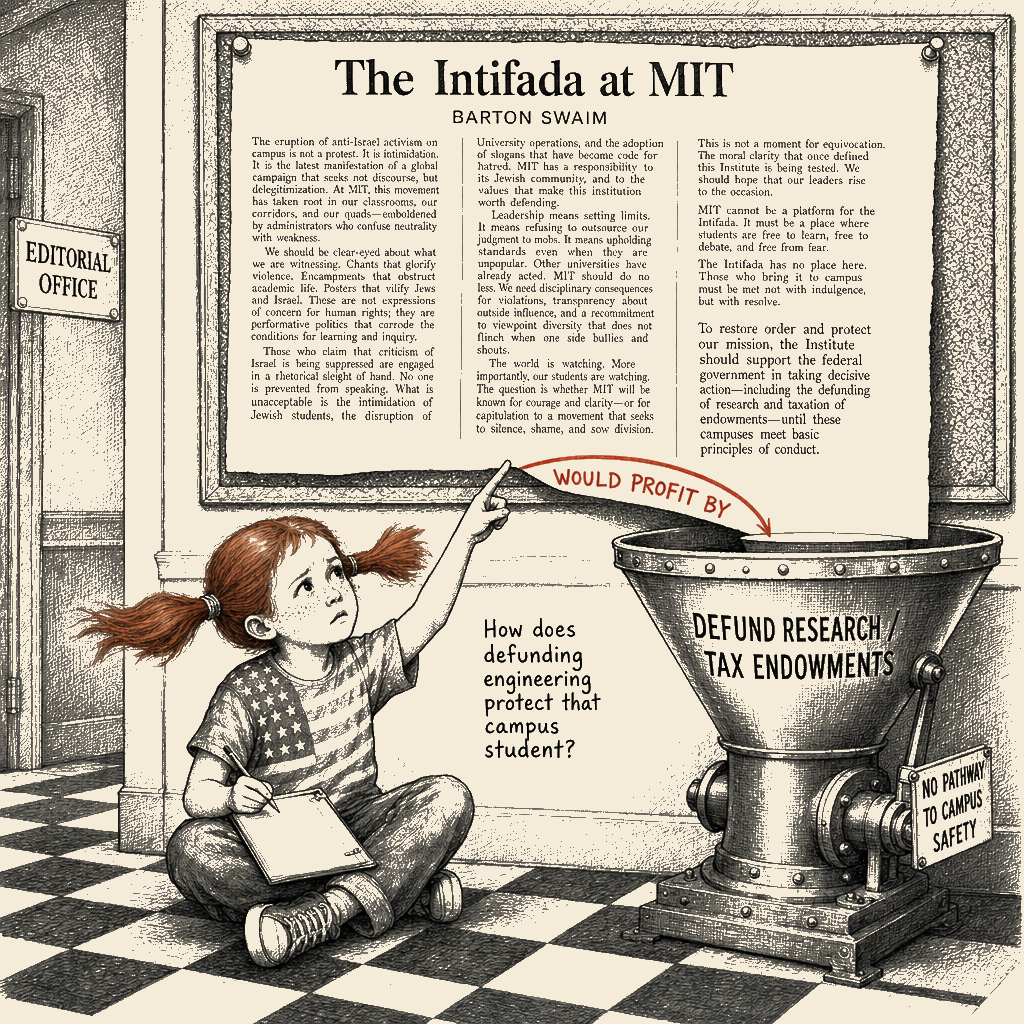
- The load-bearing omission is the causal mechanism: there is no documented pathway by which the federal government defunding an engineering department, freezing research grants, or targeting an endowment makes the Infinite Corridor safer for a Jewish student. The omission is what allows the pivot to land.
- The concentrated beneficiary is the punitive federal apparatus targeting the knowledge class; the diffuse cost is borne by the universities’ research, teaching, and constitutional function, and — ironically — by the very Jewish students kept as moral shields while the state targets the endowment. The editorial itself never specifies what “rough treatment” actually entails — withholding federal research grants, endowment taxation, accreditation pressure, visa restrictions on international students — leaving the mechanism unspecified and therefore unanswerable.
The Operation
Let’s name the machinery before we look at the gears. The editorial is executing a pattern known in analytical frameworks as the righteous redirect — using a genuine moral failure on the part of a target the apparatus already wanted to weaken, to launder a punitive policy that has no causal relationship to the failure being decried. The most relevant techniques are frame-engineered relabeling for the rebranding of punitive state action as righteous accountability, and the red herring for the pivot from the actual student-safety issue to the unrelated federal policy lever. The identity move tracks the as a [identity] credibility move.
Institutional authorship. The conservative culture-war apparatus — the Manhattan Institute / Claremont / Federalist Society pipeline that spent a decade building the wedge against university autonomy, the think-tank-and-foundation circuit that produced the “campus cancel culture” frame as a precedent to the current enforcement posture. The giveaway is the final-paragraph hook to the Trump punitive agenda, which is the signature move of that ecosystem. Sheffi’s book is self-published; it is not a peer-reviewed institutional product, but the editorial uses it as if it were a definitive reckoning.
Distributional impact. The concentrated beneficiary is the Trump administration’s domestic policy apparatus, which gets to use a genuine moral crisis to justify defunding and dismantling universities. The diffuse cost is borne by the actual function of the universities — research, teaching, scientific and medical progress that depends on federal funding — and, ironically, by the very Jewish students kept as moral shields while the state targets the endowment.
Alternative design. A policy actually optimized to protect Jewish students on campus would target the documented harassment and discrimination through Title VI enforcement, campus police coordination, disciplinary processes, and the kind of institutional reforms the Harvard and Columbia task forces attempted, however imperfectly. It would not freeze research grants, threaten accreditation, or use anti-discrimination law as a weapon against institutional autonomy. The editorial’s silence on this distinction is the silence of an operation that wants the punishment, not the protection.
FGL. Fear — the reader’s fear that Jewish students are unsafe, which is real and documented, and which the editorial deploys. Greed — the institutional beneficiaries of university weakness have their own interest, which the editorial does not surface. Laziness — the reader’s cognitive shortcut from “Jewish students are suffering” to “punish the universities” is doing the work, and the closing paragraph is built for that shortcut.
Selflessness / selfishness placement. Mixed. The genuine student-safety concern is real and selfless. The policy lever it is being hooked to is the conservative project of weakening the knowledge class, which is selfish at the institutional level and defended in moral language.
Technique identification:
1. Identity-as-Credibility — the credibility move. Swaim deploys Yossi Sheffi not merely as a witness but as an unassailable avatar. The textual cue is the identity stack in his own prose: “Yossi Sheffi, a professor of engineering… born in Israel in 1948, has taught at MIT for 48 years and has no plans to retire.” The credentials are doing argumentative work. Sheffi is the ultimate un-cancelable victim; his identity inoculates the book against charges of bias, allowing Swaim to use the book to advance a structural attack on the university without appearing to attack the idea of the university.
2. Dehumanization of the Protesters — Bandura’s dehumanization mechanism. The protesters are stripped of political agency and rendered as a contagion. Swaim highlights a “hilarious episode” of a graduate student playing “peekaboo” with a protester, and quotes students describing the protesters as being in a “trance” or a “cult.” The textual cue is the reduction of political actors to an infection or an irrational mob — children playing peekaboo, cultists in trances. By rendering the protesters as irrational, Swaim removes the obligation to engage their political arguments and frames the campus not as a site of debate but as a site of infection to be cured.
3. Frame-Engineered Relabeling — relabeling. The Trump administration’s punitive apparatus against universities is relabeled as accountability for moral cowardice. The substitution operates on the audience’s cognition: “rough treatment” is the editorial’s preferred term for federal funding withdrawal, endowment taxation, accreditation pressure, and visa restrictions. None of those mechanisms would survive the descriptor “punitive state action against a class of institutions”; the relabeling is what makes them legible as justice rather than as retribution.
4. The Red Herring / Pivot Closer — the pivot. The closing paragraph is the load-bearing structural move. Swaim pivots from the campus failure to the Trump administration’s “rough treatment” of MIT. The textual cue: “Those aghast at the Trump administration’s rough treatment of MIT and other elite institutions would profit by… pondering the severity of the betrayal.” The pivot is the verb profit by: an instruction to the reader, not an argument about the students. It equates the university’s failure to protect students with the state’s deliberate punitive action against the university, and tells the reader: Your outrage at the university should be redirected into support for the state punishing the university.
When you have a sympathetic victim, you use them to bypass the audience’s normal skepticism about state power. The reader feels they are punishing the betrayal, when they are actually endorsing a punitive state policy that has no causal link to fixing the betrayal. The trick worked because the sympathy was real, and the target was swapped underneath it.
The Record
Anchor receipts. Swaim relies on Sheffi’s self-published book as the primary narrative source, supplemented by the documented public record of the Harvard and Columbia reports, President Kornbluth’s October 10, 2023 statement (verifiable as a published MIT communication; the editorial’s quotation is accurately reproduced, with the italicization of “in my opinion” being editorial emphasis layered onto the reproduction rather than present in Kornbluth’s original), and Rep. Elise Stefanik’s questioning of Kornbluth at the December 5, 2023 House Education Committee hearing (verifiable from the congressional record and contemporaneous reporting).
Supporting receipts. The descriptions of the campus environment — chalked slogans, blocked thoroughfares, administrative capitulation — are well-documented in the broader public record and align with congressional testimony from late 2023 and early 2024. The MIT spokesman’s response is on the record.
Unconfirmed claims (convergence threshold not met).
- Sheffi’s self-publication date and self-description of “Unsafe at MIT” are the author’s own claims; we have no independent document verification beyond his self-report and the editorial’s reproduction.
- The “if any other minority had been treated as Jews… we would have seen National Guardsmen patrolling” counterfactual is rhetorical; no documentary basis supports or refutes it.
- The characterization of campus protest demands as amounting to “the Jewish state’s eradication” is not consistent with the documented demands of the major campus protest coalitions as reported by campus press (The Harvard Crimson, The Columbia Spectator, The MIT Tech) and national coverage during the relevant period. The framing of protesters as cult-like is Sheffi’s editorial characterization; the documentary record includes substantial internal disagreement, organized debate, and explicit policy demands — none of which the editorial engages.
Per-citation verdicts. The factual substrate of the campus environment is sound. The analytical break occurs not in the description of the harm but in the prescribed solution — and in the suppression of the actual demands and internal politics of the protest movement the editorial reduces to a contagion.
The load-bearing omission. The editorial never defines what the Trump administration’s “rough treatment” actually entails. Whether it is withholding federal research grants, targeting endowments, regulatory harassment, accreditation pressure, or visa restrictions on international students — the editorial does not specify. There is no documented pathway by which the federal government defunding an engineering department makes the Infinite Corridor safer for a Jewish student. The omission is deliberate: naming the actual mechanism of the state’s “rough treatment” would break the moral spell, because the reader would see the mechanism is a punishment of the institution, not a protection of the student.
Missing information declaration. The editorial does not engage: the documented demands of the major campus protest coalitions; the documented scale of Palestinian civilian casualties in Gaza during the period under review; the Title VI framework that would actually address the documented antisemitism on campus; the alternative account from students and faculty who experienced the period differently than Sheffi’s book describes. The MIT administration’s response — which the editorial itself notes was silence rather than a report — is itself a documented record worth weighing alongside Sheffi’s account.
How to Recognize This
The pattern named in plain terms. A book review that pivots at the last paragraph to defend the Trump administration’s actions. A piece about campus antisemitism that ends with permission structure for federal enforcement. What the apparatus codes as a subspecies of frame-engineered relabeling is the Moral Shield Pivot — using a genuine moral crisis involving a vulnerable group to redirect the audience’s legitimate moral outrage toward a punitive state action that has no causal relationship to the crisis.
The mechanism. The book review functions as a vehicle for an editorial product the book itself does not explicitly endorse. The reader who reads only the closing paragraph receives the editorial product; the reader who reads the whole piece receives a book review whose substantive content has been selected to support the closing argument. The technique exploits the reader’s deference to “reviewed literature” — the book review genre signals authority and care, and the closing pivot lands within that signaled authority. The reader absorbs the framing without recognizing the architecture.
Two-to-four concrete textual signals.
- A book review whose closing paragraph defends a political position the reviewed book does not itself explicitly endorse.
- A piece about one subject (campus antisemitism) that pivots in its final paragraph to a different subject (the Trump administration’s treatment of universities), with the pivot triggered by a verb of instruction (“would profit by”) rather than by an argument about the first subject.
- A piece that treats a single sympathetic source (Sheffi’s self-published book) as the authoritative account of a contested event without engaging alternative accounts.
- A piece that uses historically loaded terms (“intifada”) to describe contemporary activity that the piece has not established as analogous to the term’s historical referent, activating an emotional response disproportionate to the documented behavior.
Why it works. The book-review genre signals authority; the loaded-term signaling (“intifada,” “cult,” “trance”) activates strong emotional response; the closing pivot lands within the signaled authority and is read as conclusion rather than as editorial product. When the state is framed as the avenger of a moral wrong, the reader stops asking what the state is actually doing. The reader’s fear for Jewish students is real and human, and that reality is what the operation depends on.
What to do when you see it. Read the closing paragraph first; if it is doing political work the rest of the piece has not earned, the piece is using the genre as vehicle. Trace the cited source’s funding chain and institutional home — Sheffi’s book is self-published by an Israeli-born MIT faculty member with no independent peer review; treat accordingly. Trace the causal mechanism. Ask the question the editorial suppresses: Does the proposed state action actually fix the moral failure described, or does it just punish the institution? If the state’s action has no causal pathway to protecting the vulnerable group, the moral crisis is being used as a shield for a power grab. Check the omissions: what documented record is the piece not engaging? Here, the actual demands of the protests and the scale of Palestinian civilian harm are both omitted. Look for the same vocabulary across the syndication network; “intifada at MIT” is not a neutral description. Reduce the frame’s automatic activation by naming the technique the editorial is deploying before absorbing its conclusion.
The witness. This analysis dissects pieces of this kind. The closing-pivot move is a common architectural tool. The recognition the reader carries forward is not that the editorial’s concerns are baseless — campus antisemitism is real, documented, and serious, and universities have Title VI obligations to address it. The recognition is that the editorial’s architecture — the book-review-as-vehicle, the dehumanization of the protesters, the frame-engineered relabeling of punishment as accountability, the selective citation, the closing pivot to permission structure, the loaded-term signaling — is doing work the piece does not disclose. The reader can hold both: the reality of campus antisemitism and the recognition that this piece is using that reality to deliver an editorial product the book itself does not explicitly endorse. The bitterness carried about operations like this is disclosed and it is bound; the documentary record holds the proof, and the machinery speaks for itself.

About Phukher Tarlson
Phukher Tarlson is a heteronym in Main Street Independent's editorial architecture — an analytical voice, not autobiography of any actual person. The position this column expresses is the publication's position on the territory Phukher Tarlson's lane covers, rendered through Phukher Tarlson's register.