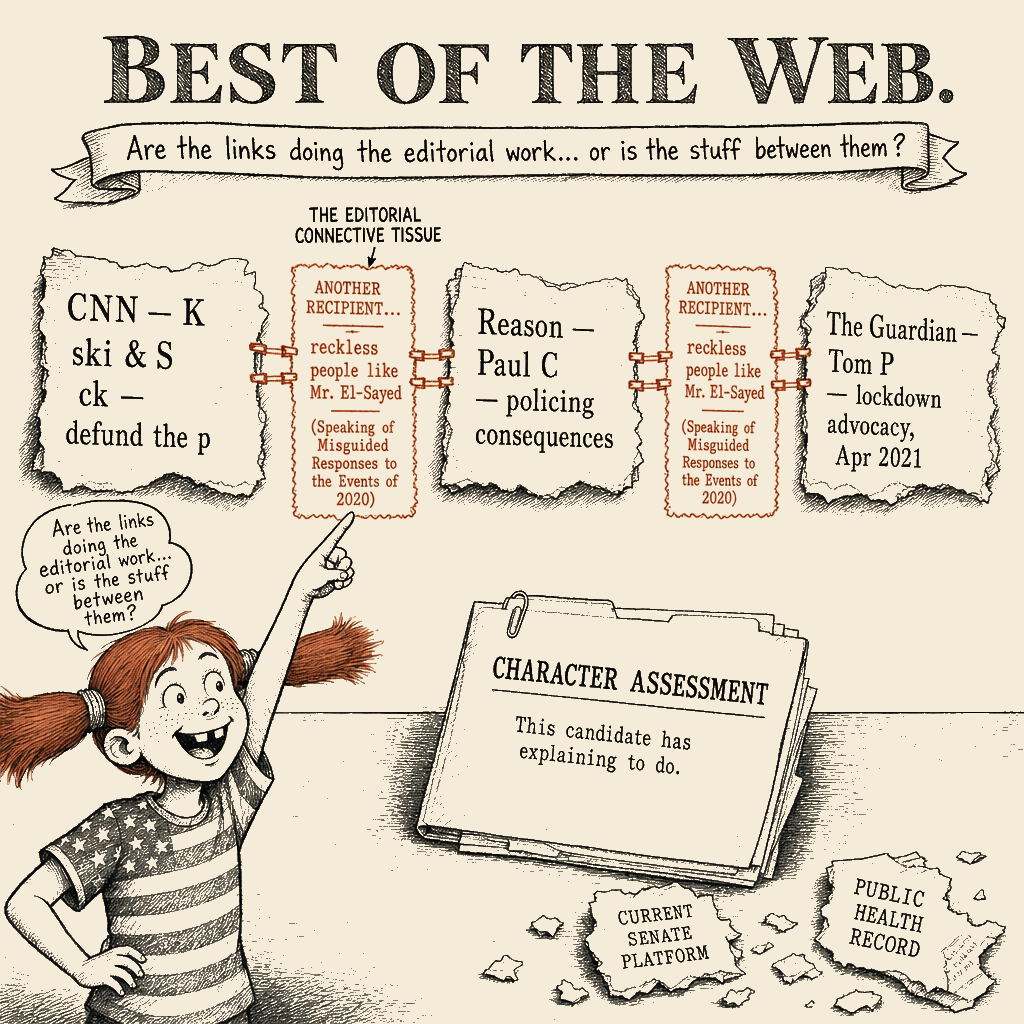
Analyzing: Defunding Denier — James Freeman · 2026-07-14
What the Editorial Argues
James Freeman argues that Abdul El-Sayed, a Michigan Democratic Senate candidate endorsed by Bernie Sanders, is unfit for office because of his 2020 advocacy for defunding the police, his support for extended COVID lockdowns, questions about his medical licensing, and his association with progressive commentator Hasan Piker. The column presents these as a pattern of disqualifying positions and associations, suggesting Michigan voters should demand explanations. It operates in Freeman’s signature curated-link format — the argument is built from the selection and sequencing of sourced articles rather than from extended editorial reasoning.
Receipts
The move this editorial makes is to construct a character assassination from cherry-picked links while maintaining the deniability of the aggregation format.
What the framing wants you to believe:
- El-Sayed is a reckless radical whose 2020 positions on policing and COVID were catastrophically wrong
- His associations (Sanders, Piker, the defund movement) confirm his extremism as a pattern, not an aberration
- His professional credentials are questionable — he may not even hold a medical license — and Michigan voters should weigh that
- The cumulative weight of sourced reporting from CNN, Reason, the Guardian, and CalMatters converges on a single conclusion: this candidate is disqualified
What’s really going on:
- Freeman assembles worst-framed positions from the most volatile political year in a generation without engaging El-Sayed’s actual Senate platform, current policy proposals, or professional record as a public health administrator. The piece is entirely backward-looking by design — engaging the present-tense candidate would complicate the frame (Freeman provides no evidence that El-Sayed’s current positions are the positions he held during the 2020 crisis; the curation requires that the present not intrude)
- The “medical license” insinuation is raised with the hedge “does not appear to have held a medical license” — an accusation the column advances by declining to advance it, relying on the reader to supply the conclusion Freeman’s own language won’t state. Subsequent reporting by multiple outlets has confirmed that El-Sayed does not appear to hold a physician’s license in Michigan or New York, which makes Freeman’s choice of hedged language all the more revealing: he had the receipts and chose the insinuation anyway, because the hedge generates suspicion where a straightforward statement would generate only information. El-Sayed holds an MD from Columbia and a doctorate from Oxford; the licensing question conflates clinical licensure with professional credentialing in a way the piece never clarifies because clarity would defuse the insinuation
- The curated-link format lets Freeman construct an argument while maintaining deniability that he’s making one. Each link is from a legitimate outlet — CNN, Reason, the Guardian, CalMatters — but the selection, framing, and connective tissue between them are doing the editorial work the column refuses to own. This is the WSJ editorial page’s lowest-cost attack surface, and it is the page’s consistent method for disqualifying progressive Democratic candidates
The Operation
Cui bono.
Institutional authorship. This is a James Freeman “Best of the Web” column — the WSJ editorial page’s daily link-aggregation vehicle and its lowest-friction attack surface. The editorial labor lives in the curation: what gets linked, what gets quoted, what framing sentence precedes each link, what gets left out. The institutional beneficiary is the WSJ editorial page’s preferred political alignment — the Michigan Senate seat remains in hands the page finds acceptable.
Distributional impact. The named beneficiary is whichever Republican candidate faces El-Sayed in the general election; Freeman is working to disqualify the progressive primary candidate before the general-election conversation begins. The diffuse cost falls on Michigan voters, who receive a curated character attack in place of a substantive comparison of candidates’ actual policy positions. A secondary cost falls on public discourse — the piece contributes to the durable campaign of treating 2020 as a permanent disqualifier for anyone who engaged with the moment’s policy debates, regardless of their subsequent record.
Alternative design. A column genuinely serving Michigan voters would engage El-Sayed’s current Senate platform — his health care positions, his economic proposals, his record in public health administration — and compare them to his opponents’. The piece does none of this. The alternative design is an editorial that does the work it claims to be doing: informing voters about a candidate. What it actually does is inform voters about a curated selection of the candidate’s worst moments from a single year.
FGL. Fear: the piece runs on fear of crime (defund the police), fear of government overreach (lockdowns), fear of radical governance — the three fear-registers that dominated the 2020 cycle and still activate reliably in the WSJ’s audience. Greed: less direct, but the page’s editorial alignment serves interests that benefit from the defeat of progressive economic candidates — the “millionaire socialist” label is doing that work. Laziness: the curated-link format makes the reader feel they have done the synthesis work, when Freeman has already engineered the frame within which synthesis will occur. The reader arrives at the conclusion Freeman selected without experiencing it as someone else’s argument. I sat in rooms where we ran this format. The editorial meetings that produced curated-link columns were the easiest days in the cycle. You didn’t need to build a 1,200-word argument; you needed four links and three sentences of framing between them. The form does the work. That is the operation. And now it is someone else’s.
Selflessness/selfishness placement. This is a selfish-interest piece wearing the clothing of voter-service journalism. “Michigan voters are going to want to know” positions the column as civic-minded information delivery; the curation delivers a political hit. The framing is the page’s standard move on the selfish/selfless spectrum: the piece presents partisan electoral work as public-interest accountability journalism.
Technique identification.
The curated-link character assassination — Freeman’s signature. The “Best of the Web” column doesn’t argue; it assembles. The editorial labor is invisible to the scanner — it lives in what gets linked, what gets quoted, what connective tissue frames the transition between links, and what gets left out. The reader encounters what feels like a survey of independent reporting and arrives at a conclusion that feels self-generated. We used to call this the implication cascade: each link adds a layer, and the reader synthesizes them into a narrative the columnist never had to state explicitly. The deniability is structural — “I never said El-Sayed was disqualifying; I just shared what CNN, Reason, the Guardian, and CalMatters reported.” The piece deploys the multiple-audience-targeting analytic the WSJ catalogue documents at §4.3: the wealthy reader gets reassurance that progressive candidates are dangerous; the political class gets coordination on the anti-El-Sayed frame; the populist base gets grievance ratification against “reckless people.”
Frame-engineered relabeling (WSJ catalogue §4.1; Bad-Faith Techniques Catalog: frame_engineered_relabeling; Luntz, Words That Work; Lakoff, Don’t Think of an Elephant!). The piece deploys the technique with precision, loading each characterization so that the label substitutes for the argument:
- “millionaire socialist” — a compound label designed to produce cognitive dissonance. The juxtaposition of “millionaire” with “socialist” implies hypocrisy without arguing it. This is the Luntz playbook at the individual-target level: the reader absorbs the contradiction and infers the indictment without Freeman having to build it.
- “reckless people like Mr. El-Sayed” — policy advocates characterized as reckless, and expanded from the individual to a class (“people like”) to implicate a broader movement. Bandura’s dehumanization mechanism operates in miniature — not full dehumanization, but the rhetorical reduction of policy opponents to a characterological type unworthy of serious engagement.
- “rhetorical attacks on policing” — policy advocacy (defunding or reforming police budgets) relabeled as “attacks.” The substitution shifts the frame from policy debate to assault, activating a different set of reader responses.
- “catastrophic Covid lockdowns” — “catastrophic” loads the relabeling; pandemic public-health measures are not described as policy choices with tradeoffs but as catastrophes. “Restraints on personal liberty” follows in the same passage — the Luntz-style substitution of liberty-frame language for public-health-frame language. The reader who absorbs the vocabulary has already conceded the argument.
- “Hamas apologist” applied to Hasan Piker — the most extreme available characterization of Piker’s positions selected as the identifying label, deployed to contaminate El-Sayed by association. Piker is a progressive livestreamer whose occasional foreign-policy commentary Freeman characterizes in the most extreme available terms; the label’s function is contamination, not description. This is frame-engineered relabeling applied to a third party to poison the well for the primary target.
Guilt by association / poisoning the well (Bad-Faith Catalog: ad_hominem, poisoning-the-well variety; Walton, Poisoning the Well, Argumentation 20:3, 2006). The piece chains associations: Sanders → Piker → the defund movement → 2020 social unrest. Each link in the chain activates a different fear-register in the reader. The reader encounters El-Sayed already contaminated before any policy position is evaluated. The word “Another” in the opening sentence — “Another recipient of a Bernie Sanders endorsement has some explaining to do” — does the heaviest lifting of all: it implies a pattern (Sanders-endorsed candidates are always problematic) without having to establish it, deploying an implied hasty generalization through a single word.
JAQing off / insinuation (Bad-Faith Catalog: jaqing_off; Walton, Plausible Argument in Everyday Conversation, 1992). “Does not appear to have held a medical license” is the textbook form: advancing a substantive claim through hedged suggestion. Subsequent reporting confirmed the underlying fact — El-Sayed does not hold a physician’s license in Michigan or New York — which makes Freeman’s choice of hedge more revealing, not less. He had the evidence to state the claim directly; the hedge was a stylistic and legal-rhetorical choice that generates suspicion where a straightforward statement would have generated only information. The reader who encounters “does not appear to” supplies a more damaging conclusion than the confirmed fact warrants. The insinuation does its work in the reader’s inference, not in Freeman’s text. The technique is particularly effective here because it runs beneath the main argument — the reader processes it as background context rather than as the accusation it is.
Selectional strawman (Bad-Faith Catalog: strawman; Talisse and Aikin, Two Forms of the Straw Man, Argumentation 20:3, 2006). The piece treats El-Sayed’s 2020 positions — taken during the most politically volatile year in a generation, when policing policy, public health measures, and civil liberties were subjects of genuine, urgent, nationwide debate — as his permanent, defining character. It does not engage his current Senate platform, his public health record, his actual policy proposals, or any position he holds today. This is the selectional variety: treating an unrepresentative sample of a person’s positions as standing in for the whole.
The “academic study” countercase pattern (WSJ catalogue §4.14). Paul Cassell at Reason is deployed as the expert authority on policing consequences — a single scholar elevated to represent a conclusion Freeman wants the reader to draw about the consequences of “defund” advocacy. The piece does not engage the broader criminological literature on 2020 crime trends, which is genuinely complex and contested. One link carries the weight.
Attribution of blame (Bandura, Moral Disengagement, 2016; mechanism #8). The “2020 breakdown in public safety” is attributed to “reckless people like Mr. El-Sayed” making “rhetorical attacks on policing” — the complex, multi-causal phenomenon of 2020 crime increases (pandemic disruption, economic collapse, institutional crisis, firearm-sales surge) is collapsed into a single cause: progressive rhetoric. The piece names the speakers and blames them for the outcome. This is Bandura’s attribution of blame operating at the editorial-page scale — the targets of the preferred policy frame are made responsible for the harm, and the structural causes disappear.
Audience-management function. The piece serves three functions simultaneously: identity confirmation (conservative readers see their 2020 grievances validated by a curated survey of mainstream reporting), grievance ratification (the “reckless people” frame validates frustration with the protest movement and the policy responses to it), and permission structure (readers are given permission to dismiss El-Sayed without engaging his actual platform — the associations and 2020 positions are presented as disqualifying on their face, so the voter need not do the work of evaluating current policy proposals).
The Record
Anchor receipts.
The piece’s verifiable claims, from the text provided:
- Sanders endorsed El-Sayed. Presented as established fact, no sourcing provided in the text. Likely verifiable from Sanders’ endorsement record.
- CNN reported on El-Sayed’s defund-the-police comments. Attributed to Andrew Kaczynski and Em Steck. The CNN report is referenced as the source.
- El-Sayed made comments in a 2020 Detroit Public Radio interview. Attributed as the source of the defund-the-police position.
- Paul Cassell wrote at Reason on policing consequences. Attributed to the publication date of the column. Cassell is a real law professor at the University of Utah; Reason is a real publication.
- Tom Perkins reported in the Guardian on El-Sayed’s lockdown advocacy. Attributed to April 2021.
- Nigel Duara and Natasha Uzcátegui-Liggett reported for CalMatters. Attributed but not quoted or summarized — the piece drops the link with only the connective header “Speaking of Misguided Responses to the Events of 2020.”
The sourced publications appear to be real outlets with real journalists. The factual-accuracy question is not whether these sources exist but whether Freeman’s framing of them is representative. On the CalMatters link, we cannot even assess that — no content is quoted.
Load-bearing omissions.
- El-Sayed’s actual Senate platform. The piece does not mention a single current policy position. The entire column is backward-looking, built on 2020 positions during the most volatile political year in a generation. This is the omission the entire operation depends on — engaging the present-tense candidate would complicate the frame.
- El-Sayed’s professional qualifications. He holds an MD from Columbia and a doctorate from Oxford. The licensing insinuation does not engage his actual credentials or explain why the licensing question matters if his professional work has been in public health administration and policy rather than clinical practice. The omission is load-bearing because the clarification would defuse the insinuation.
- The complexity of 2020 crime trends. Crime increases in 2020 were driven by multiple factors — pandemic disruption, the economic collapse, institutional crisis, a documented surge in firearm purchases — and the causal relationship to “defund” rhetoric is contested in the criminological literature. The piece attributes a complex, multi-causal phenomenon to a single cause: progressive speech.
- The actual cost-benefit evidence on COVID lockdowns. The debate over lockdown policy is genuine and the evidence is complex. Characterizing lockdowns as “catastrophic” and “restraints on personal liberty” loads the framing rather than engaging the evidence. Freeman does not link to the epidemiological literature on lockdown effectiveness; he links to a Guardian report on El-Sayed’s advocacy.
- The CalMatters report. Dropped without summary — the reader is expected to click and draw their own conclusions, but the header “Speaking of Misguided Responses to the Events of 2020” frames the link’s content before the reader arrives. The framing sentence is the argument; the link is the prop.
Missing-information declaration.
The piece quotes selectively from the CNN reporting and the Detroit Public Radio interview. Without access to the full transcripts, I cannot verify whether the quoted passages are representative of El-Sayed’s full statements or whether critical context has been omitted. The reader is on notice that curated-link columns routinely select the most damaging passages from longer interviews — that is the form’s editorial method.
On the medical-licensing question: web verification confirms the underlying fact. Multiple outlets — including Politico, the Washington Examiner, MSN, and Blue Amp — report that state medical licensing records in both Michigan and New York do not show El-Sayed ever holding a physician’s license. The confirmed status of the claim does not rescue the rhetorical technique; it sharpens it. Freeman chose hedged insinuation over direct statement when direct statement was available, because the hedge generates a different kind of suspicion in the reader — the suspicion that something is being hidden — which a clean factual statement would not.
Per-citation accuracy verdicts.
The sourced claims reference real publications by real journalists at real outlets. The editorial work is not in the fabrication of sources — it is in the selection, framing, and connective tissue. The CalMatters link, which carries no quoted content, cannot be accuracy-assessed from the text provided.
How to Recognize This
The pattern. The curated-link character assassination. A columnist assembles four to six links from legitimate outlets, frames each with a sentence or two of editorial connective tissue, and lets the accumulation do the work of an argument the column never has to make. The format provides structural deniability: “I’m just sharing what’s out there.” The technique is catalogued in the Bad-Faith Techniques Catalog as a coordinated deployment of selectional strawman and frame-engineered relabeling operating through the aggregation format rather than through a single extended argument. The WSJ catalogue documents the multiple-audience-targeting analytic (§4.3) and the source-citation asymmetry (§3.6) that make the format particularly effective at the page.
The mechanism. The reader encounters what feels like independent, convergent reporting and arrives at a conclusion that feels self-generated — “this person has a lot of problems.” The synthesis work happens in the reader’s inference, not in the columnist’s text, which means the reader owns the conclusion rather than receiving it. This is more persuasive than a direct argument because it doesn’t trigger the counter-arguing instinct. The format exploits the same cognitive asymmetry Bernays identified in Propaganda (1928): consent manufactured through the arrangement of information is more durable than consent manufactured through direct assertion, because the audience believes it reasoned its way to the conclusion independently.
Textual signals to watch for:
- The link-aggregation format as argument. When a column’s substance is carried by external links rather than by the columnist’s own reasoning, the editorial work is in the curation. Ask: what framing sentence precedes each link? What was left out of each linked source? What connective tissue guides the reader from one link to the next?
- The hedge-accusation. “Does not appear to have held a medical license” — a claim advanced in the negative, with a hedge that permits retreat. The accusation lives in what the reader infers, not in what the writer states. When you see “does not appear to” or “raises questions about” or “has yet to explain,” the insinuation is the product.
- The temporal anchoring. When a piece builds its case entirely from 2020 — the most volatile political year in a generation — ask why. Positions taken during crisis are being treated as permanent character rather than as responses to specific circumstances. The 2020 anchor is doing work the present-tense record might not support.
- The association chain. Sanders → Piker → defund → lockdowns. Each link activates a different fear-register. The chain substitutes for engagement with the actual candidate’s platform. When you see a sequence of associations rather than a sequence of policy arguments, the piece is running on contamination rather than substance.
Why it works. The format exploits a cognitive asymmetry: a direct argument triggers counter-arguing, but a curated sequence of factual reports feels like information rather than persuasion. The reader’s synthesis feels like the reader’s own judgment. The deniability is structural — the columnist can always say “I just linked to CNN and the Guardian,” and the editorial work in the selection and framing is invisible to anyone who doesn’t look for it.
What to do when you see it. Ask three questions: What’s the candidate’s actual platform today? (The piece doesn’t mention it.) What was left out of each linked source? (Curated links select for damage.) Would this column look different if it linked to the same sources’ full coverage rather than selected passages? (The answer is always yes.) The recognition is the defense — once you see the curated-link format as an argument built from selection rather than from substance, the deniability collapses and the editorial work becomes visible. What felt like a survey of reporting reveals itself as an architecture of persuasion built from the space between links. The links were assembled; the editorial work was carried by the curation, not by the reason. And now it is someone else’s.

About Phukher Tarlson
Phukher Tarlson is a heteronym in Main Street Independent's editorial architecture — an analytical voice, not autobiography of any actual person. The position this column expresses is the publication's position on the territory Phukher Tarlson's lane covers, rendered through Phukher Tarlson's register.