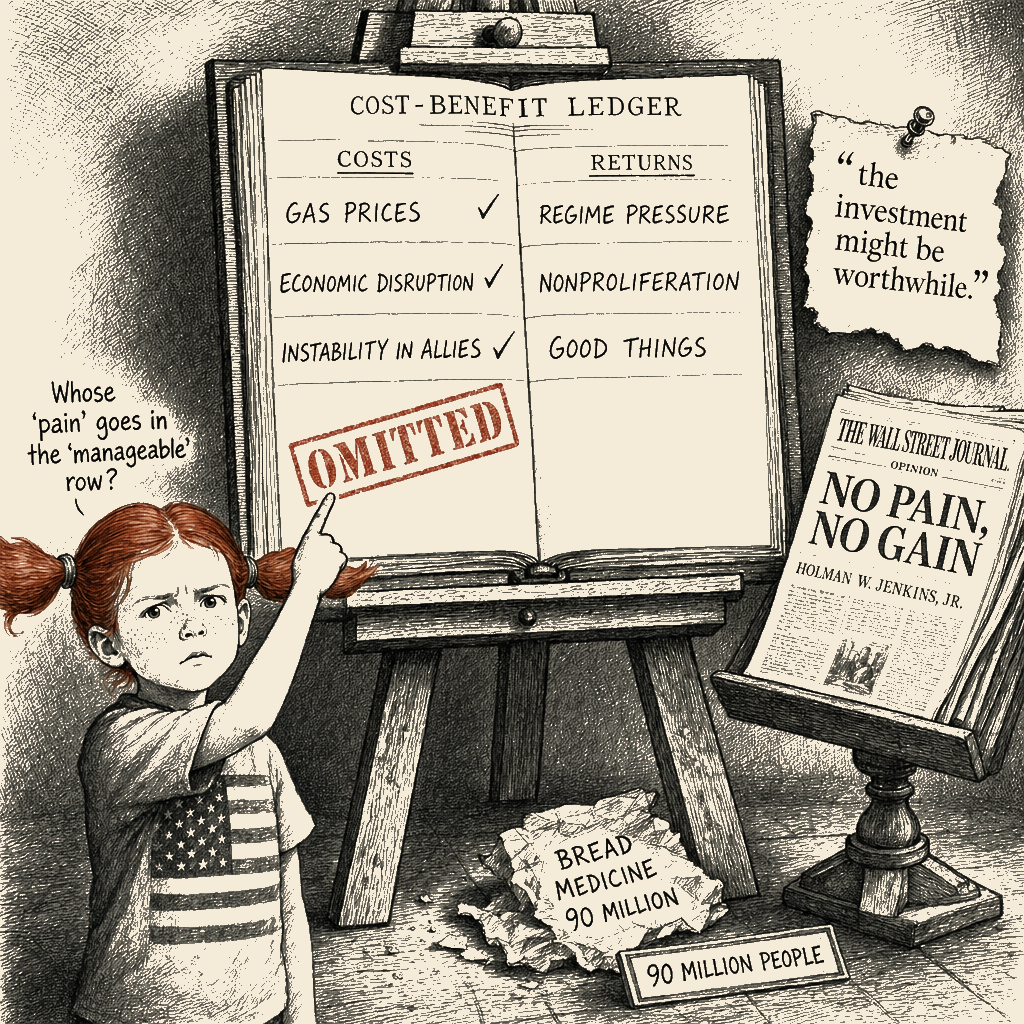
Analyzing: No Pain, No Gain in Iran Blockade — Holman W. Jenkins, Jr. · 2026-07-14
What the Editorial Argues
Jenkins argues that a U.S. naval blockade of Iran’s ports — as opposed to a ground operation to force open the Strait of Hormuz — is the coercive measure “proportionate” to American interests. He contends that the energy disruption has been manageable, that global consumers are adapting, and that the blockade will deprive the Iranian regime of the revenue and imports it needs to sustain its nuclear program, proxy network, and missile/drone ambitions. Jenkins treats the blockade as a strategic “investment” that will pressure Iran toward concessions its leaders have long refused, eventually weakening the regime’s domestic authority and allowing the Iranian people to prosper once the “oil curse” lifts. He frames media coverage of the Iran war as missing the point by treating it as a sporting event rather than Clausewitzian “politics by other means.”
Receipts
Jenkins relabels an act of war as a business calculation — and the relabeling is what erases the civilians from the frame.
- What the framing wants you to believe: a naval blockade is a measured, proportionate “coercive measure” — a strategic “investment” that might produce “good things” for the Iranian people; the media is obsessed with who “won” while the serious analysts focus on the real strategy; the costs (higher gas prices, economic disruption) are manageable and worth bearing.
- What’s really going on: Jenkins has deployed the WSJ editorial page’s signature technique — frame-engineered relabeling — to transform a naval blockade into “investment” language so cleanly that the piece never once names what a blockade means for the approximately 90 million people whose food, medicine, and imports it cuts off. The piece’s own concession is the tell: Jenkins acknowledges “high gasoline prices at home, damage to the world economy, possible instability in local allies” — these are the civilian costs he can see — then immediately recasts them as the costs that “might be worthwhile” if the blockade forces Iran to abandon its “outlaw and peace-breaker stance.” The humanitarian cost to the Iranian population, the legal status of blockades under international law, and the precedent of U.S. occupation strategy in the very countries Jenkins invokes — Iraq and Afghanistan — are absent. The piece’s audience-management function is a four-layer permission structure (§4.3 WSJ catalogue: the wealthy reader gets cost-benefit language; the technocrat gets “proportionate”; the hawk gets “outlaw and peace-breaker”; the populist base gets the media-as-sporting-event grievance ratification) operating simultaneously to make an act of war read as strategic maturity. Under the UN Convention on the Law of the Sea and the San Remo Manual on armed conflict at sea, a blockade of a sovereign state’s ports is a use of force — a category the piece never engages because engaging it would collapse the “investment” frame into its actual referent: a military siege of a nation of approximately 90 million.
The substitutions are not decorative. They are the mechanism. Here is the relabeling table with Jenkins’s own language — the receipts, line by line:
| What is actually happening | Jenkins’s exact words | What the words invite |
|---|---|---|
| Naval blockade of a sovereign state’s ports | ”coercive measure realistically proportionate to U.S. interests” | Policy decision, not an act of war |
| Economic warfare against a civilian population | ”the investment might be worthwhile if it forces the Iranian regime to abandon its outlaw and peace-breaker stance” | Business calculation with acceptable risk |
| Eruption of military conflict | ”Mr. Trump’s war, however otherwise ill-managed and ill-planned” | Ownership by a single negotiator; a deal gone sideways, not a war |
| Forcible cutting of all imports to 90 million people | ”the renewed blockade of Iran’s ports that Mr. Trump actually decreed Monday” | Administrative action — a decree, a policy announcement |
| Inability to import food and medicine | ”gone will be all hope of rebuilding and investment” | Economic setback, not humanitarian crisis |
| Regime change through economic strangulation | ”suddenly the world becomes a much better place” | Utopian liberation — the pain was worth it |
The operational logic is Luntz’s: get the audience to adopt the label, and the audience adopts the frame. Jenkins has internalized this at the sentence level. Once the reader processes the blockade as an “investment,” the reader is doing cost-benefit analysis rather than reckoning with what a naval siege means for a civilian population. The relabeling is not decorative — it is the mechanism by which the humanitarian erasure is executed.
The Operation
The Techniques
The piece deploys a tight cluster of Bandura mechanisms — not as scholarly reference but as operational apparatus. The techniques work in concert; naming the cluster is more useful than naming any one.
Frame-engineered relabeling (§4.1 WSJ catalogue; frame_engineered_relabeling in the Bad-Faith Techniques Catalog). This is the load-bearing technique. The Receipts table above shows each substitution with Jenkins’s own language. The operational logic is Luntz’s: get the audience to adopt the label, and the audience adopts the frame. Once the reader processes the blockade as an “investment,” the reader is doing cost-benefit analysis rather than reckoning with what a naval siege means for a civilian population.
Moral justification (Bandura mechanism 1). The blockade is reframed as serving a higher cause — global security, nonproliferation, liberating the Iranian people from the oil curse. The textual trigger is Jenkins’s description of Iran’s stance as an “outlaw and peace-breaker stance toward its region and the world, which promised only more conflict down the road” — moral justification operating at full operational load. The “outlaw and peace-breaker” language performs double duty: it is euphemistic labeling for the designated enemy and moral justification for the siege simultaneously. The piece’s headline — “No Pain, No Gain” — imports the self-help genre’s logic into the discourse of military violence. Pain is reframed as productive. The question whose pain is answered only by implication: the pain is Iran’s. The question what that pain looks like — cut-off medicine, food insecurity, economic collapse for a population of 90 million — is never addressed because the investment frame has already resolved it: the pain is the cost of the gain.
Advantageous comparison (Bandura mechanism 3). The piece opens by setting up a ground operation to force open the Strait of Hormuz — “It would require ground troops. It would be costly and open-ended. It would also be grossly disproportionate to any investment Donald Trump wished to make in his Iran war” — as the alternative the blockade improves upon. The comparison makes the blockade read as the reasonable, proportionate option. But the ground operation is an option nobody proposed and nobody is pursuing. The actual alternative the piece never engages is not blockading anyone at all — diplomacy, sanctions adjustment, multilateral engagement, or simply accepting that Iran is a regional power with its own interests. By not naming this baseline, the piece ensures the reader’s comparison operates between the blockade and something worse, rather than between the blockade and something better.
Displacement of responsibility (Bandura mechanism 4). “While his blockade lasts, gone will be all hope of rebuilding and investment.” The agentless construction is the tell. Not “the United States blockade will destroy Iran’s economy” — “gone will be all hope.” The harm is presented as a natural consequence of the blockade’s existence rather than as something the U.S. is actively imposing on a civilian population. The regime’s “outlaw” status displaces the responsibility for the humanitarian harm onto Iran’s leadership: they brought this on themselves by being outlaws. The Iranian people disappear as agents or victims — they are beneficiaries of liberation, waiting for the oil curse to lift.
Dehumanization through delegitimation (Bandura mechanism 7, light form). The piece does not dehumanize the Iranian people — it is more sophisticated than that. It dehumanizes the Iranian government by coding it as criminal (“outlaw and peace-breaker,” “spurned billions of dollars in offered sanctions relief, believing these dollars would still be available anyway once they got done twisting a U.S. president’s tail”), which licenses treating the population’s suffering as acceptable collateral. Once the government is coded as illegitimate, the harm the blockade inflicts on the governed population becomes the government’s fault rather than the blockading power’s. The population is reframed as future beneficiaries of the regime’s collapse — they will be better off once the blockade breaks the regime’s authority. This is the same structure as the austerity-thrift archetype (§4.2 WSJ catalogue): the suffering is reframed as character-building, and the party causing the suffering gets to feel virtuous about it. Jenkins’s closing vision — “suddenly the world becomes a much better place” — is the purest expression of this: the 90 million people whose lives are disrupted are future beneficiaries, not present victims.
The missing technique: what is NOT deployed. The piece contains zero engagement with:
- International legal status of blockades (the UN Charter, the San Remo Manual, the law of armed conflict at sea)
- Humanitarian impact on the Iranian civilian population (food, medicine, economic collapse)
- Precedent from the operations Jenkins himself invokes (Iraq, Afghanistan — decades-long occupations that failed to produce the “good things” the piece promises from a blockade)
- Alternative designs (diplomacy, multilateral engagement, sanctions adjustment)
- The actual “investment” calculus (what does the blockade cost the United States, in dollars, lives, and strategic capital — not just what it costs Iran)
Each absence is doing load-bearing work. The legal engagement would reclassify the blockade from “coercive measure” to “act of war.” The humanitarian analysis would populate the investment frame with its actual costs — human bodies, not just gas prices. The precedent would reveal that the U.S. has spent two decades and trillions of dollars in the region without achieving the kind of regime transformation the piece promises from a naval siege. The alternative-design discussion would expose the false binary (blockade vs. ground operation) that the advantageous comparison depends on. The piece works precisely because none of these are present.
Cui Bono
Institutional authorship. The piece is unsigned in the institutional sense — Jenkins writes as a member of the editorial board, using the board’s institutional authority. The placement chain: WSJ editorial board → Holman Jenkins, Jr. (board member, Gerald Loeb Award winner, 30+ years on the page) → the WSJ op-ed page’s institutional credibility. The piece carries the weight of the board’s standing position even though it is signed, because Jenkins is the board.
Distributional impact.
- Concentrated beneficiaries: the U.S. strategic establishment (Gulf dominance secured through economic rather than military means); energy firms and shipping interests that benefit from a weakened Iran; the broader sanctions-and-blockade apparatus that normalizes economic warfare as a policy tool rather than an act of war.
- Diffuse cost-bearers: the Iranian civilian population (food insecurity, medical shortages, economic collapse); neighboring states’ populations (Kuwait cut off from oil outlets, Qatar forced onto alternative supply chains); global consumers and economies (energy disruption, inflationary pressure).
- Alternative design: if optimized for the piece’s stated rationale — preventing nuclear proliferation and deterring Iranian proxy activity — the policy might look like multilateral diplomatic engagement with realistic security guarantees, arms-control frameworks addressing the actual proliferation pathway, or economic incentives calibrated to the regime’s decision-making structure rather than to the civilian population’s survival. The blockade is optimized for regime pressure through civilian suffering — a different objective than the one it is dressed up to serve.
FGL (Fear/Greed/Laziness).
- Jenkins / the board: Fear that Iran’s nuclear program will outpace containment; Greed for a clean strategic “win” that justifies the costs already incurred; Laziness in not engaging the alternative-design literature or the humanitarian-impact analysis that would complicate the investment frame.
- The apex beneficiary (the U.S. strategic establishment): Greed for Gulf dominance maintenance without the ground-troop commitment Iraq and Afghanistan required; Fear of appearing weak on Iran.
- The rank-and-file reader: Fear of Iranian aggression (real and legitimate, rooted in the regime’s actual behavior); Laziness in accepting the “investment” frame without reckoning with what the investment buys at the human level. The reader’s fear is real and human — the piece is designed to harness it, not to address it.
Selflessness/selfishness placement: mixed, leaning selfish. The piece advocates for U.S. strategic interests and presents them as universal goods, which is the classic selfless-claim/real-beneficiary structure. There is a genuine security interest in nonproliferation and in limiting Iranian proxy activity — the true half. The suppressed variable is that the blockade’s primary effect is regime pressure through civilian suffering, and the regime transformation the piece imagines is speculative while the humanitarian cost is immediate.
Audience-Management Function
The piece executes the WSJ board’s four-audience-targeting pattern (§4.3 WSJ catalogue) at the sentence level:
- The wealthy reader / strategic establishment: “the investment might be worthwhile” — cost-benefit language that reassures the reader this is calculated, not reckless.
- The technocratic class: “proportionate to U.S. interests,” “coercive measure” — quasi-strategic vocabulary, citable in serious settings.
- The hawk / populist base: “outlaw and peace-breaker stance,” “twisting a U.S. president’s tail” — grievance ratification; the Iranian regime as the out-group that brought this on itself.
- The general readership: “politics by other means,” “the press has been waging its own mighty struggle over who ‘won’” — status display; the reader is positioned as someone who sees through the media’s sporting-event framing to the real strategy underneath.
All four layers operate within a single piece, executing the WSJ board’s standard audience-management architecture. The permission structure is the piece’s primary function: it gives the reader permission to support a blockade — an act of war — by framing it as an investment whose costs are manageable and whose returns are transformative.
The Record: Jenkins’s Disclosed Context
Jenkins positions himself as someone who “said” the right things at the right time — “by the first week, I said he was looking for an out,” “these are the same forces of energy realism that just days before the war I said were working.” The self-positioning is the editorial-board credibility move: the reader is invited to trust the analysis because the analyst was prescient. This is the technocratic-credential ledger (§3.7 WSJ catalogue) operating at the personal rather than institutional level.
The piece also concedes that the 20% cargo-value tax — “the one element that perhaps made the plan workable” — “disappeared in 24 hours with another Trump tweet.” The concession is a disclosure that the plan the piece advocates may already be inoperative, but it is delivered as a parenthetical disappointment rather than as grounds for questioning the plan’s viability. The investment frame survives the concession because the investment frame was never dependent on the specific policy details — it was dependent on the label.
The Record
Receipts and their quality:
The piece produces no external receipts. Its arguments rest on Jenkins’s personal authority and on the general strategic framework of U.S. Gulf policy. There are no citations to international law, humanitarian-impact studies, economic analyses of the blockade’s costs, or precedent studies from comparable operations. The piece’s analytical method is assertion-through-authority: “this column has long maintained”; “by the first week, I said.”
The one empirical claim the piece makes — that “global energy consumers now have had six months to adjust to the unreliability of Persian Gulf oil” — is presented without sourcing, citation, or qualification. Whether the adjustment has been orderly or chaotic, who bore the adjustment costs, and whether the adjustment is sustainable are all questions the investment frame does not require the piece to answer.
Load-bearing omissions:
-
International legal status of blockades. A blockade of a sovereign state’s ports is a use of force under the UN Charter and the laws of armed conflict. The San Remo Manual on the Law of Armed Conflict at Sea (1994) sets out detailed rules for blockades, including requirements for notification, humanitarian access, and proportionality. The piece never engages this framework because engaging it would reclassify the blockade from “coercive measure” to “act of war,” which would collapse the investment frame.
-
Humanitarian impact on the Iranian civilian population. Iran has approximately 90 million people. A complete naval blockade cutting off all imports would affect food supply, medical supply, and economic activity for the entire population. The piece treats this population as passive beneficiaries of the regime’s future collapse — “the oil curse will lay less heavily on its people” — rather than as present victims of the blockade the piece advocates.
-
The precedent the piece itself invokes. Jenkins writes: “Mr. Trump can learn from his predecessors in Iraq and Afghanistan. In America’s giant political economy, a continuing overseas military operation like his proposed blockade can rapidly fade in domestic political salience.” He is using the precedent to argue that the American public will tolerate the blockade — the domestic-political-salience argument. But the precedent, read honestly, is the opposite of what the piece needs it to be: the U.S. spent two decades and trillions of dollars occupying Iraq and Afghanistan, neither of which produced the regime transformation the piece promises from a naval siege. The precedent undermines the argument if applied symmetrically rather than selectively.
-
Alternative designs. The piece’s advantageous comparison operates between the blockade and a ground operation to force open the Strait. The comparison to not blockading anyone — diplomacy, multilateral engagement, arms-control frameworks, economic incentives — is never made because making it would expose the false binary.
Per-citation accuracy verdicts: N/A. The piece produces no external citations.
Missing-information declaration: The piece’s empirical claims (energy adaptation, blockade enforceability, regime concession likelihood) rest entirely on Jenkins’s strategic assessment, presented without sourcing. The retained-memory flag applies: these are Jenkins’s professional judgments, not documentary claims, and the reader is on notice they are non-verifiable from the piece alone.
How to Recognize This
The pattern is the war-as-investment frame — a specific deployment of the austerity-thrift archetype (§4.2 WSJ catalogue) in which military violence against a civilian population is reframed as a rational business calculation whose costs are “manageable” and whose returns are “good things.”
The mechanism: Frame-engineered relabeling gets the reader to adopt economic vocabulary (“investment,” “costs,” “returns,” “manageable,” “proportionate”), and once the reader is inside the economic frame, the humanitarian cost vanishes because economics has no vocabulary for “the children who will go without medicine.” The investment frame is not an argument for the blockade — it is the rhetorical apparatus that replaces the argument by making the blockade’s actual content (a naval siege of 90 million people) inexpressible within the frame the reader has adopted.
Textual signals to look for:
-
The “investment” substitution. When a piece about military action uses the word “investment” or “cost-benefit” or “worthwhile” — and the costs it names are gas prices and economic disruption while the costs it does not name are human bodies — the investment frame is operating. The tell is always what is in the cost column (things that affect the reader’s economy) versus what is out of it (things that happen to someone else’s body).
-
The advantageous comparison to an option nobody proposed. When a piece sets up its preferred policy against a worse alternative that no one is actually pursuing — rather than against the baseline of doing nothing — the comparison is engineered to make the preferred policy read as moderate. Check: is the comparison between the advocated policy and the status quo, or between the advocated policy and something worse? If the latter, the piece is managing your perception, not informing your judgment.
-
The agentless constructions. “Gone will be all hope.” “The world becomes a much better place.” When the piece’s descriptions of harm use passive voice or agentless constructions — and the agent (the United States, the blockading power) is the piece’s protagonist — the displacement of responsibility is operating. The harm is happening; no one is doing it. Ask: who is imposing this blockade? If the piece cannot say it in plain language, the piece is hiding what it is advocating.
-
The “who won” misdirection. When a piece frames media coverage as missing the point by asking who “won” — positioning itself as the sophisticated realist that sees the deeper strategic logic — the audience-management function is a status-display move. The reader who accepts the positioning has been invited to adopt the piece’s frame as the insider’s frame, which means the piece’s labels have become the reader’s labels. Ask: am I analyzing this, or have I adopted the piece’s vocabulary? If you are using “investment” and “coercive measure” and “proportionate” in your own internal narration, the relabeling has worked.
Why it works. The investment frame works because it imports the logic of rational self-interest — the logic the WSJ reader lives inside every day — into a domain where that logic is inadequate. Business investments have costs and returns; military sieges have victims. The frame makes the victimhood invisible by providing no vocabulary for it. The reader who has adopted the frame literally cannot see the humanitarian dimension because the frame has no category for it. This is not ignorance — it is the frame working as designed. We operators used to call this “the category error the reader doesn’t know they’ve made.”
The litmus test. The next time someone tells you the pain is worth the gain, ask one question: does this piece’s cost-benefit ledger include the price of a loaf of bread in Tehran? If it does not, the investment frame has done its work — it has replaced a military siege with a spreadsheet, and the spreadsheet has no row for the people.
What to do when you see it. Restore the vocabulary the frame excludes. Replace “investment” with “blockade.” Replace “coercive measure” with “naval siege.” Replace “the Iranian regime” with “the 90 million people whose imports are being cut off.” Replace “good things follow” with “what happens to the children when the medicine doesn’t arrive?” The relabeling works in only one direction — it operates by substitution, not by addition. Restoring the original vocabulary does not require you to take a position on the policy; it requires you to see the policy as it is before the investment frame performed its erasure. That seeing is the recognition. Carry it forward — the next time someone tells you the pain is worth the gain, ask whose pain, and ask them to name it in plain language.

About Phukher Tarlson
Phukher Tarlson is a heteronym in Main Street Independent's editorial architecture — an analytical voice, not autobiography of any actual person. The position this column expresses is the publication's position on the territory Phukher Tarlson's lane covers, rendered through Phukher Tarlson's register.