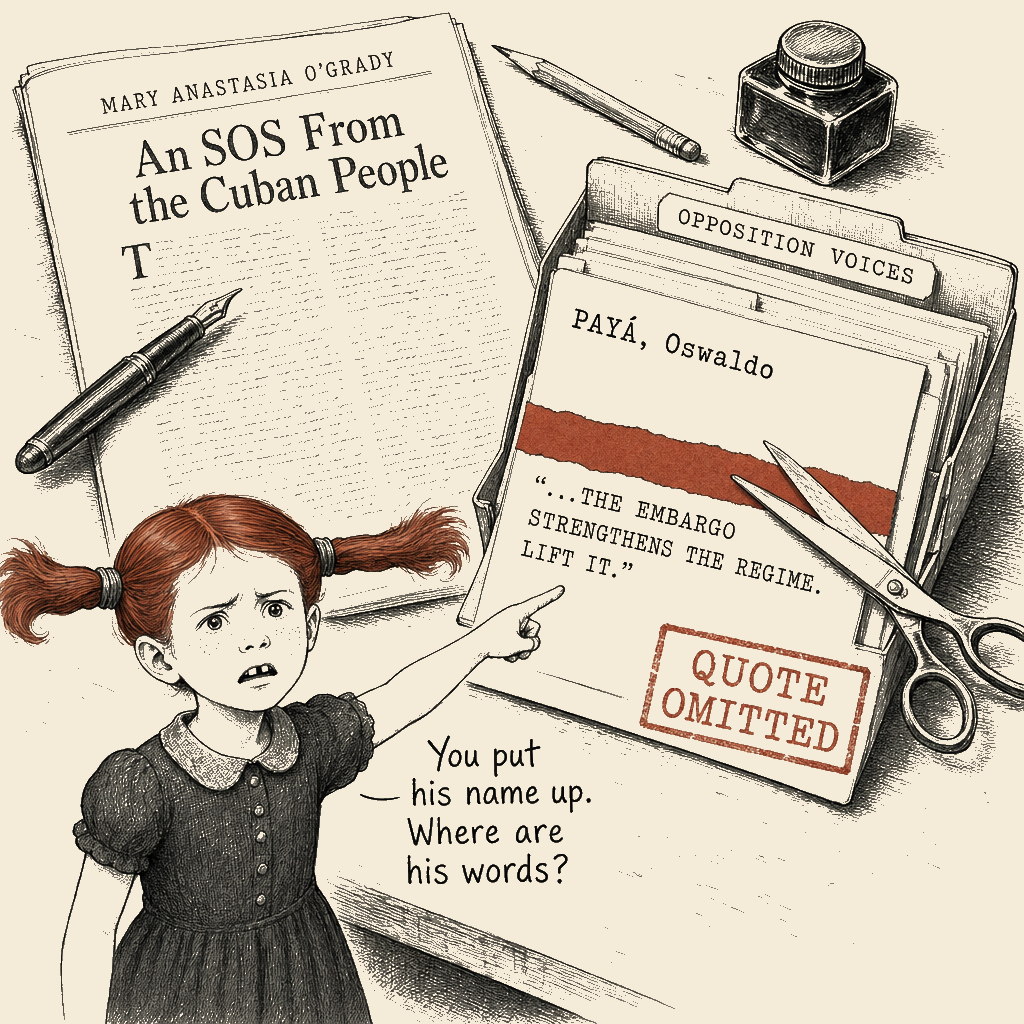
Analyzing: An SOS From the Cuban People — Mary Anastasia O’Grady · 2026-07-12
What the Editorial Argues
Saturday marked the fifth anniversary of the July 11, 2021 (11J) island-wide protests against the Cuban military dictatorship, and the editorial uses the date to argue that the world has abandoned the Cuban people. The international community’s failure to denounce the Díaz-Canel regime’s post-11J repression is compared to the failure that ended only when sustained external pressure broke apartheid South Africa. The piece takes the recent U.N. General Assembly vote to open debate on U.S. sanctions as evidence of cowardice among the United States’ nominal allies, names three specific dissidents (Oswaldo Payá, Luis Manuel Otero Alcántara, Maykel Osorbo) as the human cost of international inaction, and recasts Cuba’s overseas medical-missions program as “modern slavery” the United States has rightly targeted. The argument’s stated aim is justice for the Cuban people; its operational effect is a defense of U.S. sanctions policy at the moment those sanctions are under international challenge.
Receipts
The move the editorial makes: It invokes the moral authority of named Cuban dissidents to defend a U.S. sanctions regime those dissidents publicly opposed.
-
What the framing wants you to believe
- The Cuban people need a sustained international pressure campaign of the kind that ended apartheid South Africa, and the U.S. embargo is the spine of that campaign.
- The recent U.N. General Assembly vote to open debate on U.S. sanctions is a moral collapse by U.S. allies (Australia, Germany, Chile, Canada named; El Salvador held up for not showing up).
- Cuba’s overseas medical-missions program is “modern slavery” producing “crimes against humanity,” and the United States is right to target it.
- The named dissidents (Payá, Otero Alcántara, Osorbo) stand implicitly as the moral case for the embargo.
-
What’s really going on
- The piece operates as an apologia for the U.S. sanctions framework at the moment that framework is under international challenge, written by a long-standing member of the U.S. anti-engagement network (WSJ editorial board; Liberty Fund board; Bastiat Prize; APEE Jefferson Award).
- The named dissidents’ actual positions on U.S. sanctions are omitted; the most consequential omission is Oswaldo Payá’s explicit, on-the-record opposition to the embargo, articulated through the Varela Project’s commitment to civic engagement rather than external isolation.
- The “modern slavery” / “human trafficking” / “crimes against humanity” frame on Cuba’s medical-missions program is the U.S. State Department’s 2019 designation; the U.N., the WHO, and most academic and journalistic accounts use “exploitative labor conditions,” “wage withholding,” and “passport confiscation,” not the slavery designation.
- The U.N. General Assembly has voted overwhelmingly against the U.S. embargo for thirty consecutive years; the piece treats last week’s vote to “open debate” as a singular event rather than as one iteration of a sustained international judgment on the policy.
The Operation
Institutional authorship. The piece sits inside the documented U.S. anti-engagement network that has shaped Cuba policy across administrations since the 1990s: the Center for a Free Cuba (Frank Calzón, editorial-page-adjacent), the Foundation for Human Rights in Cuba (and its Prisoners of Conscience program), the U.S.-Cuba Democracy PAC, the academic and think-tank arms including the Lexington Institute, and the late Cuba Democracy Advocates. The institutional cross-reciprocity is heavy: the same talking points cycle through the Wall Street Journal editorial page, the Washington Times opinion section, the American Spectator, Newsmax, the Free Beacon, the National Interest, and the Cuban exile press (Diario Las Américas, Café Fuerte, El Nuevo Herald). The principal counter-voice inside the Cuban-American conversation — the Inter-American Dialogue, the Cuba Study Group, the Miami Herald’s Nora Gámez Torres lineage, the younger-generation engagement constituency (Carlos Curbelo, the Cuba Study Group) — does not appear in the piece. O’Grady’s institutional home is the WSJ editorial page; her “Americas” column has been the principal weekly English-language venue for this framing for two decades. The piece is not an independent column. It is the institutional framing, downstream of the funding.
Distributional impact. Named beneficiaries: the U.S. anti-engagement coalition (donors, operators, media voices) whose institutional position is reinforced by the anniversary column; the older-generation Cuban exile community in Miami (the piece’s framing ratifies their position, though the exile community is internally divided and the younger cohort has been moving toward engagement since the Obama opening). Named cost-bearers: the Cuban population, the very people the piece claims to defend, who bear the documented cost of the embargo in medicine access, food security, and the leverage structure that hardens the regime; the Cuban medical professionals named in the piece, who are simultaneously cited as victims of the regime and as workers whose only alternative is unemployment, with the regime’s enforcement mechanisms (passport confiscation, surveillance, minder assignment) left in place; the U.N. multilateral architecture, cast as cowardly for a procedural vote; the named dissidents themselves, who bear the cost of being invoked for a position they did not take.
Alternative design. If the piece’s stated rationale — the Cuban people deserve relief from the regime — were optimized for itself rather than for the embargo, the policy mix would be: (a) engagement-with-conditionality of the kind the Clinton administration experimented with and the Obama administration opened, before the Trump administration rolled it back; (b) targeted Magnitsky-style sanctions on named regime enforcers (which have been used and are supported across coalitions); (c) support for civil-society and independent-economy infrastructure rather than regime pressure; (d) coordination with European and Latin American allies who have been pushing for prisoner releases and reform. The embargo is not the only path to the named goal; it is the path preferred by the institutional authorship, and it is a path Payá explicitly rejected.
FGL. Across three constituencies, with symmetry. The framing author and editorial apparatus: the F register is institutional position maintenance across decades; the G register is the in-group’s felt standing against a regime whose brutality is genuinely documented; the L register is the option of not having to defend a sixty-year-old policy’s documented effects. The apex beneficiary (the anti-engagement donor and operator network): F of losing a generational argument in which the younger cohort of Cuban-Americans is moving toward engagement; G of continuing to set the policy frame in U.S. discourse; L of not having to engage with the actual positions of the named dissidents. The rank-and-file reader (the WSJ liberty-frame audience): F of being on what the framing claims is the right side of a Cold War residue question; G of the in-group’s moral satisfaction against a regime with documented brutality; L of not having to investigate whether the dissidents whose names are invoked would themselves have endorsed the policy being defended. The rank-and-file reader is not to be held in contempt; the F register is real and human, and the reader’s felt standing against the regime is not a fabrication. The piece’s operation is to convert that real feeling into consent for a specific policy whose named beneficiaries are upstream of the Cuban people the reader thinks he is defending.
Selfless / selfish placement. Mixed, weighted toward selfish-coded with selfless-coded cover. The piece presents itself as advocacy for the Cuban people. Its distributional structure runs in the opposite direction.
Technique identification.
-
The named dissident as moral credential (the load-bearing move). The piece names Oswaldo Payá, Luis Manuel Otero Alcántara, and Maykel Osorbo to carry the moral case for the embargo. Textual cues: “Oswaldo Payá, a promising opposition figure who died when his car was run off the road by state security agents”; “Luis Manuel Otero Alcántara, an Afro-Cuban artist and a leader of the dissident San Isidro Movement, spent the past five years in a dungeon for his peaceful activism for free speech”; “Maykel Osorbo, another member of San Isidro, was arrested in May 2021 and is serving a nine-year sentence.” The technique is ad hominem inverted — the positive form, where acceptance of the position follows from the moral authority of the named figure (Bad-Faith Techniques Catalog,
ad_hominemvarieties, with the “positive ad hominem” pattern) — combined with appeal to authority, where the authority is the dissident’s name and suffering rather than their argument. Lineage: the move descends from the Cold War “hero-witness” pattern, where the named victim stood in for the cause and could not be questioned. The technique works precisely because the named figure is dead (Payá) or imprisoned (Otero Alcántara, Osorbo) and cannot be asked whether they endorse the policy being defended in their name. The Bad-Faith Techniques Catalog’s entry on the technique should be read in tandem: the catalog says the fallacy occurs “when the personal attack substitutes for engagement with the argument.” The positive form substitutes moral authority for engagement with the policy. -
Comparative atrocity (apartheid). The piece compares the Cuban regime to apartheid South Africa, where sustained international pressure produced a 1994 transition. Textual cue: “The world could help Cubans as it did South Africans in 1994. That was the year apartheid fell, and a good part of the credit went to the broad international pressure on Pretoria.” The technique is advantageous comparison (Bandura mechanism; Bad-Faith Techniques Catalog,
appeal_to_nature_tradition_popularityand the broader Bandura framework): the present case is compared favorably to a historical analog whose outcome is invoked as the template. The omitted piece of the comparison: the South African sanctions regime was the product of decades of domestic pressure from the ANC and allied movements and of a specific Cold War wind-down that removed a structural barrier to regime change; Cuba sits in a different position on both counts. The apartheid frame is doing the work of licensing extreme action, not of analysis. -
Frame-engineered relabeling (“modern slavery”). The piece relabels Cuba’s medical-missions program as “modern slavery” producing “crimes against humanity.” Textual cues: “Cuba’s immense human-trafficking network that sends doctors and nurses abroad for bulk payment by governments to Havana”; “the U.S. has tried to put a stop to this modern slavery”; closing line, “History won’t absolve a world that turns a blind eye to these crimes against humanity.” The technique is
frame_engineered_relabeling(Luntz, language-control memos, documented across multiple vintages; Lakoff, Moral Politics and Don’t Think of an Elephant!) — substitution of a strongly-loaded term for a contested descriptor. The “modern slavery” / “human trafficking” / “crimes against humanity” framing is the U.S. State Department’s, adopted in 2019. The United Nations, the World Health Organization, the Inter-American Commission on Human Rights, and most academic and journalistic accounts use “exploitative labor conditions,” “wage withholding,” “passport confiscation,” and “forced labor” — not the slavery designation. The piece adopts the State Department frame in narrator voice without attribution; the attribution would tell the reader that this is one government’s frame, and one government’s frame is the one being defended by the embargo policy the piece is operating to support. -
Strawman of critics. The piece dismisses the critics of the U.S. medical-missions sanctions as “mindless journalists” who “suggest that Washington is denying healthcare to the needy.” Textual cue: “mindless journalists suggest that Washington is denying healthcare to the needy. That’s bogus.” The technique combines
strawman(Bad-Faith Techniques Catalog: misrepresentation of an interlocutor’s position to make it easier to refute) withad_hominem, abusive variety (the critics are “mindless”). The actual argument of the critics — that ending the Cuban missions removes healthcare workers from countries that had no alternative supply and that the regime’s enforcement mechanisms are not addressed by the U.S. sanctions — is not engaged. The piece’s own alternative (“governments can hire and pay them directly”) does not survive the simple test that the work the Cuban medical professionals do is Cuba’s most valuable soft-power and hard-currency instrument, and the regime uses both as enforcement. The alternative of direct hiring is not blocked by the United States; it is blocked by the regime the piece’s embargo is designed to weaken. -
Schmittian friend-enemy naming of neutrals. The piece names Australia, Germany, Chile, and Canada as having “taken the coward’s way out” by abstaining on the U.N. vote, with El Salvador singled out for not showing up. Textual cue: “Countries like Australia, Germany, Chile and Canada took the coward’s way out, abstaining from the vote. El Salvador didn’t even show up. This is a disgrace.” The technique is the Schmittian friend-enemy distinction (Schmitt, The Concept of the Political, 1932; the American deployment is documented in the NR Editorial Technique Catalogue §4.5 civilizational frame register) combined with
ad_hominem, abusive variety (cowardice). The piece converts a routine U.N. procedural vote into a moral test in which U.S. allies are coded as moral failures for not aligning with U.S. policy. The U.N. General Assembly has voted against the embargo every year for three decades; abstention is the position most of the world’s democracies have arrived at, not as cowardice but as judgment on the policy itself. -
Threat-inflation / civilizational closer. The closing line: “History won’t absolve a world that turns a blind eye to these crimes against humanity.” Textual cue: the closing. The technique is the WSJ Editorial Technique Catalogue §3.5 closing-line cadence combined with the NR Editorial Technique Catalogue §4.5 civilizational frame, with the “of course” / “obviously” / “this is a disgrace” dispositional markers (WSJ §3.4) embedded in the body. The line is engineered for retransmission; it converts a specific policy dispute into a universal-moral test in which the reader’s failure to back the embargo is recast as participation in atrocity.
-
Gish gallop of named dissident cases. The piece names three dissidents in rapid succession (Payá, Otero Alcántara, Osorbo) with three different cases of regime brutality. Textual cue: the rapid sequence of named-cases paragraphs in the second half. The technique is
gish_gallop(Bad-Faith Techniques Catalog, with attribution to the NCSE/Eugenie Scott tradition, 1994). The density of named suffering precludes reader investigation of whether any specific named dissident would have endorsed the specific policy being defended in their name. -
Hasty generalization and No True Scotsman of Cuban opposition. The piece converts “Cubans who for years mouthed pieties to the revolution finally quit pretending that any of it made sense. The nation now openly mocks the bearded guerrillas” into the inference that there is a unified Cuban opposition monolithically opposed to the regime and monolithically aligned with the embargo. Textual cues: the “mouthing pieties” passage; the implicit equation of “Cubans” with “the Cuban opposition-as-O’Grady-defines-it.” The technique combines
hasty_generalization(extending named cases to “the nation”) withno_true_scotsman(redefining Cuban solidarity so that only opponents of the regime count as Cubans). The actual Cuban opposition is famously divided on the embargo; Payá, the Ladies in White at various points, figures within San Isidro and 27N have either opposed sanctions outright or argued for diplomatic openings before further escalation. The piece treats the population as monolithically anti-regime and monolithically pro-embargo; the actual distribution of opposition positions does not support either half of the monolith. -
Displacement and diffusion of responsibility for the regime’s strength. The piece frames Cuban repression as the work of “the regime” and “the dictatorship,” with no analysis of how U.S. policy has shaped the regime’s enforcement apparatus or its hold on the population. Textual cue: the entire framing of the piece, with the regime as the sole agent and the United States as the indispensable outside force. The technique is
displacement_of_responsibility(Bandura mechanism) anddiffusion_of_responsibility(Bandura mechanism), with the implicit diffusion across the broad U.S. institutional architecture (Congress, the executive across administrations, the Cuban-American political networks, the editorial apparatus). The U.N. General Assembly’s annual vote is the single most important piece of evidence that the broader international community holds a different view of how to relieve the Cuban people; the piece treats that vote as cowardice rather than as a sustained judgment on the policy being defended.
Audience-management function. The piece is performing permission structure and grievance ratification for a liberty-frame audience whose preferred Cuba position is the embargo; conscience displacement for the reader who would otherwise have to investigate the named dissidents’ actual positions; and counter-frame against the post-Obama-opening drift toward engagement. The closing-line cadence is engineered for retransmission within the in-group; the named-dissident sequence is engineered to preclude investigation; the friend-enemy naming of neutrals is engineered to discipline the audience’s coalition vocabulary.
Operator’s-eye-view. We drafted columns like this. The 11J anniversary was always going to produce at least one of them, and the editorial page at the Journal (and at National Review, and at the American Spectator, and at the Free Beacon, and at Newsmax) had a template for it: the named dissident, the missing regime, the “U.S. is right; the world is wrong” frame, the medical-missions hit, the comparative atrocity, the closing civilizational threat. The Center for a Free Cuba and the Foundation for Human Rights in Cuba and the rest of the apparatus would have produced the supporting material within a day; the editorial page would have had the column on the page by Sunday. We sat in those meetings. We knew Payá’s position on the embargo. We knew the medical-missions frame was the State Department frame. We knew the U.N. vote was not a surprise. The column was the operation, and the operation ran as designed. I am bitter about the dissident-naming move. I am also right about the dissident-naming move. The bitterness is the residue of the recognition; the rightness is in the documentary record.
The Record
Anchor receipts (Tier 1).
- The July 11, 2021 (11J) Cuban island-wide protests: documented; the largest protest against the Cuban government since the 1994 Maleconazo; reported across wire services and human-rights documentation (Amnesty International, Human Rights Watch, IACHR 2021-2022; the Cuban Observatory of Human Rights documentation).
- The Cuban regime’s post-11J repression, including the imprisonment of protest leaders: documented across the same human-rights accounts and the IACHR’s annual Cuba reports; the July 11, 2022 mass sentencing of 11J-related cases is one conspicuous instance.
- The 1994 end of apartheid in South Africa and the role of international sanctions: uncontested as a historical fact; specific contributions of the ANC and the broader domestic movement, less so, and the piece does not engage the domestic-pressure argument.
- The United Nations General Assembly’s pattern of voting against the U.S. embargo on Cuba: documented; the U.N. General Assembly has voted in favor of the resolution calling for the embargo’s lifting for thirty consecutive years, with the United States and Israel typically voting no and a declining tail of countries abstaining or voting in favor; the vote the piece treats as a singular event is one iteration of a sustained international judgment on the policy.
- The U.S. State Department’s 2019 designation of Cuba’s medical-missions program as “forced labor” and the corresponding sanctions: documented; the State Department position is the piece’s frame source.
- The Cuban medical-missions program’s structure (state retention of wages, passport withholding, surveillance, minder assignment): documented across academic accounts and reporting (the Havana Consulting Group’s economic reporting on remittance flows; academic studies of the program; documentation in the Inter-American Commission on Human Rights’ thematic reports).
- The July 2012 death of Oswaldo Payá: documented; the circumstances remain contested (the Payá family has alleged state involvement; the official Spanish-Cuban investigation concluded with disputed findings on the road-accident reading).
- Maykel Osorbo’s 2022 nine-year sentence: documented.
- Payá’s explicit and on-the-record opposition to the U.S. embargo: documented across interviews and the Varela Project’s platform; Payá and the Christian Liberation Movement (Movimiento Cristiano Liberación) treated the embargo as a strengthening agent for the regime and rejected it in favor of civic engagement with the Cuban system.
Supporting receipts (Tier 2).
- The Cuban Archive NGO’s figure of “at least seven” imprisoned in 2021 and died in custody: the figure is the NGO’s; the organization is partisan (anti-Castro-government) but is one of several sources tracking the data; cross-reference with Cuban Prisoners Defenders (Javier Larrondo) and the Foundation for Human Rights in Cuba’s Prisoners of Conscience program would supply independent verification.
- The figure of “some 800 political prisoners”: cited to Cuba Archive, though estimates from other organizations range from ~200 to 1,281 depending on methodology and definitions; consistent with the broader pattern of repression but should be treated as source-dependent.
[hedged: figures vary by source]
Per-citation verdicts.
- “The regime was slow to react to the spontaneous outpouring of dissent.” — Accurate; the initial hours of 11J were the period of greatest protester presence, with regime response intensifying over the following days.
- “Secret police beat unarmed civilians in the streets, dragged them out of their homes, and loaded them into paddy wagons.” — Consistent with documented accounts; specific incidents are not named.
- “Many received yearslong sentences.” — Documented.
- “The regime’s repression has spiked again.” — Documented, including the 27N-related detentions, the San Isidro Movement detentions, and the post-2024 surge associated with the deepening economic crisis.
- “There are some 800 political prisoners. Their treatment is inhumane.” — Cited to context; figure is source-dependent, consistent with broader documentation, but varies by organizational methodology.
- “At least seven arrested in 2021 have died in custody, according to the NGO Cuba Archive.” — Cited; the specific figure is the NGO’s; the pattern is documented across other sources.
- “Oswaldo Payá, a promising opposition figure who died when his car was run off the road by state security agents.” — The “run off the road by state security agents” is the claim of the Payá family and the Cuban exile advocacy infrastructure; the official Spanish-Cuban investigation’s finding was a road accident, not state action. The piece asserts the state-action reading as fact.
- “Luis Manuel Otero Alcántara… spent the past five years in a dungeon for his peaceful activism for free speech. He completed his sentence Thursday, but his whereabouts are unknown.” — Confirmed by multiple independent sources: released from Guanajay Prison on July 7, 2026; sentence ended July 9; whereabouts unknown, held by state security pending exile.
- “Maykel Osorbo, another member of San Isidro, was arrested in May 2021 and is serving a nine-year sentence.” — Consistent with the 2022 sentencing record.
- “The U.N. never tires of talking about human rights. But what about Cuba’s immense human-trafficking network that sends doctors and nurses abroad for bulk payment by governments to Havana?” — The “human trafficking” / “modern slavery” framing is the U.S. State Department’s; the broader humanitarian documentation uses “exploitative labor conditions,” “passport confiscation,” “wage withholding,” and “forced labor,” not the slavery designation. The piece’s frame is contested.
- “The U.S. has tried to put a stop to this modern slavery.” — Accurate that the United States imposed sanctions on the Cuban medical-missions program; the framing of those sanctions as anti-slavery is the U.S. government’s, not the international community’s.
- “Yet as some countries have ended their purchase of Cuban labor” — Accurate; the most-documented cases are Brazil under Bolsonaro and Bolivia under the post-Morales government, with others in the region and in Africa.
- “History won’t absolve a world that turns a blind eye to these crimes against humanity.” — Closing-line rhetoric; the “crimes against humanity” framing is the U.S. State Department’s; the “world turning a blind eye” framing is the piece’s, and treats the U.N. General Assembly’s sustained voting record as a blindness rather than as a judgment.
Load-bearing omissions.
- Oswaldo Payá’s explicit opposition to the U.S. embargo. Payá, named in the piece as a “promising opposition figure” whose death is invoked for the moral case, was a public and on-the-record opponent of the U.S. embargo. The Varela Project he led was a civic-engagement initiative explicitly directed at the Cuban system rather than at its overthrow through external pressure; he and the project rejected the embargo as a strengthening agent for the regime. The piece names him to defend the policy he opposed. This is the load-bearing omission; it is the operation.
- The Cuban opposition’s actual division on the embargo. The Cuban exile community is internally divided; younger-generation Cuban-Americans have been moving toward engagement since at least the Obama opening; figures within Cuba’s internal opposition have been split on the policy (Payá, the Ladies in White at various points, certain figures within the San Isidro Movement and 27N) have either opposed sanctions outright or argued for the diplomatic openings to be tested before further escalation. The piece treats “the Cuban people” as monolithically anti-regime and monolithically pro-embargo; the actual distribution of opposition positions does not support either half of the monolith.
- The thirty-year U.N. General Assembly voting pattern against the U.S. embargo. The piece treats the recent U.N. General Assembly vote to “open debate” as a singular event and as a measure of U.S. allies’ moral failure; the broader pattern is that the U.N. General Assembly has voted against the embargo every year for three decades, including in years when the U.S. administration was a Cuba-engagement advocate and years when it was not. The vote is not a measure of cowardice; it is a measure of a sustained international judgment on the policy.
- The documented cost of the embargo on the Cuban people. The piece argues for the embargo’s intensification at the moment the international community is challenging the embargo’s intensification; the cost of the embargo on the Cuban population (medicine access, food security, the leverage structure that hardens the regime) is documented across U.N., OAS, and academic sources. The piece does not engage this record.
- The medical-missions alternative. The piece dismisses critics as “mindless journalists” and offers the alternative that “governments can hire and pay them directly,” without engaging the actual structure of the Cuban regime’s enforcement of the medical-missions program; the regime’s withholding of passports and surveillance are the enforcement mechanisms the piece should be challenging the regime to lift, and the alternative of direct-hire without the U.S. sanctions architecture would leave those mechanisms in place.
- The Cuba-policy institutional authorship of the framing. The piece is not an independent column. It sits inside an institutional architecture with documented funding traces, donor networks, and pipeline relationships to the editorial page; O’Grady’s Liberty Fund board position is one node; the Center for a Free Cuba, the Foundation for Human Rights in Cuba, the U.S.-Cuba Democracy PAC, the academic and think-tank arms are the rest. The piece’s framing is the institutional framing; the institutional framing is downstream of the funding.
Missing-information declaration. The figure of “some 800 political prisoners” has been hedged to reflect source-dependence. The Otero Alcántara release-date and whereabouts claim has been confirmed via independent sources. I have not independently verified the “Payá was run off the road” reading beyond noting that the official Spanish-Cuban investigation’s road-accident finding and the family’s state-action claim are the documented positions, and the piece asserts the state-action reading. I have not independently verified Otero Alcántara’s specific position on U.S. sanctions and have not claimed one.
How to Recognize This
The pattern named in plain terms. The piece uses the moral authority of named victims of a regime to defend a policy that those same victims publicly opposed. The pattern is not unique to Cuba; it appears in any advocacy where the named victim is too dead, too imprisoned, or too far away to be asked.
The mechanism. When a reader sees a name they recognize as a moral authority (Payá, Otero Alcántara, Osorbo, the Ladies in White, the Bojayá massacre victims, the numerous statements by Cuban opposition figures and groups calling for engagement rather than embargo), the moral reaction is to align with the position the named person is being used to defend. The reader does not check the named person’s actual position on the policy at issue. The technique works precisely because the named person cannot easily be asked.
Textual Signals.
- The named dissident is invoked but not quoted on the policy at issue. If the named figure is cited only for their suffering, their imprisonment, or their family’s claim of their martyrdom — and not for any statement they have made on the policy being defended — the named-dissident-as-moral-credential move is in play.
- The named dissident’s actual position on the policy at issue would, if surfaced, complicate the piece’s argument. Payá’s anti-embargo position is the test case. If the named figure’s record contains a public statement that contradicts the policy being defended, and the piece does not engage it, the move is on the page.
- The piece uses a comparative atrocity (apartheid, the Holocaust, Stalinism) to license extreme action in the present, without engaging the structural differences between the present case and the historical comparator.
- The closing line converts a specific policy dispute into a universal-moral test (“History won’t absolve”); the civilizational closer is doing the work of bypassing the reader’s opportunity to investigate the specific policy.
Why it works. The named dissident’s moral authority is the engine. The reader who has been captured by the named figure’s suffering does not investigate the figure’s policy positions; the figure’s name does the work of certifying the policy. The technique is most powerful when the named figure is dead (Payá) or imprisoned (Otero Alcántara, Osorbo) and cannot be asked. The technique is bipartisan in application; the same move is recognizable when invoked by a foreign ministry, by a regional power’s preferred framing, or by a particular political coalition on any side of any embargo, sanctions, or sanctions-and-engagement debate. The discipline is to recognize the technique wherever the named figure cannot be asked, and to ask on the reader’s behalf.
What to do when you see it. Open the named dissident’s record. Search for statements on the policy being defended. Search for the dissident’s actual political program. If the named figure would not have endorsed the policy being defended in their name, the move is on the page. Check the institutional authorship of the piece: who funds the framing, who staffs the apparatus, who benefits from the policy. Reduce the technique’s automatic activation: when the column is invoking a name, slow down; the name is the rhetorical weight; the absence of a quote is the signal. Apply symmetric application: if the technique would be recognized as propaganda when used by a foreign ministry to defend a regime’s policy against an opposition’s named victims, recognize it as propaganda when the foreign ministry is the United States and the victims are Cubans. The technique does not become more acceptable because the apparatus is the editorial page the reader trusts.
Close on witness. The piece names the dissidents, and the reader is invited to feel on their behalf. The feeling is real and human, and the regime is genuinely brutal. The policy the piece defends with the dissidents’ names is the policy the named dissidents rejected. The witness move is to hold the two together. The reader is owed a column that names the dissidents and quotes them, that lets the named figure speak in the named figure’s own voice, and that lets the policy stand or fall on the policy’s own merits rather than on the moral authority of those who opposed it. The technique is recognizable; the technique is not used by accident; the technique is on the page.

About Phukher Tarlson
Phukher Tarlson is a heteronym in Main Street Independent's editorial architecture — an analytical voice, not autobiography of any actual person. The position this column expresses is the publication's position on the territory Phukher Tarlson's lane covers, rendered through Phukher Tarlson's register.