Analyzing: Schumer’s Tragedy—and Ours — William McGurn · 2026-07-13
What the Editorial Argues
McGurn argues that Schumer’s historic ascent to the highest Jewish elected office in American history has been eclipsed by a surging tide of anti-Israel and antisemitic sentiment within the Democratic Party. He contends that while Republican antisemitic voices remain marginal — podcasters, gadflys, primary casualties dispatched by their own voters — the Democratic Party’s anti-Israel faction is mainstream and ascendant, chasing Jewish politicians out of public spaces, defeating pro-Israel incumbents, and pressuring Jewish Democrats into publicly recanting their support for Israel. Schumer has failed to lead his party back to its historically pro-Israel posture at the moment it matters most. The closing metaphor — drawn from a 1979 horror film — frames the threat as existential and already inside the house.
Receipts
What the framing wants you to believe:
- The Democratic Party has become structurally hostile to Jews and to Israel, and this hostility is mainstream, ascendant, and accelerating.
- Republican antisemitism exists but is marginal and self-correcting; Democratic antisemitism is systemic and growing — the “cold vs. fever” asymmetry, sourced from a Republican former White House press secretary, is presented as the analytical spine.
- Criticism of Israeli wartime conduct in Gaza — specifically the genocide designation — sits outside the bounds of legitimate political discourse; Democrats who adopt it have capitulated to mob pressure.
- Schumer has betrayed his historic role by failing to confront his party’s anti-Israel turn.
What’s really going on:
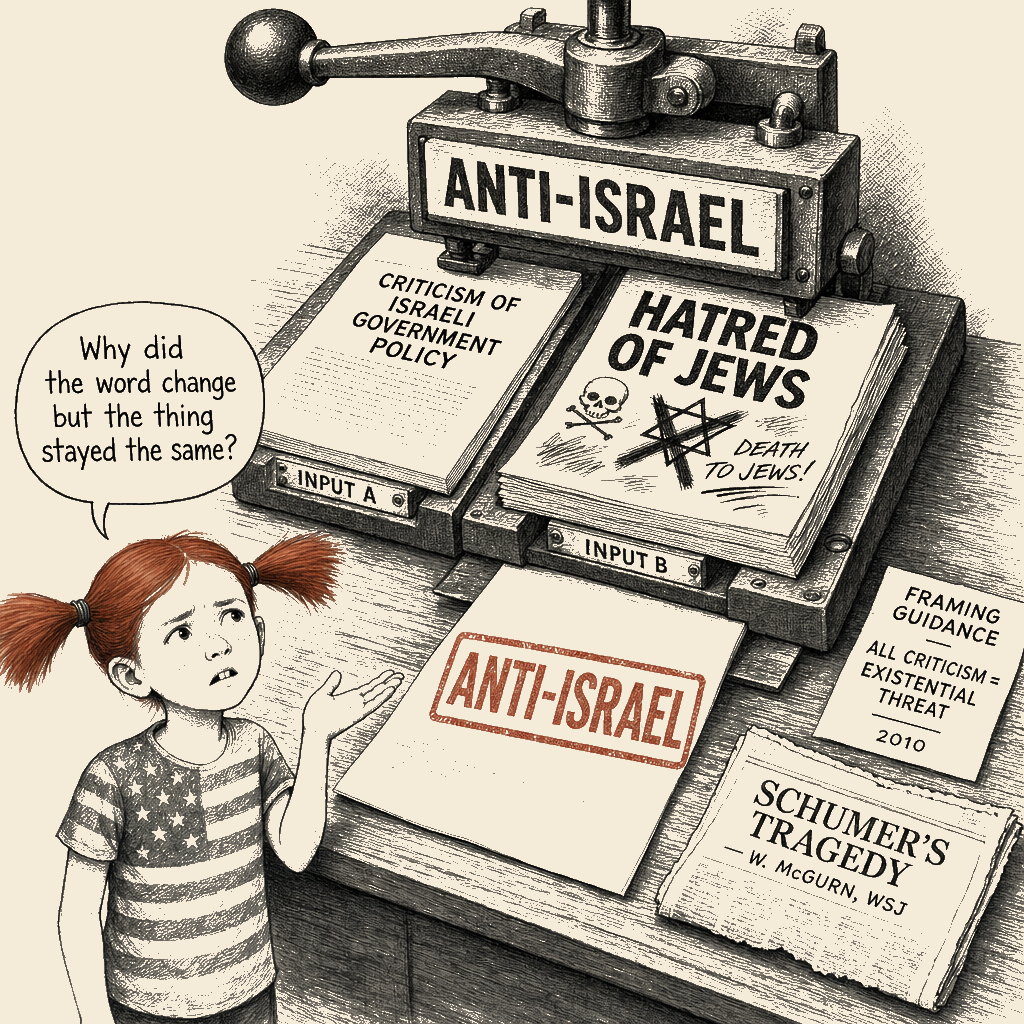
- The piece’s load-bearing move is a definitional sleight: “anti-Israel” is deployed throughout as functionally synonymous with antisemitic, without ever arguing for the equivalence. The equivalence is the argument; it is presented as background. Without it, the piece collapses from “Democrats are antisemitic” into “some Democrats disagree with the Israeli government’s wartime conduct” — a normal feature of democratic politics, not a pathology. The ICJ proceedings, the human-rights organization findings, and the active legal debate on the genocide question are the substance the piece refuses to engage; their omission is what makes the conflation sustainable.
- The sole analytical authority for the party-asymmetry claim is Ari Fleischer, a Republican former White House press secretary whose institutional interest in the conclusion — Republicans are better on antisemitism — is never disclosed. A partisan witness testifying to his own party’s relative superiority on a charged issue is not neutral testimony; Fleischer’s assessment would be indistinguishable from the conclusion his coalition wants the reader to reach. (Bad-Faith Techniques Catalog:
ad_homineminverted — positive ad-hominem, the argument is accepted because of who makes it, not because of evidence he supplies.)
The Operation
Cui Bono
Institutional authorship. McGurn writes as a member of the WSJ editorial board — the board’s Israel position delivered through its signed “Main Street” column, which carries the board’s institutional voice with the added credibility of a named author who happens to be a former Republican presidential speechwriter and former National Review Washington bureau chief. The byline provides deniability the unsigned board voice lacks; the position is the board’s. This is a recurring board technique: the signed column advances an institutional position while the named author’s personal history supplies the emotional register that the unsigned “we” cannot. We operators who built these placement chains recognized the move instantly — the byline is the shield, the board’s position is the sword.
Distributional impact.
- Beneficiaries: The Israeli government under Netanyahu, whose wartime conduct is shielded from political criticism by the reframing of that criticism as ethnic hatred; the Republican coalition, for whom Democrats-are-antisemitic functions as a mobilization frame for Jewish-voter realignment and evangelical-base confirmation; the WSJ board’s Israel-policy position, advanced with the emotional register a signed column provides.
- Cost-bearers: Jewish Americans who hold complex, internally diverse views on Israeli policy — the piece erases Jewish Voice for Peace, IfNotNow, J Street, and the institutional Jewish left by treating anti-Israel positions as intrusions from outside the Jewish community, even as it names Jewish politicians (Lander, Wiener) who hold those positions; Democratic voters and politicians who criticize Israeli government conduct and are reframed as antisemitic; the discourse about actual antisemitism, which is diluted when government-policy criticism and ethnic hatred are collapsed into a single category.
Alternative design. If this piece were optimized for its stated rationale — concern about rising antisemitism — it would distinguish between hatred of Jews and disagreement with the Israeli government’s wartime conduct. It would engage the ICJ proceedings and the human-rights documentation rather than treating the genocide designation as self-evidently absurd. It would note that the Democratic Party’s official position has maintained military aid to Israel. It would examine whether the grassroots sentiment the piece describes represents structural party hostility or the normal range of democratic disagreement amplified by social-media selection effects. It would apply the same forensic granularity to Republican antisemitic incidents that it applies to Democratic ones.
FGL applied symmetrically:
- McGurn/board: Fear that the Israel-policy consensus is eroding (real); institutional interest in maintaining the Republican-as-friend-of-Israel frame (material); Laziness in engaging the substance of Gaza criticism (the piece never does).
- Republican donor/activist class: Greed for the political advantage of the antisemitism frame; Fear that Jewish-voter realignment toward Democrats would close a coalition-expansion opportunity.
- Rank-and-file reader: Fear of antisemitism (real and human — the reader’s fear is legitimate); Confirmation that the Democratic Party is the problem (the piece supplies this); Laziness in distinguishing government criticism from ethnic hatred (the piece makes this unnecessary by never drawing the distinction).
Selflessness/selfishness placement: Selfish. The piece’s structural function is partisan: it converts a serious question (antisemitism) into a weapon against one party while insulating the other. The mourning register is the mask; the prosecution brief is the content.
Technique Identification
1. Conflation of government criticism with ethnic hatred — the piece’s load-bearing move.
Textual cue: “Anti-Israel” is deployed throughout as functionally interchangeable with antisemitic, without the piece ever arguing for the equivalence. The Goldman primary loss is framed as anti-Israel (“He doesn’t hate Israel” presented as the translation of being called a “genocide enabler”), collapsing the distinction between supporting a government’s military conduct and belonging to an ethnic or religious group. The Wiener sequence is framed as capitulation to a mob rather than as a politician arriving at a position through democratic pressure — which is how democratic politics works.
Catalogue cross-reference: Bad-Faith Techniques Catalog: equivocation (cf. BFT equivocation — the term shifts meaning between hatred of Jews and criticism of a government’s military policy; the equivocation lets the stronger case carry the weaker). WSJ Editorial Technique Catalogue §4.1, frame_engineered_relabeling — the substitution of “anti-Israel” for “critical of Israeli government policy” carries different connotations and shifts the cognitive frame.
Lineage: The conflation is a documented message-discipline product, not an organic development. The 2010 Israel Project talking-points memo, obtained and published, instructed pro-Israel communicators to frame all criticism as threatening Israel’s existential security — the structural template for treating government-policy disagreement as ethnic threat. We operators who built versions of this frame knew exactly what the substitution accomplished: it made the critic defend themselves against a charge (hatred) rather than engage the substance (policy).
2. Asymmetric minimization — Republican antisemitism compressed; Democratic antisemitism forensically detailed.
Textual cue: “While the right has its share of anti-Israel voices, they tend to be outside the GOP” — this sentence does extraordinary structural work in a single clause. Massie was “unseated in a May primary,” which is actually evidence that Republican voters rejected an antisemitic candidate, but the piece barely registers this as a corrective. The Fleischer “cold vs. fever” quote is presented as the analytical framework without challenge.
Catalogue cross-reference: WSJ Editorial Technique Catalogue §4.9, the “blue state failure” analogue applied to party-as-failure, with asymmetric coverage substituting for symmetric analysis. Bad-Faith Techniques Catalog: selective_attention — the piece attends to Democratic anti-Israel incidents with forensic granularity (who said what, at which event, under what pressure) while compressing Republican antisemitism into a single dismissive clause. The asymmetry of detail produces the asymmetry of conclusion.
3. Identity-as-credibility frame — the Schumer-as-tragedy architecture.
Textual cue: The headline and opening: “Schumer’s Tragedy—and Ours.” The entire piece is structured around Schumer’s Jewish identity as the organizing principle. His tragedy is that his party turned against his people. The piece opens by establishing his Jewishness as his defining political feature, then narrates his party’s departure from it.
Catalogue cross-reference: WSJ Editorial Technique Catalogue §4.18, the “as a [identity]” credibility move — Schumer’s Jewishness carries the argument’s emotional weight, framing intra-Jewish and intra-Democratic disagreement about Israeli policy as betrayal rather than as ordinary contestation within a diverse coalition.
4. Threat-inflation closer — the horror-movie metaphor.
Textual cue: The closing paragraph’s reference to “When a Stranger Calls” — “The calls are coming from inside the house” — inflates the policy debate into an existential-threat narrative. The metaphor does not describe a specific harm or cite a specific finding; it produces a feeling of imminent danger through cultural association.
Catalogue cross-reference: WSJ Editorial Technique Catalogue §4.13, the threat-inflation closer. The closing-line cadence (§3.5) is engineered for retransmission — the horror-movie reference is memorable, shareable, and requires no evidence.
5. Manufactured certainty on a contested legal question.
Textual cue: The genocide designation is treated as self-evidently absurd — Lander and Wiener are framed as capitulating to mob pressure when they use the term. The piece never engages the ICJ proceedings in South Africa v. Israel, the findings by Human Rights Watch, Amnesty International, and B’Tselem, or the legal scholarship on the genocide question. The treatment is not “this is a contested legal question” but “this is obviously wrong and anyone who says it has been bullied.”
Catalogue cross-reference: Bad-Faith Techniques Catalog: manufactured_controversy in reverse — manufactured certainty. The piece treats a legally and empirically contested question as settled, suppressing the documented proceedings that constitute the actual state of the debate. The Oreskes-and-Conway pattern inverted: instead of manufacturing doubt where consensus exists, the piece manufactures certainty where genuine contestation exists.
Audience-management function: Identity confirmation (the pro-Israel reader’s position is validated as morally correct) and grievance ratification (antisemitism is real and the Democrats own it). The piece also functions as a permission structure for Jewish readers considering departure from the Democratic coalition — the horror-movie closer makes departure feel self-protective rather than partisan.
The Record
Receipts
Anchor receipts:
- Schumer became the first Jewish Senate majority leader in 2021; Democrats lost their majority in 2024. (Tier 1 — public record.)
- Massie lost his May 2026 primary. (Tier 1 — public record.) The piece correctly reports this but misframes its significance: a Republican electorate removed an antisemitic candidate, which is the correction working.
- Goldman lost the Democratic primary to Lander. (Tier 1 — public record.)
- Wiener was confronted at the Trans March and subsequently released a statement characterizing Israel’s conduct as genocide. (Tier 1 — public record, per the piece’s own account and contemporaneous reporting.)
- The AP poll: 44% of American Jews hold a favorable opinion of Mamdani; 39% view Netanyahu favorably. (Tier 1 — wire service poll, AP-NORC Center for Public Affairs Research, corroborated by multiple independent outlets including the Forward, the NY Daily News, and Israel Hayom.) The poll is real; the piece uses it to imply Jewish Americans are being led astray rather than to engage why Jewish opinion might be shifting.
Supporting receipts:
- Fleischer’s “cold vs. fever” quote, attributed to a Politico interview. (Tier 3 — partisan commentary from a Republican operative whose institutional interest in the conclusion is undisclosed by the piece. The original Politico interview has not been independently verified within this analysis — see Per-Citation Verdicts below for reader-facing caution.)
- The “When a Stranger Calls” reference is the 1979 film. (Tier 1 — cultural reference, accurately cited.)
Load-Bearing Omissions
-
The substance of the genocide question. The ICJ has issued provisional measures in South Africa v. Israel, beginning with the January 2024 order and followed by additional measures. Multiple international human-rights organizations have issued findings on the conduct in Gaza. The legal question of whether the conduct meets the Genocide Convention definition is actively litigated. The piece treats the genocide designation as self-evidently absurd without engaging any of this. This is the omission that makes the conflation frame sustainable — if the reader were shown the substance, the piece’s equation of “genocide” with “anti-Israel extremism” would require argument rather than assumption.
-
Jewish institutional diversity on Israel. Jewish Voice for Peace, IfNotNow, J Street, and the Jewish Electorate Institute represent Jewish Americans who criticize Israeli government policy. The piece treats anti-Israel positions as external to the Jewish community while naming Jewish politicians (Lander, Wiener) who hold them. The implication is that these Jews are dupes or captives rather than participants in an internal Jewish debate that has existed since before the state of Israel was founded.
-
The Democratic Party’s actual policy position. The party’s congressional leadership maintained military aid to Israel throughout the Gaza conflict. Schumer voted for Israel aid packages. The official party apparatus has not shifted to match the grassroots sentiment the piece describes. The gap between institutional position and base sentiment is a normal democratic phenomenon; the piece treats it as evidence of structural betrayal.
-
Documented far-right antisemitic violence and mobilization. The piece mentions only Massie and Owens. It does not mention the Tree of Life shooting, the Charlottesville march, or the documented surge in far-right antisemitic incidents. By limiting Republican antisemitism to “marginal” voices while cataloguing Democratic anti-Israel incidents at granular specificity, the piece constructs an asymmetry the full record does not support at equal resolution.
-
The author’s own institutional position. McGurn is a former Bush chief speechwriter and former National Review Washington bureau chief — career positions within the Republican-apparatus and conservative-movement institutions that benefit from the Democrats-are-antisemitic frame. The piece does not disclose this as a relevant interest.
Per-Citation Verdicts
-
Fleischer’s “cold vs. fever” (attributed to Politico): Accurately cited as Fleischer’s stated position. But Fleischer is a Republican partisan whose institutional interest in the conclusion — Republicans are better on antisemitism — is the piece’s undisclosed variable. The quote functions as the piece’s analytical spine, and the spine is a party operative’s self-serving assessment presented as neutral observation. Reader caution: the original Politico interview has not been independently retrieved for this analysis; the quote is cited at second hand through this WSJ piece. The original source may contain additional context, qualification, or surrounding discussion that the WSJ excerpt does not reproduce. Treat the quote as Fleischer’s stated position, not as independently verified neutral testimony. [Selectively deployed — the piece presents Fleischer as an authority rather than as an interested party.]
-
The AP poll on Jewish opinion of Mamdani and Netanyahu: Accurately cited. The AP-NORC Center for Public Affairs Research poll figures (44% Mamdani favorable, 39% Netanyahu favorable) are corroborated by multiple independent outlets. The piece uses the poll to imply Jewish Americans are making a mistake rather than to engage why their views may be shifting. [Accurate citation, loaded deployment.]
-
Massie’s concession statement: Accurately quoted. The significance is inverted — Massie’s defeat by his own party’s voters is evidence the system corrected, and the piece treats it as corroborating evidence of the problem. [Accurate quote, misframed significance.]
Missing-Information Declaration
- The ICJ proceedings on South Africa v. Israel are a matter of public record; provisional measures were ordered beginning January 2024 with subsequent orders. The general existence and nature of the proceedings is well-established.
- The specific details of the Wiener confrontation and the Goldman primary dynamics are drawn from the piece’s own account; independent verification of framing accuracy is limited.
- The 2010 Israel Project talking-points memo is documented through multiple reporting outlets that obtained and excerpted the document; the approximate date range (2009–2011) and general content (framing guidance in existential-security terms) are corroborated. The precise year “2010” and the exact scope of the memo’s prescriptions (whether “all criticism” or specific policy domains) cannot be confirmed without access to the original document.
- The Fleischer Politico interview is cited at second hand through this piece; the original source has not been independently verified within this analysis. Readers should be aware that the excerpt may selectively represent Fleischer’s full remarks.
How to Recognize This
This is the conflation frame — the structural technique of merging two distinct phenomena (government criticism and ethnic hatred) into a single category, then treating the merged category as self-evidently evil so that anyone who criticizes the government is automatically positioned as an enemy of the people.
The mechanism. The reader’s genuine concern about antisemitism — a real and serious phenomenon — is activated and then directed at a target (the Democratic Party) through a definitional move the reader is never invited to examine. The piece never argues that criticism of Israeli government policy is antisemitic; it assumes it, structurally, by using “anti-Israel” and “antisemitic” as interchangeable terms. The reader who accepts the interchangeability has already accepted the conclusion. The reader who questions it is positioned as insufficiently concerned about hatred — the piece’s emotional architecture makes questioning the frame feel like indifference to the suffering it describes.
Textual signals to watch for:
- The unexamined equivalence. A piece treats two distinct phenomena as synonyms without ever arguing for the equivalence. The equivalence is the argument; it is presented as atmospheric background rather than as a claim requiring defense.
- Asymmetric granularity. One side’s incidents are described with forensic specificity — who said what, at which event, under what pressure; the other side’s incidents are compressed into a single dismissive clause. The asymmetry of detail produces the asymmetry of conclusion before the reader encounters a single fact.
- The partisan authority presented as neutral. A named figure from one coalition is quoted as if their assessment were an objective finding rather than a partisan analysis with material interest in the conclusion. Check the cited authority’s institutional position and ask whether their conclusion benefits their coalition.
- The existential-threat closer. The argument escalates from specific incidents to a feeling of imminent danger in the final paragraph, using a cultural reference or metaphor that produces emotional closure without evidentiary closure. The reader walks away with a feeling, not a finding.
Why it works. Antisemitism is real. The reader’s concern about it is legitimate. The piece earns the reader’s trust by naming a genuine threat, then spends that trust on a partisan conclusion through a definitional sleight-of-hand the reader is not invited to examine. The emotional register — mourning, concern, lament — disarms the critical apparatus. The reader who would scrutinize a partisan argument does not scrutinize one that presents itself as grief.
What to do when you see it.
- Separate the two phenomena. Ask: is this piece about hatred of Jews, or about disagreement with the Israeli government? If the piece treats them as one, the piece is doing definitional work, not analytical work.
- Check the cited authorities. Who benefits from the conclusion? Is the analytical spine a partisan actor whose interest aligns with the conclusion?
- Look for the omission. What is the substance of the criticism the piece refuses to engage? If the piece tells you the criticism is wrong without ever telling you what the criticism says, the piece is arguing from the frame, not from the evidence.
- Apply the symmetry test. If the same incidents occurred in the other party, would the piece treat them with the same granularity and reach the same conclusion? If not, the asymmetry is the operation.
The reader carries this forward. The distinction between criticizing a government and hating a people is not a technicality — it is the line between democratic discourse and its suppression. Every piece that erases that line makes the next piece easier to erase it. Recognition is not a one-time event; it is a discipline the reader maintains on each encounter, the way a spell-checker maintains language or a smoke detector maintains the boundary between warmth and fire. The reader who can draw the line when the frame first appears does not need to be told after the fact that the operation ran.

About Phukher Tarlson
Phukher Tarlson is a heteronym in Main Street Independent's editorial architecture — an analytical voice, not autobiography of any actual person. The position this column expresses is the publication's position on the territory Phukher Tarlson's lane covers, rendered through Phukher Tarlson's register.