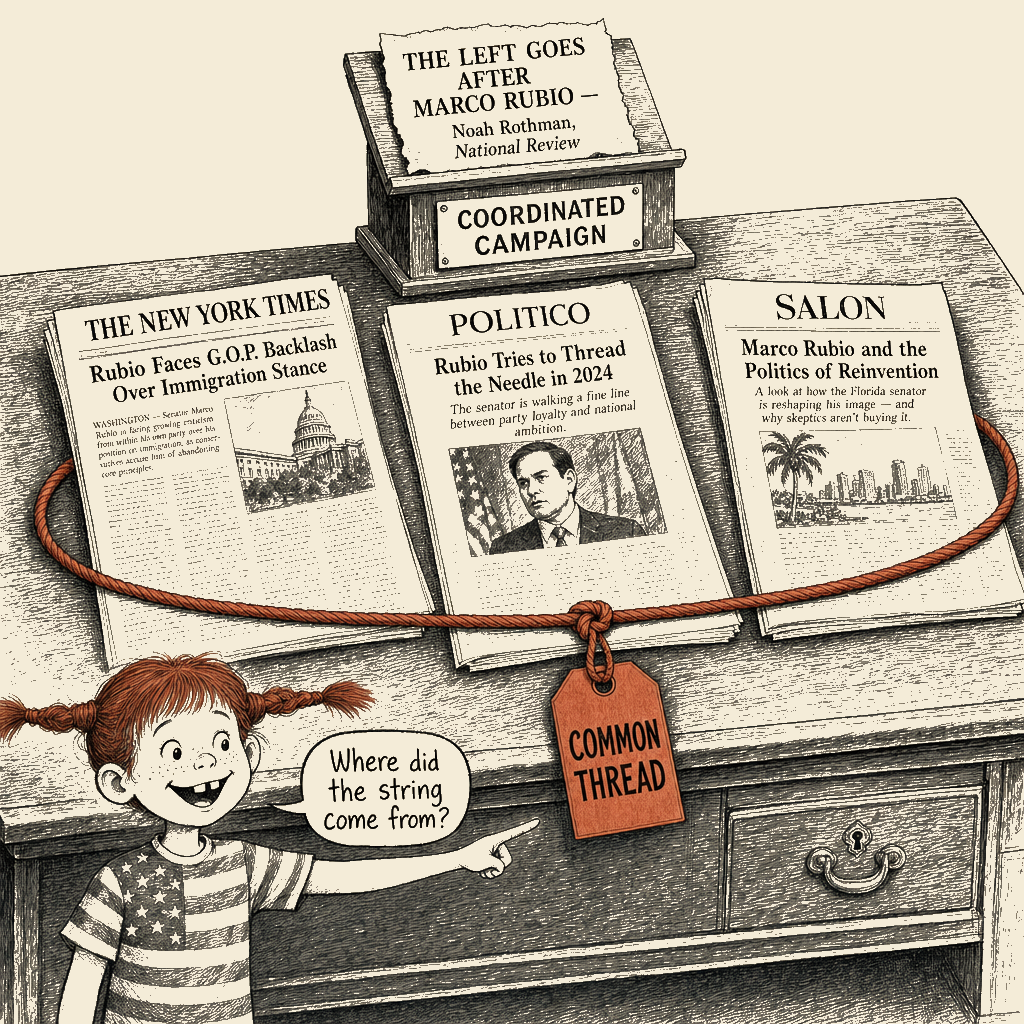
Analyzing: The Left Goes After Marco Rubio — Noah Rothman · 2026-07-13
What the Editorial Argues
Noah Rothman’s column asserts that a sudden, coordinated effort is afoot: the political left, in its many manifestations, is trying to define Secretary of State Marco Rubio in negative terms before he can define himself. According to Rothman, three recent pieces—a New York Times analysis of Rubio’s extraordinary role in Venezuela, a Politico article on his invocation of 1990s hip-hop, and a Salon commentary on his Europe anti-left push—are not independent acts of journalism or opinion but evidence of a single “common thread.” That thread, he writes, is Rubio’s status as “the foremost threat to the socialist project in America.” The editorial weaves these disparate items into a narrative of left-wing panic, laced with Cold War nostalgia and hypocritical whataboutism, and closes by framing Rubio as a victim whose very attackers prove his conservative mettle.
Receipts
What the framing wants you to believe:
- A monolithic “left,” stretching from the Democratic Socialists of America to the New York Times and Salon, is maliciously manufacturing spurious attacks to kneecap Marco Rubio before the 2028 cycle.
- Each separate article is not a distinct critical act but a component of a coordinated campaign—and its existence is itself proof that Rubio is the candidate the left fears most.
- The substance of the criticisms (colonial-style executive authority, cultural appropriation, policing left-wing violence abroad) can be dismissed wholesale because they come from hypocritical communists or their fellow travelers.
What’s really going on:
- The piece is a classic political inoculation. It aggregates unrelated, independently generated pieces of reporting and commentary into a phantom “left-wing smear campaign,” thereby preemptively insulating Rubio from scrutiny and converting any opposition into a credential. The actual beneficiary is Rubio’s political brand, which is positioned as the conservative champion whose power is confirmed by the very existence of left-of-center critique.
- The load-bearing omission is any evidence of coordination among the cited outlets. Rothman’s case rests on his own pattern-recognition, not on leaked emails, shared talking points, or even a common donor. The “campaign” is a story woven by the writer, not a fact he discovered.
The Operation
Cui bono.
Institutional authorship. Noah Rothman is a senior writer at National Review and a principal voice in the post-2016 populist-conservative register. NR’s op-ed pages, particularly its online section, reward exactly this formula: spot a rising Republican figure, gather scattered criticism, reframe it as an existential threat from a unified “left,” and deliver a permission-giving narrative to the conservative reader.
Distributional impact. The piece funnels attention and loyalty toward Rubio while training its audience to see any future critical reporting on him as one more installment of the left’s grinding attack machine. The New York Times and Politico journalists, whose work is selectively quoted and deformed, absorb reputational damage. The rank-and-file reader is offered a simple, comfortable world in which opposition is inherently illegitimate—a posture that degrades their capacity to evaluate information. The costs, as usual, are borne by the diffuse public, while the concentrated benefit flows to the politician who is inoculated and the media apparatus that traffics in the inoculation.
Alternative design. An honest critique of media coverage would examine each piece on its own terms. It would acknowledge that the Times report did not advocate colonialism but described a novel arrangement of American financial control; it might note that the hip-hop discussion engages genuine cultural dynamics; it would admit that one Salon columnist’s speculation is just that. But that design would not produce a clean narrative of a Rubio ascendant, besieged by enemies. It would be a nuanced reading, and it would not activate the base.
Fear, Greed, Laziness. For Rothman and NR, the incentive (Greed) is attention and influence: the “they fear him” trope reliably activates conservatives, generating clicks, social-media traction, and a gratifying sense of inside knowledge. For Rubio, the Fear is that without such inoculation, his record and actions might be assessed on the merits. For the reader, Laziness: accepting the “left is attacking our guy” frame requires no independent verification of whether the criticisms have substance. The piece is thoroughly selfish; it serves a narrow political and professional agenda at the cost of honest public debate.
Technique identification.
1. Frame-engineered relabeling—the “Left” monolith.
Rothman’s title and text collapse Democratic Socialists, New York Times reporters, Politico editors, a Salon columnist, and generic “socialists” into a single agent: “The Left.” Textual cue: “When the Democratic Socialists of America aren’t praising Karl Marx… they and their allies pretend…” and “That explains the far-left activist class’s sudden burst of quaint enthusiasm…” This transforms diverse, sometimes contradictory sources into a unitary enemy. The operation is to trigger a tribal, defensive reflex: any criticism, from any quarter, can be dismissed as the work of the monolith. Lineage: the Schmittian friend-enemy distinction transposed to domestic media critique; the category “Left” functions as the constitutive other that gives the conservative “we” its identity. (Bad-Faith Techniques Catalog: frame_engineered_relabeling; NR Editorial Technique Catalogue: the “friend-enemy” frame.)
2. Whataboutism as deflection.
When the Times analysis invokes colonial comparisons, Rothman retorts that Venezuela was already a client of Cuba and the anti-American axis. “Venezuela was already a colonial enterprise before January 3. It was just a colony managed by America’s enemies, which did not trouble the socialist left.” This is classic whataboutism: it deflects from the current critique of U.S. executive power by pointing to the other side’s alleged past indifference. Textual cue: “if this is ‘imperialism,’ it’s the only sort that troubles the left.” The technique avoids engaging the substance of whether the sweeping, single-official fiscal control described in the Times is appropriate. (Bad-Faith Catalog: whataboutism.)
3. Strawman of left-wing positions.
Rothman characterizes the left’s reaction as a nostalgic reenactment of Kremlin-era politics, dismissing genuine concerns about Rubio’s role and cultural appropriation as “quaint enthusiasm” and “communist shibboleths.” He reduces the Times’ reporting—which includes neutral description and quotes from historians—to a “trigger” for socialists. Textual cue: “That’s how I initially read the New York Times analysis… But it was the invocation of colonialism that triggered the socialist left.” By framing the entire debate as a reflex of left-wing nostalgia, he avoids addressing the actual arguments. (Bad-Faith Catalog: strawman.)
4. Manufacturing a coordinated campaign out of independent events.
The column connects three unconnected pieces and insists they share a “common thread” and an “all-consuming need.” No evidence of coordination is supplied. The sole link is Rothman’s interpretive overlay. Textual cue: “The common thread through all this isn’t Venezuela’s status, the State Department’s intelligence-sharing initiatives, or even the cultural cachet of gangster rap. It’s Rubio and the all-consuming need the left suddenly feels to define him in negative terms before he can define himself.” This is a pattern-creation fallacy: three editorial decisions, made by different organizations with different incentives, are woven into a pseudo-conspiracy. (Bad-Faith Catalog: hasty_generalization; adjacent to manufactured_controversy.)
5. The “quiet part out loud” move.
Rothman seizes on a single Salon columnist’s speculation that Rubio will carry Trumpism forward after Trump and frames it as an accidental admission of a hidden agenda. Textual cue: “Fortunately, Salon contributor Heather Digby Parton read through the subtext of these reports and said the quiet part out loud.” This technique elevates one pundit’s opinion to the status of a conspiracy reveal, without demonstrating that it reflects any broader plan. It is a rhetorical sleight-of-hand that substitutes a spicy quote for documentary evidence. (Bad-Faith Catalog: anecdotal_evidence — elevating a single pundit’s remark to the status of conspiracy confession without documentary support.)
Audience-management function. The piece serves multiple audiences simultaneously: for the populist base, it provides grievance ratification (“they hate us and our man”); for the professional conservative, it supplies a permission structure to rally behind Rubio without interrogating his record; for the donor and activist class, it positions Rubio as a left-defined bogeyman, enhancing his brand. It is a compact specimen of the right-wing opinion machine’s capacity to generate its own reality, insulating a favored figure by recasting criticism as a badge of honor.
Complicity disclosure. I wrote pieces of this exact shape. The “they fear him” inoculation is a device we operators deployed routinely whenever a figure we wanted to elevate came under fire. You gather a few critical articles, strip out their nuance, insist they are components of a hidden campaign, and close by pointing to the very existence of the attacks as proof of the target’s threat. I recognize the machinery because I helped assemble it.
The Record
Anchor receipts. The source texts—the New York Times analysis by Tyler Pager and Anatoly Kurmanaev, the Politico feature, the Salon column—are publicly available. The Times piece, in particular, is a reported analysis of the unusual concentration of fiscal authority the State Department now holds over Venezuela; it is not an advocacy piece for colonialism, however much Rothman’s selective quoting of the viceroy and colonial language creates that impression. The Politico piece engages real cultural tensions around conservative appropriation of hip-hop; the Salon column is a single commentator’s speculation. None of these articles are demonstrated to have been coordinated.
Load-bearing omissions. The column omits nearly all the substantive details of the Rubio Venezuela arrangement—the unilateral control, the escrow accounts, the creditor dynamics—because engaging them would require a more complicated defense than “the left is nostalgic for communists.” It omits the substantive context of the hip-hop debate and the specifics of the European anti-left initiative. Most critically, it omits any evidence that the outlets in question were working in concert. The claim of a coordinated “left” campaign is a phantom conjured by the author, unsupported by any evidence of coordination. The piece’s own structure is a pattern-recognition error presented as reporting.
Per-citation verdicts. The New York Times is used as raw material for Rothman’s synthesis, its reporters’ careful descriptive language transformed into an indictment of Rubio as colonial viceroy; the historian Bradley Simpson is introduced only to be mocked as a hand-wringing academic, his quoted concern about dollar diplomacy dismissed without engagement. The Politico feature, with its genuine debate about cultural appropriation and political branding, is flattened into a single source’s quote about “neutering” hip-hop, stripped of the piece’s broader inquiry. The Salon column, a single op-ed writer’s analysis of Rubio’s role in the post-Trump GOP, is elevated to the status of a conspiratorial confession, presented as if Parton had accidentally revealed a hidden plan rather than offered a straightforward opinion. No countervailing evidence is supplied that would support the existential-threat claim.
Missing-information declaration. I have not examined Rothman’s private correspondence or NR’s editorial deliberations, and I cannot speak to intent. The analysis above rests on the public text and its demonstrable techniques. The structural case is sufficient to identify the operation.
How to Recognize This
The pattern is the Preemptive Inoculation: a piece that gathers unrelated criticisms from different corners, assembles them into a phantom “smear campaign,” and uses the attack itself as evidence that the target is a threat. You have seen it before; you will see it again.
What it does to you. It offers permission to stop thinking. Instead of asking whether the criticisms have any truth—whether a Secretary of State holding national-escrow power is something to debate, whether a politician’s cultural references are worth examining, whether a single pundit’s speculation amounts to evidence—you are handed a ready-made enemy and an embattled hero. The world becomes simpler, and your analytical energy is replaced by tribal warmth.
Signals to spot next time.
- The headline or opening graf announces a sudden, coordinated “assault” or “smear” by “the left” or “the media.”
- Disparate articles from outlets with different editorial stances are bundled together via vague invocations of a “common thread.”
- The piece relies heavily on whataboutism (“What about when the other side did X?”) to dodge the substance.
- A single pundit’s speculative remark is framed as the confession of a hidden plot.
Why it works. The frame activates in-group loyalty and the well-worn cognitive habit of seeing a monolithic enemy. It converts critical scrutiny into a credential for the target. For the reader already inclined to support the figure, the piece provides moral reassurance; for the undecided, it sets the terms on which future information will be processed.
What to do when you see it. Separate the criticisms. Take each source and ask: What is it actually saying? Is there any evidence of coordination, or is the writer merely the one who connected the dots? If the piece pivots on whataboutism, ask whether the past hypocrisy it cites actually bears on the present fact. Trace the financial and editorial incentives—who gains from the inoculation? Remember that not every string of critical articles is a conspiracy; sometimes, a politician is simply doing things worth criticizing.
You carry the recognition now. When a piece tells you a man is being unfairly attacked by a vast, unified enemy, you know you are being offered a permission structure, not an argument. That structure was built for a purpose. Your job is to refuse it.

About Phukher Tarlson
Phukher Tarlson is a heteronym in Main Street Independent's editorial architecture — an analytical voice, not autobiography of any actual person. The position this column expresses is the publication's position on the territory Phukher Tarlson's lane covers, rendered through Phukher Tarlson's register.