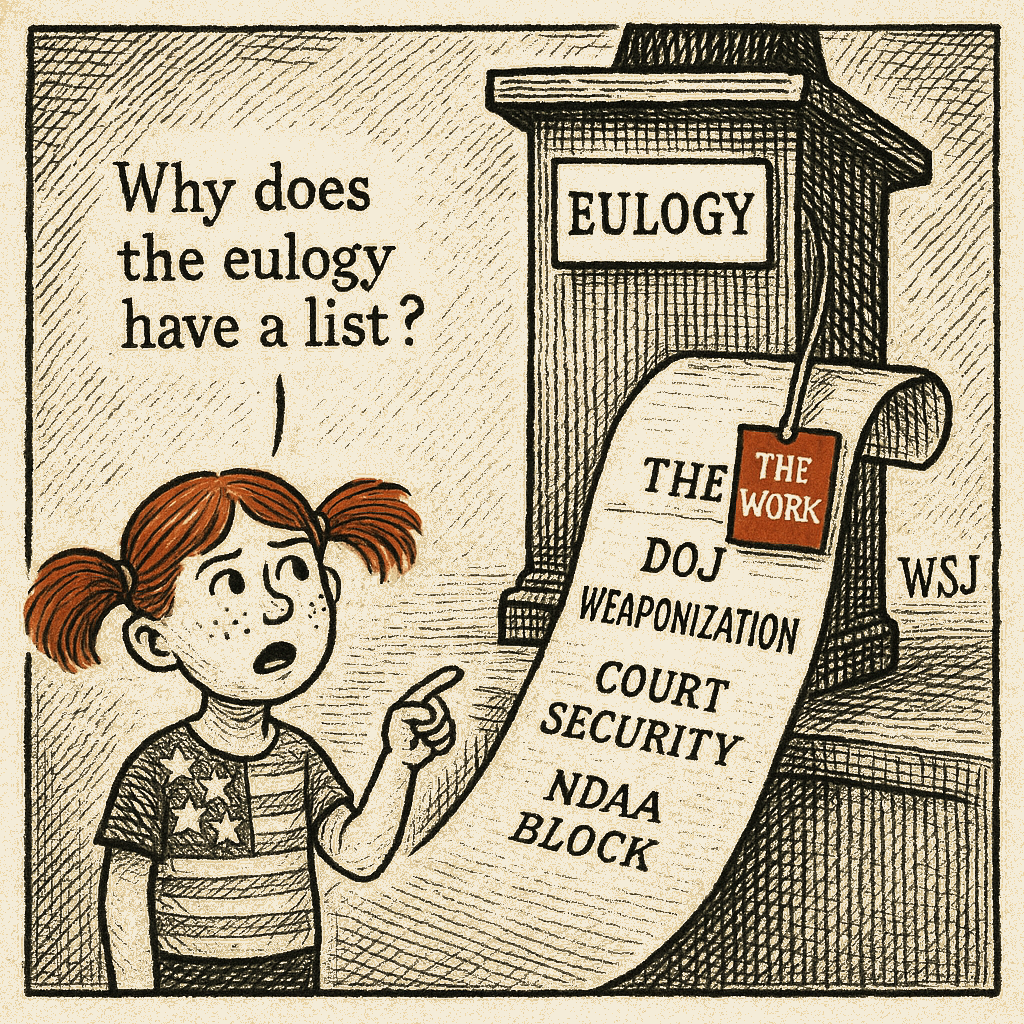
Analyzing: Life After Lindsey — Kimberley A. Strassel · 2026-07-15
What the Editorial Argues
The editorial opens with a tribute to the late Senator Lindsey Graham, then pivots — across a single “also” — into a five-item catalogue of partisan grievances. The eulogy is the cover; the catalogue is the payload. Each item in the catalogue performs a specific rhetorical operation:
- The DOJ remains politicized — frame-engineered relabeling (WSJ Technique Catalogue §4.1), the standing WSJ grievance about the Biden DOJ, deployed here via the “weaponization” frame. The editorial concedes Trump’s DOJ has not lived up to its pledge, then immediately pivots to blame Biden’s team — whataboutism (Bad-Faith Techniques Catalog §3; WSJ §4.17).
- House Republicans are bogged down in procedural infighting over daylight saving time and election bills — presented as the messy reality of a razor-thin majority, suppressing the fact that the holdouts are Republicans blocking their own party’s agenda. The editorial frames this as “the work of governing” rather than internal dysfunction.
- The Supreme Court needs more security funding because it has been politicized — threat-inflation closer (WSJ §4.13), passive construction letting the reader fill in “Democrats” as the agent of politicization without the column having to argue the case.
- Iran exploited a gap in sanctions enforcement — a factual claim deployed as a fear-appeal coda, reinforcing the narrative that the Biden administration’s weakness enabled the adversary.
- Democrats broke a decades-old tradition by blocking the NDAA — selective moral outrage (WSJ §4.4 deficit double standard; Bad-Faith Catalog §4.11), applied to a single procedural vote while the editorial is silent on the substance of the NDAA itself.
The spine of the piece is: Graham would want the work to go on. Here is the work. The work is the grievance list.
Receipts
What the framing wants you to believe:
- Lindsey Graham was an irreplaceable figure of principle and dealmaking whose death creates a void no one can fill.
- The real scandal in Washington is Jack Smith’s overreach — snooping on members of Congress — and the Biden-era politicization of the Justice Department.
- House Republican dysfunction over daylight saving time and election bills is just the messy reality of a razor-thin majority; the important thing is that Congress is back to work.
- The Supreme Court’s security request is “the price of politicizing the Court” — a warning against the left’s treatment of the institution.
What’s really going on:
- Graham’s eulogy is the frame through which the editorial advances a catalogue of partisan grievances — the weaponization narrative against the DOJ (WSJ’s signature frame-engineered relabeling, catalogue §4.1), blame on Democrats for blocking the NDAA, and a warning that criticism of the Court has security consequences. The mourning is genuine; the column that rides it is not.
- The Jack Smith revelations are presented as the DOJ’s “unjustifiable” conduct, but the piece suppresses that the filter-team language and subpoena process are standard investigatory mechanics — the spin is in the framing, not in any documented illegality. The editorial quotes Grassley’s complaint about the filter-team bypass in detail but never notes that filter teams are a standard DOJ mechanism described in the Attorney General’s Manual; the omission is the silence where a routine procedural fact would normalise the practice. The editorial treats a routine procedural complaint as proof of constitutional violation. The load-bearing omission is the absence of any finding of actual misconduct by Smith — only the allegation that he bypassed a filter review, without evidence of what was obtained or leaked.
- The Supreme Court security paragraph defers its own work: the Court is requesting more agents “because it has been politicized” — but the piece never names who politicized it. The passive construction lets the reader fill in “Democrats” without the column having to argue the case.
The Operation
Cui bono. Institutional authorship: The writer is a WSJ editorial-board member writing her signed column, which operates as a transmission belt for the board’s standing frames — weaponization of the DOJ, politicization of the Court, Democratic obstructionism. The piece is a position statement dressed as a eulogy. Distributional impact: The concentrated beneficiary is the Republican political coalition, which gets a high-credibility voice (the eulogist, above reproach) reinforcing its preferred narratives: the DOJ is out to get them, the Court is under siege, Democrats break norms while Republicans keep working. The diffuse cost-bearers are readers who absorb these frames unchallenged and voters who make decisions based on them. Alternative design: A column that genuinely honored Graham’s bipartisanship on immigration, his work with Democrats, his vote for Kavanaugh’s accuser’s hearing — without using his coffin to advance a partisan grievance list — would have produced a different piece. The writer chose the grievance list. FGL: Fear (the DOJ is coming for you; Iran is getting money; Democrats will shut down the government) operates on the reader; Greed (the political benefit of controlling the narrative) operates on the Republican party; Laziness (accepting the weaponization frame without examining the underlying legal process) operates on the reader who trusts the WSJ brand.
Classification: selfish. The piece uses a genuine human tragedy to advance coalitional messaging that would not survive a standalone argument.
Technique identification.
Frame-engineered relabeling (WSJ Technique Catalogue §4.1): The column deploys the “weaponization” frame — Smith’s conduct is “politicization,” “unjustifiable,” “riffling.” The same vocabulary would never be applied to a Republican-led investigation of Democratic officials. The tell is in sentence 1 of the Smith section: “The Trump Justice Department has hardly lived up to the president’s campaign pledge to end the ‘weaponization’ of the DOJ, though no one should ever forget that the model for DOJ politicization was forged by Joe Biden’s team, in particular former special counsel Jack Smith.” This is the whataboutism opener — concede a small ground on the current administration, then immediately shift blame to the prior one.
Whataboutism (Bad-Faith Techniques Catalog §3; WSJ §4.17): The Smith section’s structure: “The current DOJ is still bad; but here’s what the previous DOJ did.” The move deflects from the Trump-era weaponization debate entirely by re-focusing on a Biden-era special counsel. The suppressed question: was Jack Smith’s conduct actually illegal, or just aggressive? The column never answers — the allegation is treated as proof.
The eulogy-as-credibility-licensing (adjacent to WSJ §4.18 “as a [identity] credibility move”): Graham’s gravitas — his “unwavering voice,” his “deep ties with Trump,” his friendship — is invoked to license the surrounding grievances. A dead senator’s reputation is a harder object to criticize than a living columnist’s argument. The column opens with mourning; the reader is positioned as callous if they question the analysis that follows.
Selective moral outrage (WSJ §4.4 deficit double standard; Bad-Faith Catalog §4.11): Outrage over Smith’s filter-team bypass, silence on Trump’s pressure campaign on DOJ officials, his calls for investigations of political opponents, his firing of inspectors general, his removal of DOJ officials who would not bend to his will. The standard moves: the piece is outraged about procedure in the case it disfavors and silent about substance in the case it favors.
Threat-inflation closer (WSJ §4.13): The Supreme Court security paragraph — “This is the price of politicizing the Supreme Court” — closes with a civilizational warning. The actual content is a routine budget request; the framing turns it into a moral indictment of those who criticize the Court.
The third-graf turn (WSJ §3.3): “Washington is still dealing with the shock and grief… Senate Republicans also face the grim knowledge that they must move quickly to deal with pressing new circumstances.” The turn from genuine mourning to legislative logistics is the pivot where the column shifts from tribute to partisan agenda.
Audience-management function: The piece serves multiple audiences simultaneously. The GOP political class receives a permission structure: here is our message, here is how to talk about the DOJ, the NDAA, the Court. The rank-and-file conservative reader receives identity confirmation: your side is grieving but working; the other side is politicizing. The elite reader receives credentialed seriousness — the writer’s Bradley Prize, her Sunday-show circuit standing — making the frames citable in respectable discourse. The column does not need to persuade anyone; it needs to ratify pre-existing positions.
The Bandura cluster: The piece deploys four mechanisms, each anchored to specific textual moments:
- Moral justification operates at “no one should ever forget that the model for DOJ politicization was forged by Joe Biden’s team” — the “no one should ever forget” registers the column as defending the Constitution, not as making a legal claim.
- Displacement of responsibility operates at the pivot “though” in the same sentence — concede Trump DOJ is imperfect, then attribute the original sin to Biden.
Having relocated the blame, the column then reshapes what actually happened.
- Distortion of consequences operates at “riffling through a broad sweep of communications of opposition politicians” — a procedural filter-team question is rewritten as a constitutional violation.
- Attribution of blame operates at the passive construction “This is the price of politicizing the Supreme Court” — the agent is unnamed, but the location in the column (after the security-funding request) and the absence of any Republican criticism of the Court pins the blame on “the left” by implication.
The Record
Anchor receipts.
- The column states that Jack Smith’s office subpoenaed text messages of Trump administration officials and bypassed a filter team. The factual kernel — that subpoenas were issued and that filter-team procedures existed — is a documented DOJ practice. But the column’s characterization (“riffling through a broad sweep of communications of opposition politicians”) is editorial, not factual. The DOJ has acknowledged the subpoena; the editorial’s framing of it as “unjustifiable” is the editorial claim, not an undisputed fact. Tier 2 source: Grassley’s investigation and DOJ correspondence — from the piece’s own description, no violation has been established, only alleged.
- The 44 members of Congress caught in the sweep: factual, from the documents. Tier 1 (the actual documents cited by Grassley).
- Iran exported “millions of barrels of oil” during a gap in sanctions: sourced to Bloomberg. Tier 2.
- NDAA block by Senate Democrats: factual vote. Tier 1.
- Education fraud: sourced to Open the Books and State Financial Officers Foundation. Tier 3 — advocacy organization report, not a primary document. The report’s methodology and definition of “fraud” are not disclosed in the column.
Load-bearing omissions.
- The column never states what the Smith subpoenas found. The DOJ correspondence cited by Grassley is the only documentary support the editorial offers. The editorial’s claim of “unjustifiable” conduct is not established by the correspondence itself; it is the editorial’s gloss. The piece never names what the subpoenas actually obtained — the gap is the load-bearing omission.
- The column never mentions that the “weaponization” frame was itself the Trump campaign’s pre-emptive defense against legitimate investigations — the standard was set by the party the editorial is defending, not just by Smith.
- The column never mentions that Graham himself was a fierce partisan who voted for Sotomayor and Kagan and delivered the Kavanaugh-floor-tirade the column quotes approvingly. The piece treats Graham as a unifier while selectively ignoring the partisan battles he was at the center of.
- The column never engages the possibility that Smith’s investigation was valid — that members of Congress may have communicated with Trump’s team about January 6 or classified documents in ways relevant to a legitimate criminal investigation. The column treats the subpoena as prima facie overreach without naming what was being investigated.
Unconfirmed claims: “Smith’s investigators bypassed a special ‘filter team’” — the column presents this as established fact, but the DOJ correspondence cited by Grassley (the source the editorial uses) is itself a subject of dispute. The procedure may have been less clean than DOJ promised; it may also have been within standard practice. The column asserts the worst interpretation without acknowledging the uncertainty.
Symmetric-application note: The column’s outrage over DOJ subpoenas of congressional communications would, if applied symmetrically, require equal outrage when Republican-led investigations subpoena Democratic communications. The piece does not apply this standard.
How to Recognize This
The pattern: A tribute to a beloved figure functions as the emotional license for a partisan grievance list. The feeling of mourning lowers the reader’s critical guard; the column wraps its advocacy in respect.
The mechanism: Moral justification — the eulogist is above reproach, so the grievances she airs inherit her standing. Emotional permission structure — disagreeing with the analysis feels like disrespecting the dead.
Textual signals to watch for:
- The opening paragraphs spend emotional capital on the eulogy; the transition into legislative complaints is handled with “also” or “meanwhile” — as if the two registers are equivalent. The jump from “Rest in peace, Senator” to “The Trump Justice Department has hardly lived up to…” is the signal.
- The passive construction for contentious claims: “This is the price of politicizing the Supreme Court” — who politicized it? The passive lets the reader fill in the target without the column having to argue.
- The parenthesis-as-verdict: “the model for DOJ politicization was forged by Joe Biden’s team, in particular former special counsel Jack Smith.” That “in particular” is doing all the argumentative work.
- The quote-reprint as endorsement: the column closes with Graham’s 2018 Kavanaugh tirade, reprinted at length, as the emotional anchor. The reader who finishes on that quote leaves feeling Graham’s anger — which is now the column’s closing argument.
Trigger-to-technique index:
- Opening eulogy before grievance list → credibility-licensing move (§4.18 / adjacent)
- “Though” pivoting from current DOJ to Biden DOJ → whataboutism (§3 / §4.17)
- Passive “this is the price of politicizing” → threat-inflation closer (§4.13)
- Parenthetical “in particular Jack Smith” → frame-engineered relabeling (§4.1)
- Outrage at filter-team bypass, silence on Trump DOJ pressure → selective moral outrage (§4.4 / Bad-Faith §4.11)
- “No one should ever forget” → moral justification (Bandura)
Why it works: Grief suspends the reader’s adversarial posture. A column that opens with “Washington is still dealing with the shock and grief” cannot be easily challenged — the challenger looks callous. The eulogy is the camouflage the operation wears.
What to do when you see it: Separate the tribute from the policy arguments. Ask: does the analysis stand on its own merits, or does it borrow credibility from the deceased? Read the column again without the opening and closing eulogies — what remains is a standard WSJ grievance list. Then ask the questions the piece suppressed: What did Smith’s subpoenas actually find? Who benefits from the “weaponization” frame? Which party’s DOJ conduct is the column silent on? The mechanism works only as long as the reader does not separate the emotions from the arguments.

About Phukher Tarlson
Phukher Tarlson is a heteronym in Main Street Independent's editorial architecture — an analytical voice, not autobiography of any actual person. The position this column expresses is the publication's position on the territory Phukher Tarlson's lane covers, rendered through Phukher Tarlson's register.