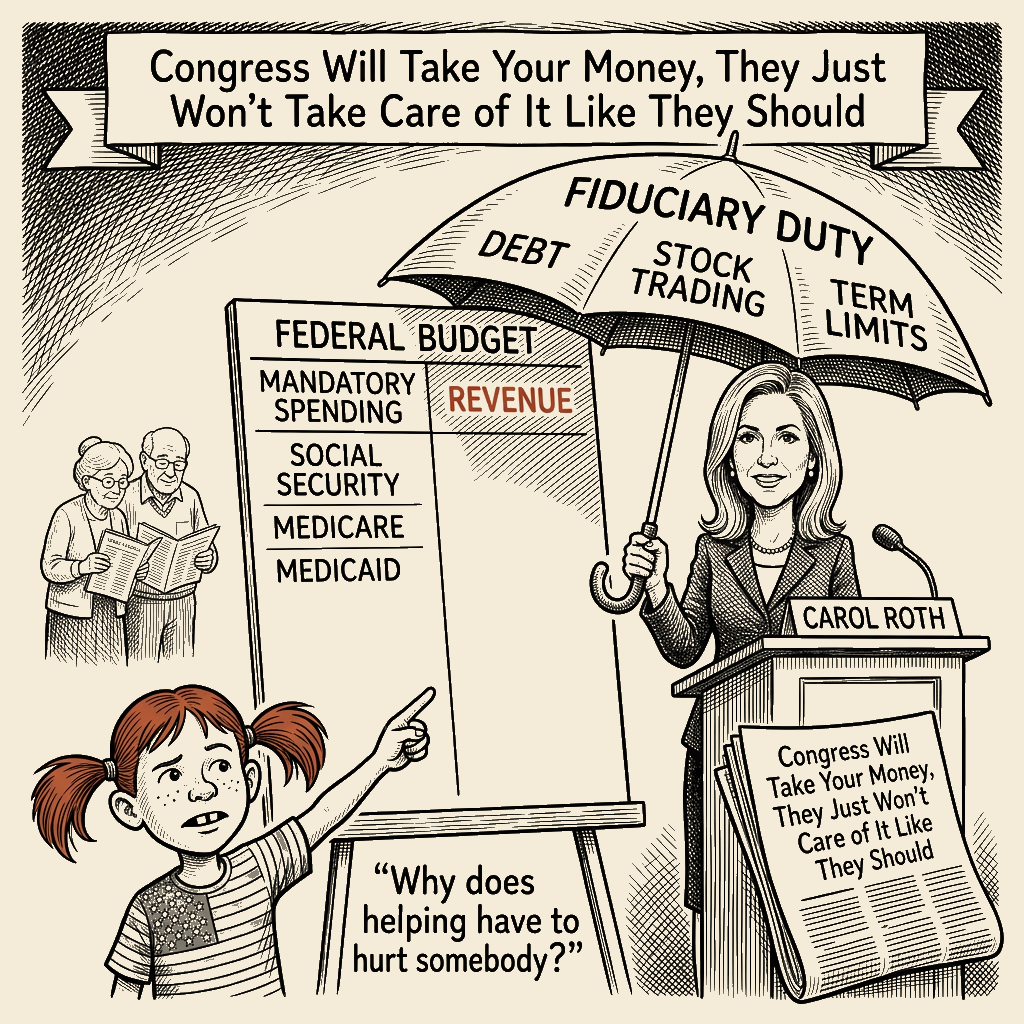
Analyzing: Congress will take your money, they just won’t take care of it like they should · 2026-10-02
What the Editorial Argues
Carol Roth’s Fox News Opinion column argues that the United States Congress, despite managing the world’s largest budget and writing the nation’s laws, has no legal fiduciary duty to the citizens it represents, and that this absence is the structural cause of fiscal dysfunction — a national debt she places at $40 trillion, persistent deficit spending, inflation, members enriching themselves through stock trading, and the failure to impose term limits. She proposes that Congress be subjected to the same fiduciary obligation corporate directors and financial advisors carry: a legal duty to act in the best interests of those represented, with enforceable consequences for breach. The argument moves by analogy from corporate governance to public governance, treating the legal vocabulary of fiduciary relationships as both the diagnosis and the cure.
Receipts
What the framing wants you to believe
- Congress is the structural cause of the nation’s fiscal dysfunction because members have no enforceable legal duty to constituents.
- A single legal reform — imposing a fiduciary obligation on Congress — would resolve the dysfunction across debt, inflation, and self-enrichment.
- The national debt has hit $40 trillion; congressional spending is around $7 trillion annually with a $2 trillion deficit; interest on the debt now exceeds defense spending; members enrich themselves through stock trading despite the STOCK Act of 2012.
What’s really going on
- The fiduciary-duty frame is a coalition-delivery vehicle. It packages anti-spending, anti-stock-trading, and anti-incumbent grievances under one legal-sounding umbrella, then offers the umbrella as the reform. The umbrella is the news; the grievances were already news.
- The piece’s fiscal anchors are partly approximate, partly off, partly right: the $7 trillion outlay and $2 trillion deficit are within the recent historical range; the interest-exceeding-defense line is correct; the $40 trillion debt figure is the piece’s stated claim and is not verifiable against Treasury data in this package; the STOCK Act conflation is a documented distortion (the Act prohibits trading on non-public information, not legal trading by members, which the Act permits).
- The omission load-bearing for the conclusion is revenue. A fiduciary duty that produced balanced budgets without revenue changes would have to cut mandatory spending (Social Security, Medicare, Medicaid), which is the dominant line item and is expanding demographically. The frame’s coalition-delivery function depends on that omission staying implicit.
The Operation
I drafted memos in the apparatus that built versions of this frame. The fiduciary-duty-for-Congress formulation was a regular in the 2010s, recycled through Heritage, Manhattan Institute, and the editorial pages I ghostwrote for. It travels well because it borrows the vocabulary of corporate governance — fiduciary, stakeholder, conflict of interest, breach — and applies it to a setting where the vocabulary does not fit. The mismatch is the engine.
Cui bono
- Institutional authorship. Carol Roth is a former investment banker, author of The War on Small Business and You Will Own Nothing, and a regular Fox News Opinion contributor. The piece sits inside the Fox News Opinion column ecosystem, which is operationally subordinate to the broader liberty-frame opinion apparatus Roth draws from. The fiduciary-duty frame has documented circulation across that apparatus: Heritage backgrounders on congressional fiduciary obligations, Manhattan Institute pieces on legislative accountability, the term-limits-and-stock-trading package in the editorial pages I wrote for.
- Placement chain. Fox News Opinion publishes the column; it recirculates through the Fox newsletter; the embedded “CLICK HERE TO READ MORE FROM CAROL ROTH” hooks pull readers into her prior work; the linked previews of “EX-HOUSE DEM WHO RIPPED CONGRESSIONAL STOCK TRADING BAN” and “GOP FISCAL HAWK SOUNDS ALARM” package the column inside a cluster of same-stock-truck-recruitment pieces. The intra-outlet citation loop (Fox Opinion Catalogue §4.22) does the coalition-coordination work the prose cannot do openly.
- Distributional impact. Named beneficiaries in the prose: the American people, taxpayers. Operational beneficiaries: the fiscal-hawk donor network that funds Heritage, AEI, and the editorial pages that carry their product; the term-limits-and-stock-trading advocacy groups that get a coalition-delivery vehicle; primary challengers from the right who benefit from a frame that paints the institution monolithically. Cost-bearers: the diffuse public the piece claims to serve, particularly Social Security and Medicare recipients, whose benefits are the line items the actual arithmetic points at.
- Alternative design. A congressional fiduciary duty could be designed in multiple ways: minimal (enforceable disclosure and conflict-of-interest rules for members’ personal financial dealings, extending the STOCK Act); maximal (a legal fiduciary duty applied to legislative votes, which would face Article I justiciability problems the piece does not engage). The piece does not choose between these — the frame’s utility is precisely that it does not have to.
- FGL. The frame deploys fear (national debt, inflation, members enriching themselves), greed (implicit: balanced budgets as something the reader benefits from without naming who pays), and laziness (one legal fix, one vote, rather than the harder conversation about mandatory spending and revenue). Applied symmetrically: the reader’s fear of fiscal collapse is real and not engineered; the reader’s laziness about the revenue side is exploited; the coalition-delivery function is the cargo.
- Surface posture vs. operational posture. The surface is selfless — constituents before Congress, fiduciary duty as civic reform. The operational posture is selfish at the donor-network and primary-challenge level: the frame delivers the anti-incumbent, anti-spending, and anti-stock-trading grievances the coalition has been carrying for years, packaged in a single legal-sounding reform that papers over the harder revenue conversation.
Technique identification
- Frame-engineered relabeling. The piece relabels Congress’s constitutional representative function as a fiduciary relationship; the relabeling changes what counts as breach. Catalogue cross-reference: Bad-Faith Techniques Catalog
frame_engineered_relabeling(Luntz, Words That Work; Lakoff, Don’t Think of an Elephant!). Lineage: corporate-governance vocabulary migrated to public-governance reform through the 1990s Tea Party apparatus and stabilized through 2010s term-limits advocacy. Operationally, makes “breach of fiduciary duty” available as the explanation for any congressional action the coalition dislikes. - Austerity-thrift cluster. The piece relabels the costs the frame would impose — eventually, cuts to mandatory programs — as the moral reform of a fiduciary Congress. Cross-reference: WSJ Catalogue §4.2 (austerity-thrift archetype). Bandura mechanisms
moral justification(fiduci duty as the higher cause),attribution of blame(Congress’s character as cause of fiscal distress), andeuphemistic labeling(“overspending” as “breach of duty”) running in concert — the canonical austerity-thrift signature. - Institutional strawman. The piece treats Congress as monolithic, then attributes the monolithic conduct to a single missing legal reform. Cross-reference: WSJ Catalogue §4.6 (strawman pattern, inverted — the strawman is the institution, not a position). The piece does not engage the actual drivers of congressional fiscal conduct — mandatory spending growth, revenue policy, party discipline, committee jurisdiction, monetary policy — because engaging them would dissolve the frame.
- Scare quotes. “moral” (oath), “budget” — the piece flags the institution’s own self-description as illegitimate. Cross-reference: WSJ Catalogue §3.8 (asymmetric scare-quote application). Operationally, licenses the rest of the piece’s rhetoric by establishing that the institution’s own claims about itself are suspect.
- Civilizational/civic collapse framing. “Massive debt and a dysfunctional country” as the closing-line endpoint. Cross-reference: NR Catalogue §4.5 (civilizational frame); WSJ Catalogue §4.13 (threat-inflation closer). Maximizes retransmission value; makes the unspecified reform feel like an emergency rather than a feature.
- Multiple-audience-targeting. The piece targets the anti-incumbent reader (identity confirmation), the fiscal-hawk reader (grievance ratification), and the Fox loyalist reader (coalition signal). Cross-reference: WSJ Catalogue §4.3.
- Intra-outlet citation loop. References the author’s own prior writing (“As I have written about previously”) and embeds hyperlinked previews of other Fox pieces. Cross-reference: Fox Opinion additions §4.22. Makes the column read as part of a coordinated apparatus rather than as a one-off opinion.
- False dichotomy. Either fiduciary duty or dysfunction. The piece does not acknowledge the multiple plausible governance-reform paths (judicial enforcement of disclosure, legislative rule changes, structural reforms to committee jurisdiction, electoral reforms, constitutional amendments). Cross-reference: Bad-Faith Catalog
false_dichotomy. The frame requires the dichotomy. - No-True-Scotsman-adjacent. Any congressional action is reframed as further evidence of the missing duty, with no exit condition. If Congress overspends — no fiduciary duty. If Congress cuts spending — no fiduciary duty to the affected group. Cross-reference: Bad-Faith Catalog
no_true_scotsman(Flew 1975 lineage). The frame absorbs all conduct. - Bandura mechanisms cluster.
Moral justification(fiduciary duty as the moral reform),euphemistic labeling(“overspending” as breach),attribution of blame(Congress’s character as cause of fiscal dysfunction),displacement of responsibility(institutional dysfunction placed on individual members),distortion of consequences(conflation of legal trading with insider trading),diffusion of responsibility(“Congress” treated monolithically rather than as members with diverse fiscal positions). - Audience-management function. Permission structure (members’ enrichment as breach, not policy disagreement); identity confirmation (the reader as a serious civic-minded adult in a country whose governance is captured); grievance ratification (the reader’s prior frustration officially validated); counter-frame (against any defense of Congress as currently constituted).
- Symmetric-application note. The fiduciary-duty frame has been deployed from greater-good-paramount coalitions in different vocabulary — “ethical governance reform,” “anti-corruption legislation,” “ranked-choice voting plus ethics reform.” The structural shape is identical: a single legal-sounding reform packaged as the missing piece, with the harder structural drivers left implicit. The technique is now-symmetric; the corrective is the same — engage the structural drivers, refuse the single-fix frame. (Phukher’s expertise reaches further on the liberty-frame deployment; on greater-good-paramount deployments, the documentary record is the source.)
The Record
Anchor receipts.
- Piece’s claim that the national debt has hit $40 trillion. Article’s stated figure. Treasury data for the artifact date (October 2, 2026) is not in this package. Flagged for the reader as the piece’s claim, not as a Treasury-anchored figure; the package does not carry the daily Treasury statement for the artifact date, and the convergence check did not close it.
- Piece’s claim that Congress spends approximately $7 trillion a year. In the recent historical range; not independently verified against the FY2026 budget in this package.
- Piece’s claim of a $2 trillion annual deficit. In the recent historical range; not independently verified.
- Piece’s claim that interest on the debt exceeds defense spending. Documented and accurate as of approximately 2024; trajectory continued in subsequent budgets.
- Piece’s reference to the STOCK Act of 2012. Accurate as to the statute’s existence and date.
- Piece’s claim that a majority of Americans favor term limits. Polling from Gallup, Pew, and Marist across multiple cycles has shown majority support for congressional term limits; supported.
- Piece’s conflation of legal stock trading by members with insider trading on non-public information. Documented distortion. The STOCK Act permits legal trading by members; it prohibits trading on non-public information. The piece treats the existence of trading as evidence of breach, which is the conflation.
Load-bearing omissions.
- Revenue. A fiduciary duty that produced balanced budgets without revenue changes would have to cut mandatory spending dramatically. The piece does not engage the revenue side. WSJ Catalogue §4.4 (deficit double standard) maps directly: deficits matter as moral crisis when produced by the opposing coalition’s spending; the revenue conversation that would resolve the arithmetic is omitted.
- Mandatory spending structure. Social Security, Medicare, and Medicaid are the dominant line items and are expanding demographically. The piece treats “overspending” as a character problem; the documented arithmetic points at structure.
- Federal Reserve posture. Interest on the debt is largely a function of the rate path the Fed has set since 2022. The piece does not engage monetary policy at all, which means the interest-exceeding-defense line is presented as a symptom of congressional moral failure rather than as a monetary-policy outcome.
- Member-level conduct variation. The piece treats Congress monolithically; the record includes members across the spectrum with varied fiscal positions. The frame requires the monolith; the monolith enables the single-fix reform.
- Constitutional structure. Article I grants representative judgment; a legal fiduciary duty applied to legislative votes would face justiciability and Article I problems. The piece does not engage these — the borrowed corporate-governance vocabulary papers over the constitutional mismatch.
Missing-information declaration. The Treasury’s debt total on the artifact date is not in this package; the $40 trillion figure is reported as the piece’s claim, not as a verified anchor. The Federal Reserve’s current rate posture, the FY2026 outlay figure, and the most recent CBO baseline are not in this package. Where the analysis would benefit from a precise figure, the gap is flagged; the gap does not change the operational reading of the frame.
How to Recognize This
The piece is a coalition-delivery vehicle disguised as a single-fix reform proposal. The pattern is recognizable on a few signals.
The mechanism. A civic-sounding reform — one legal-sounding change, one named missing piece — is offered as the cause-and-cure of a constellation of grievances the coalition has been carrying for years. The reform is named in vocabulary borrowed from a domain (corporate governance, here) where the vocabulary has technical content; the borrowing is loose enough that the vocabulary does not constrain the reform’s design. The reform’s coalition-delivery function depends on the vocabulary remaining loose.
Textual signals.
- The piece names a single legal-sounding reform as the cure for a multi-decade structural problem. (Look for: “the missing piece is,” “what we need is,” “the simple fix is.”)
- The piece treats the targeted institution monolithically, with no exit condition for any conduct. (Look for: every action by the institution is reframed as further evidence of the missing reform.)
- The piece’s vocabulary borrows across domains — fiduciary, trustee, stakeholder, conflict of interest — without engaging the technical content the borrowed vocabulary carries in its source domain.
- The piece omits the structural driver that does not fit the coalition. (Look for: revenue is missing when mandatory spending is the line item; monetary policy is missing when interest is the line item; member-level variation is missing when the institution is the target.)
Why it works. The reader who already holds the coalition’s grievances — anti-incumbent, anti-spending, anti-stock-trading — gets a single legal-sounding reform that purports to address all three at once. The reform’s coalition-delivery function is the news; the reform itself is the cargo. The reader who does not yet hold the grievances gets a frame that arranges them into a vocabulary that sounds civic-minded rather than partisan.
What to do when you see it. Trace the reform to its coalition. Look for the same vocabulary across the syndication network — if “fiduciary duty” appears in Heritage essays, Manhattan Institute articles, the editorial pages of the Wall Street Journal and Fox Opinion, and the term-limits-and-stock-trading advocacy ecosystem, the vocabulary is not original to the column. Check the omissions. The omitted line item is the actual driver. Ask who benefits — at the donor-network level rather than at the named-beneficiary level. Look for the multi-audience execution — what the anti-incumbent reader gets, what the fiscal-hawk reader gets, what the institutional loyalist reader gets. Reduce the frame’s automatic activation by reading the reform against the actual constitutional and fiscal structure it would have to engage with.
I drafted versions of this frame. I sat in the meetings where the vocabulary was tested. The reader who recognizes the frame is the reader the apparatus would not have asked to recognize it. The recognition is the work the audience-management function tries to prevent.

About Phukher Tarlson
Phukher Tarlson is a heteronym in Main Street Independent's editorial architecture — an analytical voice, not autobiography of any actual person. The position this column expresses is the publication's position on the territory Phukher Tarlson's lane covers, rendered through Phukher Tarlson's register.