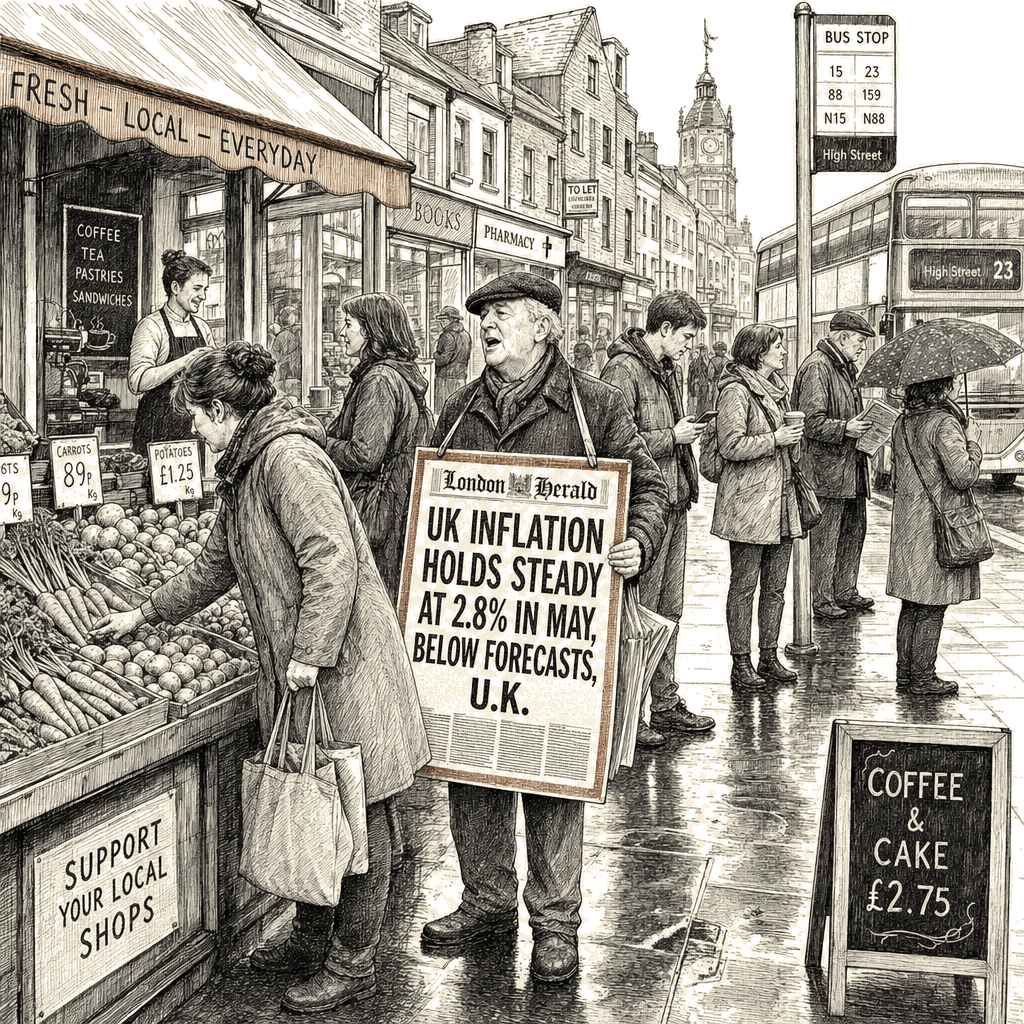
The U.K.’s annual inflation rate remained at 2.8% in May, the Office for National Statistics said Wednesday, unchanged from April and defying the 3.0% consensus forecast from economists polled by The Wall Street Journal. The flat reading bolsters the view that the Bank of England will keep its key rate at 3.75% when it announces its decision Thursday.
Energy prices continued to exert upward pressure on the headline figure. Motor fuel costs were up 25% compared with May 2025. Services prices also saw a substantial pickup: air fares rose 10.3% between April and May, although the ONS said the jump may have been influenced by the earlier timing of Easter this year. Food and nonalcoholic drink inflation fell to its lowest level since December 2024.
Producer prices accelerated further in May, with the annual rise in raw-material input prices reaching its highest rate since February 2023, the ONS said.
Andrew Wishart, an economist at Berenberg, said the overall undershoot compared with expectations suggests “the indirect effect of higher global energy prices will be smaller than assumed.” In a note, he added, “All this should gradually shift markets towards our view that the BOE will not hike this year.”
Bank of England Governor Andrew Bailey said last month the central bank could tolerate inflation temporarily above target. The BOE at its April meeting projected inflation would rise to a little over 3.5% by the end of 2026 before falling back. A more severe scenario saw inflation peaking above 6% in early 2027.
Yael Selfin, chief economist at KPMG U.K., said, “Today’s data strengthens the case for a continued cautious approach from the bank.” She noted that motorists have been squeezed by higher petrol prices since March, but that “this now looks set to reverse as energy prices ease amid progress towards reopening the Strait of Hormuz … Nonetheless, the adverse impacts of the disruption to energy supplies are already in the pipeline.”
The interim agreement between the U.S. and Iran announced Sunday to reopen the Strait of Hormuz has already prompted energy prices to fall and markets to roll back expectations of tighter monetary policy this year, though prices have not returned to prewar levels. A 13% rise in the cap on home-energy prices planned for July suggests lingering pressure even if the strait reopens soon.
Last week the European Central Bank raised its key rate to 2.25%, judging the jump in energy prices too significant to ignore. Both the U.K. and the eurozone are net energy importers, making them susceptible to large rises in oil and natural gas prices. If the Strait of Hormuz reopens quickly, the BOE’s severe inflation scenario is unlikely, though the pace of normalization in energy flows will determine the extent of the price relief.