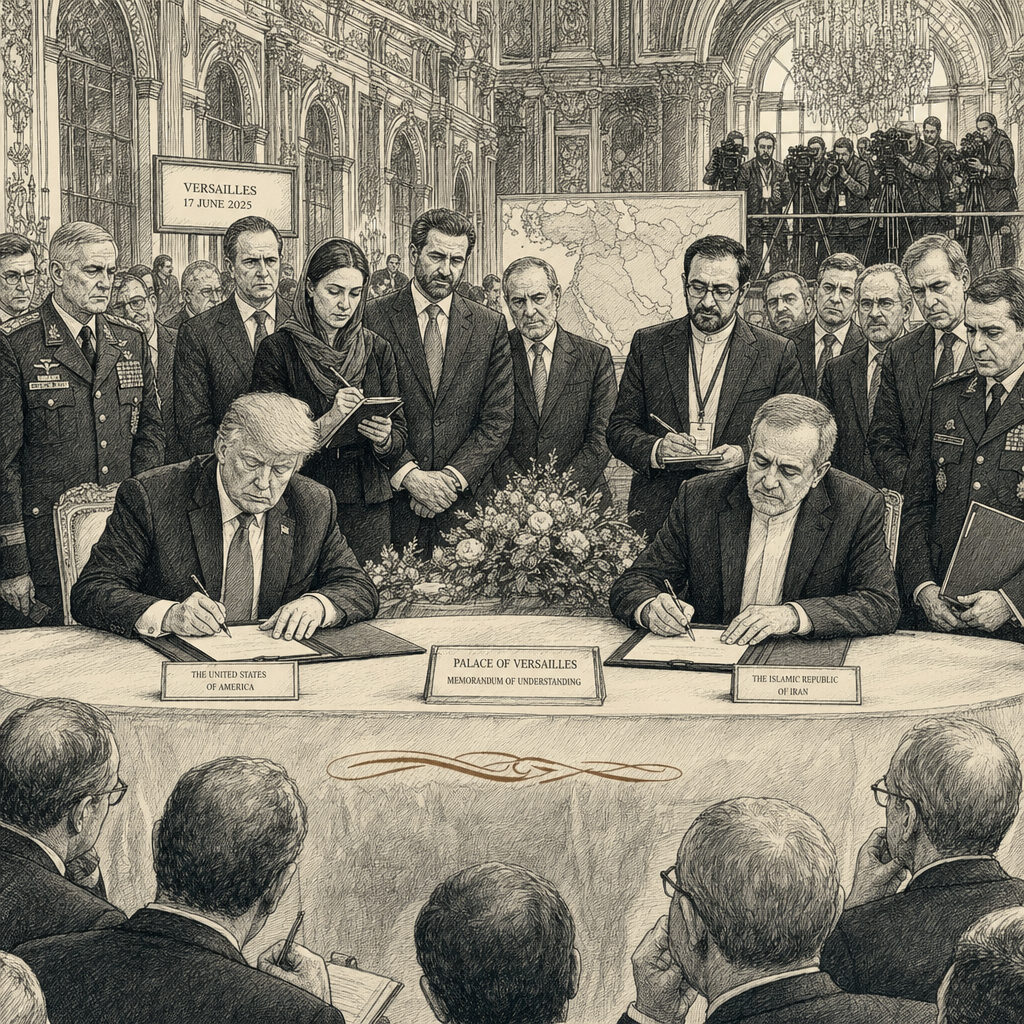
President Donald Trump and Iranian President Masoud Pezeshkian signed a memorandum of understanding at the Palace of Versailles on Wednesday that formally ends the US-Israeli military campaign against Iran that began on Feb. 28. The MOU lays out political, military, and economic terms, including the reopening of the Strait of Hormuz, which Iran had blocked during the conflict.
According to BBC International Editor Jeremy Bowen, thousands of people have been killed, many of them civilians, in Iran and Lebanon. The US and Israel have suffered a “strategic defeat,” Bowen wrote, and Iran’s regime has not only survived but been “empowered” by the outcome.
Iran’s strategy of blocking the Strait of Hormuz, through which roughly one-fifth of the world’s oil and gas supplies transit, forced Trump to agree to a series of concessions, Bowen said. These include lifting the US counter blockade of Iranian ports, waiving sanctions that allow Iran to earn billions of dollars from oil exports, and beginning the process of returning billions more in frozen assets held abroad.
The MOU also calls for an end to the war in Lebanon, though Israel has said it wants a “free hand” there. Bowen noted that issue could cause a rift between Israel and the US and benefit Iranian hardliners.
Former US Secretary of State Antony Blinken, who served under President Joe Biden, posted on X that “the only ‘achievement’ of the ceasefire is the likely reopening of the Strait of Hormuz – which was open before the war started. And we will apparently pay Iran to do so.”
The question of what the war was for, Bowen wrote, is “inescapable and will not go away.” He described the conflict as Trump’s “worst foreign policy blunder so far.”
The war may also affect Israeli Prime Minister Benjamin Netanyahu’s political future. Netanyahu faces elections in October, and Bowen said he faces a “reckoning” from Israeli voters over security failures that allowed the Oct. 7, 2023, Hamas attack from Gaza. Netanyahu’s hardline military policies, Bowen said, were designed at least in part to restore his reputation as “Mr. Security.”
According to Bowen, the US and Israeli military campaign assumed that killing former Supreme Leader Ali Khamenei would cause the regime to collapse. But Iran’s institutions, built over nearly half a century, proved resilient. “It was not like Venezuela,” Bowen wrote, “a corrupt Latin American dictatorship, that crumpled when its leader was abducted.”
Trump had predicted the regime would fall and called on Iranians to prepare for a “once-in-a-generation chance” to take back their country. Netanyahu, using biblical language, said the coalition would “smite the terror regime hip and thigh.” Neither man delivered, Bowen said.
The MOU is not a final nuclear deal but an agreement to begin 60 days of talks on Iran’s nuclear program, which can be extended. The US has said it will lift sanctions if talks progress. Bowen wrote that hardliners in Washington, Tehran, and Israel do not want the deal to succeed, and Iran may overplay its hand. But he concluded that the agreement is “way better than a war that has killed thousands and threatened a global economic recession.”