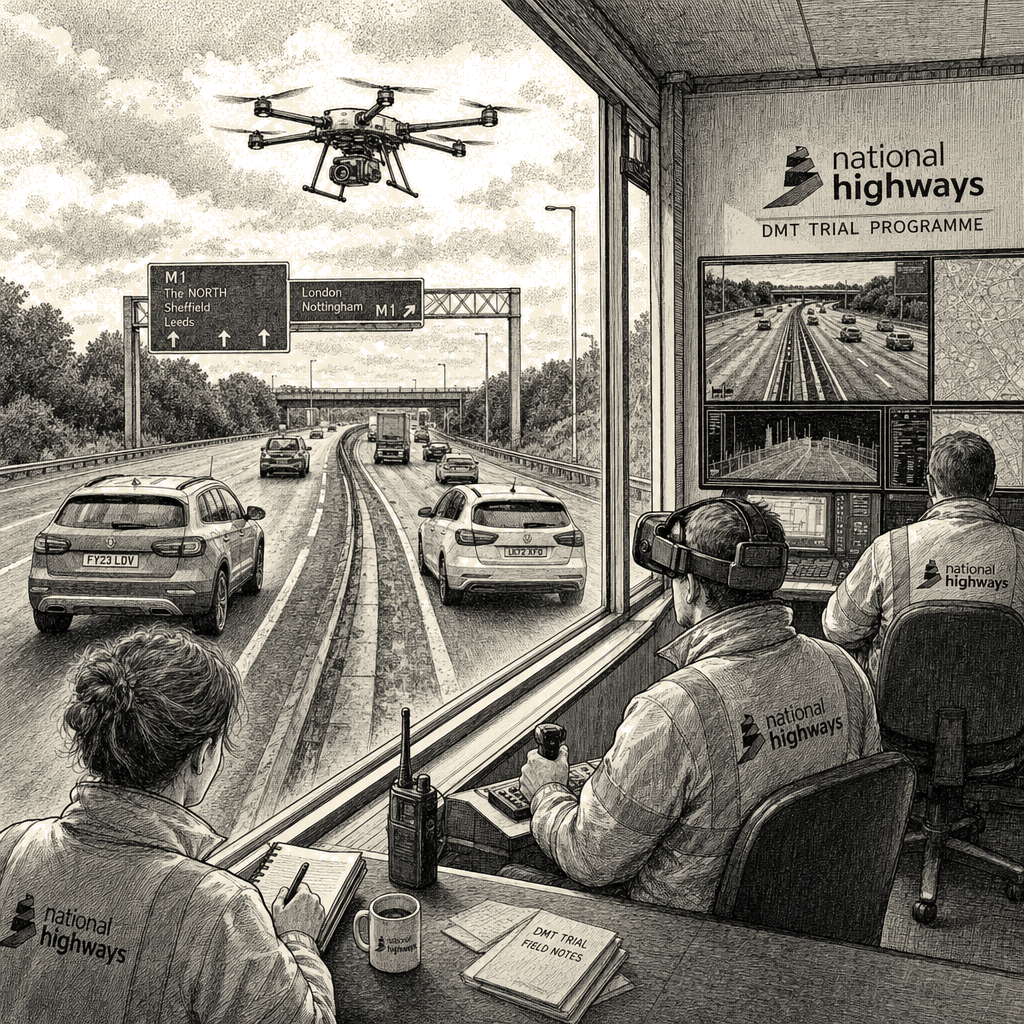
National Highways, the government-owned agency responsible for England’s major roads, is conducting a series of virtual reality tests to determine whether low-flying drones deployed for infrastructure monitoring will distract motorists. The simulations, run by VR company MXT in partnership with engineering firm Arup, are being held in London, Manchester, and Birmingham over a month-long period.
The agency already operates larger human-piloted drones that fly about 50 metres above road surfaces, a program that began in 2020 in collaboration with Arup. The next-generation drones would be smaller, fly at altitudes between 10 and 20 metres, and cost roughly one-tenth as much, according to National Highways. The lower altitude and smaller size are intended to capture more detailed images of road conditions. The agency hopes to have the new drones operational by early 2027.
Participants in the VR test are told they are taking part in a standard road safety simulation. Only after completing the scenario are they asked whether they noticed drones and whether the drones affected their driving. In addition to self-reported distraction, the simulation measures heart rate, pupil dilation, time spent not looking directly ahead, and vehicle metrics such as speed and steering control.
Callum Brown, senior adviser on airspace standards at National Highways, described the tests as “cutting edge” and said the approach represents a world first for national-level application. “They did some tests similar to this in Massachusetts,” Brown said. “But in terms of trying to apply this nationally, this is a world first. We’re at the cutting edge for this and it’s something we’ve been building to for about six years now.”
Of the 120 regular drivers and 19 heavy goods vehicle drivers who have taken part, roughly half said they noticed the drones during the simulation. However, the agency said significantly fewer participants rated the drones as “hazardous” or “dangerous.”
Ewan Murdoch, a senior consultant at Arup, said the methodology has generated interest internationally. “We’ve had some interest from colleagues in Australia who are looking potentially to do some of their things to their road authorities,” Murdoch said. “And in the US as well, they’re looking at opportunities for this, but this kind of methodology is quite interesting and novel, so I think it’s something that globally we’re seeing a strong interest in.”
One participant, 49-year-old Kevin McKeown, said he found the VR experience “a bit jarring at first” but did not believe the drones caused any problems with his driving. “It was a bit surreal like a video game, but if it increases health and safety and takes away an element of risk then I’m all for it,” McKeown said. “And if you can get distracted by a drone flying 10 metres overhead then I think you’ve got bigger issues than just a drone, and I’m not too sure you should be driving a car in the first place.”