- Alan Greenspan’s “Greenspan Put” — the expectation that the Federal Reserve will rescue markets after severe crashes — is currently on hold as the central bank prioritizes inflation control over supporting stock prices.
- The Fed first demonstrated the pattern after the 1987 Black Monday crash, promising liquidity and cutting rates after the S&P 500 fell 20% in a single day.
- Critics argue the Fed Put creates moral hazard by encouraging investors to take greater risks expecting central bank intervention.
- When the Fed responded to post-pandemic inflation in 2022, it continued raising rates even as the S&P 500 fell by a quarter from January to October, signaling the Put’s suspension.
Former Federal Reserve Chair Alan Greenspan, who died June 22 at age 100, left a lasting but now uncertain legacy for stock investors: the expectation that the central bank would step in to rescue markets after severe downturns. Analysts call this implicit guarantee the “Greenspan Put,” named for derivatives contracts that protect investors against price falls.
The Greenspan Put emerged from the recognition that stock market crashes threaten the Fed’s monetary-policy goals, analysts say. The pattern began with the Black Monday crash of Oct. 19, 1987, when the S&P 500 plummeted 20% in a single day. The Fed responded by issuing an unusual statement promising liquidity, cutting interest rates and asking banks to lend on easy terms to protect the financial system.
The late Chicago economist Lester Telser, in an oral history project at the University of California, Berkeley, said Greenspan himself was calling banks that night. “I don’t want any clearinghouse to fail. I don’t want any brokerage firm to go under,” Telser said, recounting Greenspan’s message. “You lend to the clearinghouses whatever you need, and we’re going to back you.”
The intervention worked, analysts said. Stocks recovered about half their losses within days, and the broader economy was unaffected. The Wall Street Journal contrasted the outcome with the 1929 crash, when the Fed tightened monetary policy concerned about gold outflows, contributing to bank failures and the Great Depression.
A decade later, the Fed intervened again when the collapse of giant hedge fund Long-Term Capital Management threatened Wall Street. The Fed cut rates and pushed banks to form a consortium that rescued LTCM. The justification, analysts said, was to prevent a financial breakdown.
When the dot-com bubble burst in 2000, the Fed stopped raising rates and cut sharply in 2001, citing concerns about the economic impact. The pattern had become established: the Fed would act to cushion markets when severe downturns threatened the economy.
Critics argue the Fed Put creates moral hazard — investors grow to expect central bank intervention and take greater risks than they otherwise would. Wall Street Journal columnist James Mackintosh wrote that the Fed “has demonstrated that it will rescue even midsize financial institutions to save depositors from their bad choice of bank” and has become “the market maker of last resort for the Treasury market.”
But the return of inflation has suspended the Put for equity markets, analysts say. When the Fed belatedly responded to rising inflation in 2022, it kept raising rates even as share prices fell sharply. The S&P 500 fell by a quarter from January to October 2022, the Journal reported, but the Fed continued hiking for another nine months.
Inflation has not been below the Fed’s 2% target since February 2021, according to the Journal. That has made the Fed “increasingly focused on the inflation part of its mandate,” Mackintosh wrote, making it less willing to support growth with the lower rates that shareholders favor.
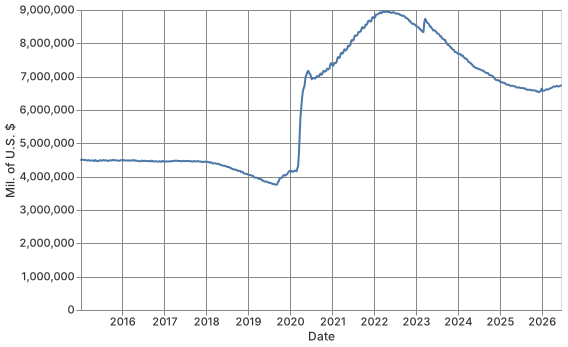
As of June 23, 2026, the S&P 500 stood at 7,472.79, according to Federal Reserve data. The Dow Jones Industrial Average was at 51,712.71. The Fed’s total assets stood at approximately $6.74 trillion.
Mackintosh wrote that if the next stock market downturn is severe enough to threaten the economy and lower inflation, the Fed Put could make a “rapid reappearance.” But he said a 20% fall likely would not be enough to trigger it, and intervention after declines of 30%, 40% or 50% would “come too late for those caught up in a crash.”