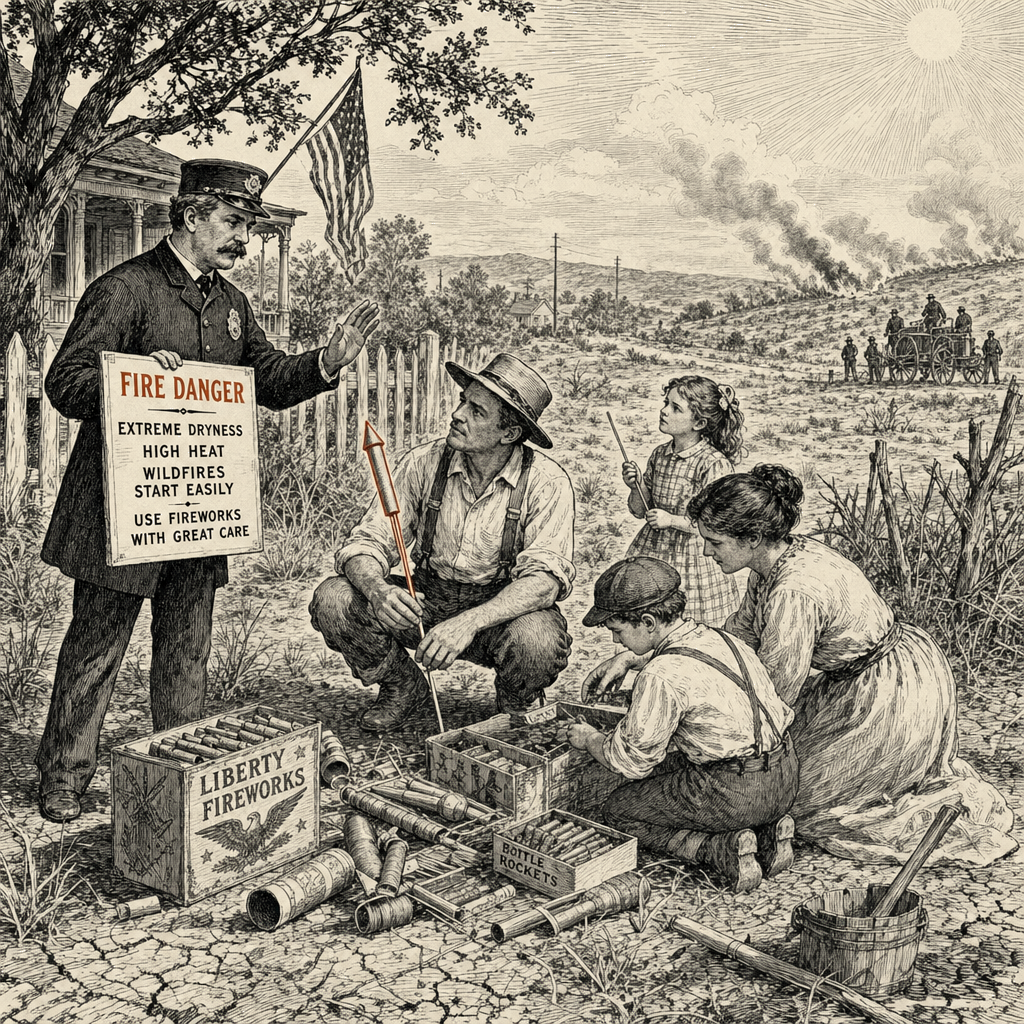
The confluence of drought, heat, and dry vegetation has created conditions across much of the United States in which small sparks from fireworks can quickly become uncontrolled wildfires, according to Lauren Lowman, an associate professor of civil and environmental engineering at Wake Forest University. Writing in The Conversation and republished by United Press International, Lowman warned that the July 4 holiday — as the nation celebrates the 250th anniversary of independence — brings exceptional fire risk.
The first half of 2026 has already seen more wildfires than the same period in any of the previous 10 years, which included some of the country’s worst fire seasons on record, Lowman wrote. Large parts of the West and Great Plains are in extreme or exceptional drought, including areas of Oklahoma, Nebraska and Utah, where wildfires in June forced entire communities to evacuate. The national wildfire forecast shows above-normal fire risk continuing into July in much of the U.S. West and Texas, and above-normal heat along with dryness through early July in large parts of the West and Southeast, Lowman reported.
Fireworks ignited an estimated 32,000 fires in the U.S. in 2023, according to data Lowman cited. Emergency rooms treated roughly 9,700 fireworks-related injuries that year, a third of them involving children, per the National Fire Protection Association, which encourages the public to leave pyrotechnics to professionals.
“Fireworks, from bottle rockets to Roman candles, start a lot of fires in the U.S. every year,” Lowman wrote.
Between 1992 and 2015, humans started 97% of all fires that threatened homes in the wildland-urban interface — areas where homes and cities overlap with wildlands, Lowman reported. July 4 stands out for its exceptional number of human-caused fires: from 1992 to 2020, roughly 15,000 fires were ignited on that date nationwide. Even in the eastern U.S., where July falls outside the peak fire season, Independence Day sees about 400 more fires than other days that month, Lowman wrote.
A study cited by Lowman found that 42% of all land burned in the western U.S. from 2001 to 2024 happened during or right after a heat wave, tying the elevated fire risk to forecasts of above-normal heat through early July.
“In hot, dry conditions it doesn’t take much to start a fire,” Lowman wrote. “Dry vegetation — trees, shrubs and grasses — provides the fuel. A windy day can substantially raise the risk of a runaway fire.”
The National Fire Protection Association encourages attending professional displays rather than using personal fireworks, Lowman noted, adding that “public displays are cheaper for you, safer for everyone, and often far more spectacular.”
In many states and drought-plagued regions, commercial fireworks are banned for community safety, Lowman wrote. Utah officials banned personal fireworks statewide ahead of the holiday as the state battled multiple large wildfires, including the Cottonwood fire, which has burned tens of thousands of acres.
This article is based on reporting by Lauren Lowman, an associate professor of civil and environmental engineering at Wake Forest University, originally published in The Conversation under a Creative Commons license and republished by United Press International.