Pullback exposes gaps in bombers, refuelers, naval power
ANKARA, Turkey — NATO leaders are meeting this week for an annual summit in the Turkish capital to confront a challenging task: how to replace the American military capabilities the Trump administration has withdrawn from Europe with little warning, defense officials and experts said.
The Pentagon’s cuts fall into two categories: reductions to U.S. Army brigades already deployed on the continent, and a scaling back of air, naval and other reinforcements the military had pledged to send in a crisis. For the Trump administration, the moves signaled it was time for European allies to take the lead in the conventional defense of the continent, allowing the U.S. to shift forces toward the Pacific to deter China and to deploy in the Western Hemisphere.
Washington has committed to maintaining its nuclear umbrella over Europe — NATO’s ultimate defense against Russia — according to the administration.
But the abrupt pullback has unnerved many European allies, who say the timeline provides no buffer for a transition at a time when Russia’s air, missile and naval assets remain largely intact, even as its ground forces are bogged down in Ukraine.
“It is difficult and dangerous for the security of NATO’s European front when capabilities are withdrawn very quickly and before it is clear when these can be replaced,” German Defense Minister Boris Pistorius said last month.
European defense spending has risen sharply in recent years, but the alliance’s industrial base is grappling with production bottlenecks. “The big issue I think that Europeans should be focusing on is the industrial cadence and capacity to actually deliver in a much quicker way to meet the moment,” said Alexandra de Hoop Scheffer, president of the German Marshall Fund.
The Trump administration earlier this year canceled the deployment of an armored brigade to Poland from Fort Hood, Texas. Trump later said he would send 5,000 troops to Poland, though the Pentagon has not so far deployed more forces there. The Pentagon also halted the deployment of an Army battalion equipped with long-range missiles in Germany, and previously removed an infantry brigade from Romania.
NATO Secretary-General Mark Rutte said the alliance is working to backfill the gaps. “Europeans are already backfilling what the U.S. cannot any longer promise,” Rutte told The Wall Street Journal in an interview. He acknowledged that “in some cases we’ve got more work to be done” on replacing American capabilities, but added that NATO is better off having realistic expectations of what the U.S. can be certain of contributing.
Retired Army Gen. Curtis Scaparrotti, a former NATO supreme allied commander, said any transfer of military responsibility must be carefully timed. “I don’t agree with the uncertainty we have injected into the force posture,” he said. “If we determine there should be changes, it cannot be immediate and without preparation, in order to ensure deterrence against what is a real threat from Russia.”
Some former U.S. officials said reduced reliance on American conventional forces could push the alliance to lean more heavily on nuclear deterrence. A six-nation program dubbed “nuclear sharing” allows some European countries, including Germany, the U.K. and Turkey, to equip their aircraft with U.S. nuclear weapons in wartime. Polish officials have said they want to join the arrangement.
“If NATO is less able to count on its conventional forces for deterrence, it makes the alliance more dependent on the credibility of American nuclear weapons,” said Celeste Wallander, who served as assistant secretary of defense for NATO and Russia policy during the Biden administration.
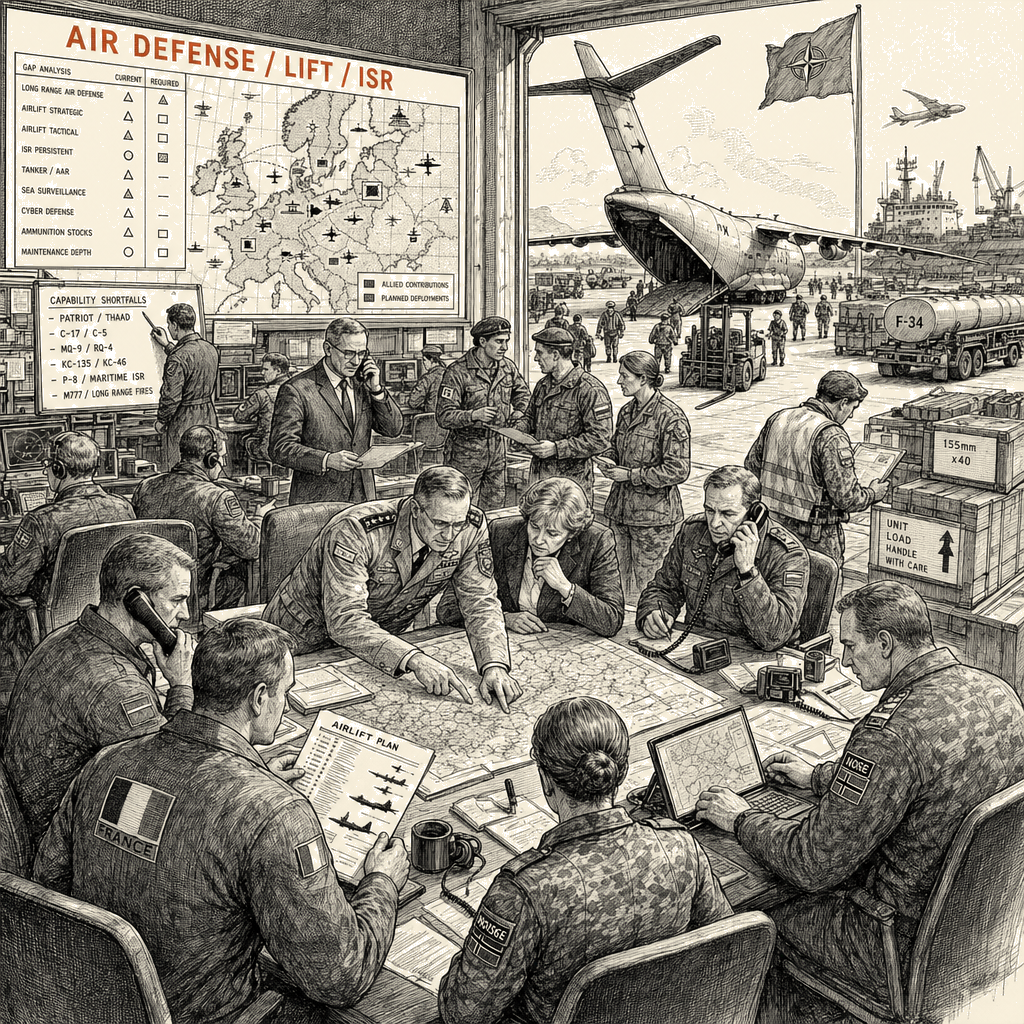
One workaround under discussion to make up for the lack of long-range strategic bombers — capability only the U.S. possesses — is to deploy more long-range missiles on the ground and additional fighter aircraft, according to Western officials. European nations have committed all new fighter aircraft to NATO’s defense instead of holding some back for national missions, alliance officials said.
But military experts said ground-based systems are a limited substitute. “Ground-based long-range fires can supplement, but they cannot come anywhere close to the reach of a bomber or replicate the bombers’ capability to quickly revisit targets,” said David Deptula, dean of the Mitchell Institute for Aerospace Studies and a retired Air Force three-star general. “Fighters cannot carry as great a payload as bombers and have less reach, and when you look at a nation the size of Russia, range matters.”
Replacing U.S. midair refueling capabilities — also in short supply — would require establishing more airfields with fuel capacity, officials said.
U.S. Air Force Gen. Alexus Grynkewich said European allies have largely filled the gaps left by the U.S. reductions. “In those few areas where they haven’t, where they do not currently have a like capability to replace, we are looking at alternate capabilities with matching effect,” Grynkewich told the Journal.
In Washington, bipartisan lawmakers have sought to block further withdrawals. Provisions in pending military-spending legislation would bar U.S. troop levels in Europe from falling below 76,000 without further review. Congress is also moving to block the removal of Army weapons and equipment stocks held in Europe, according to Pentagon and congressional officials.
“I think the department is fundamentally miscalculating the advantage from prepositioning stocks and equipment in Europe,” said Sen. Jeanne Shaheen, a New Hampshire Democrat on the Senate Armed Services Committee.
Trump is expected to meet with Ukrainian President Volodymyr Zelensky on the sidelines of the summit, according to a senior Trump administration official. The war in Ukraine — and Russia’s long-term goals of weakening NATO — is slated to be a top agenda item for the leaders, U.S. and European officials said.