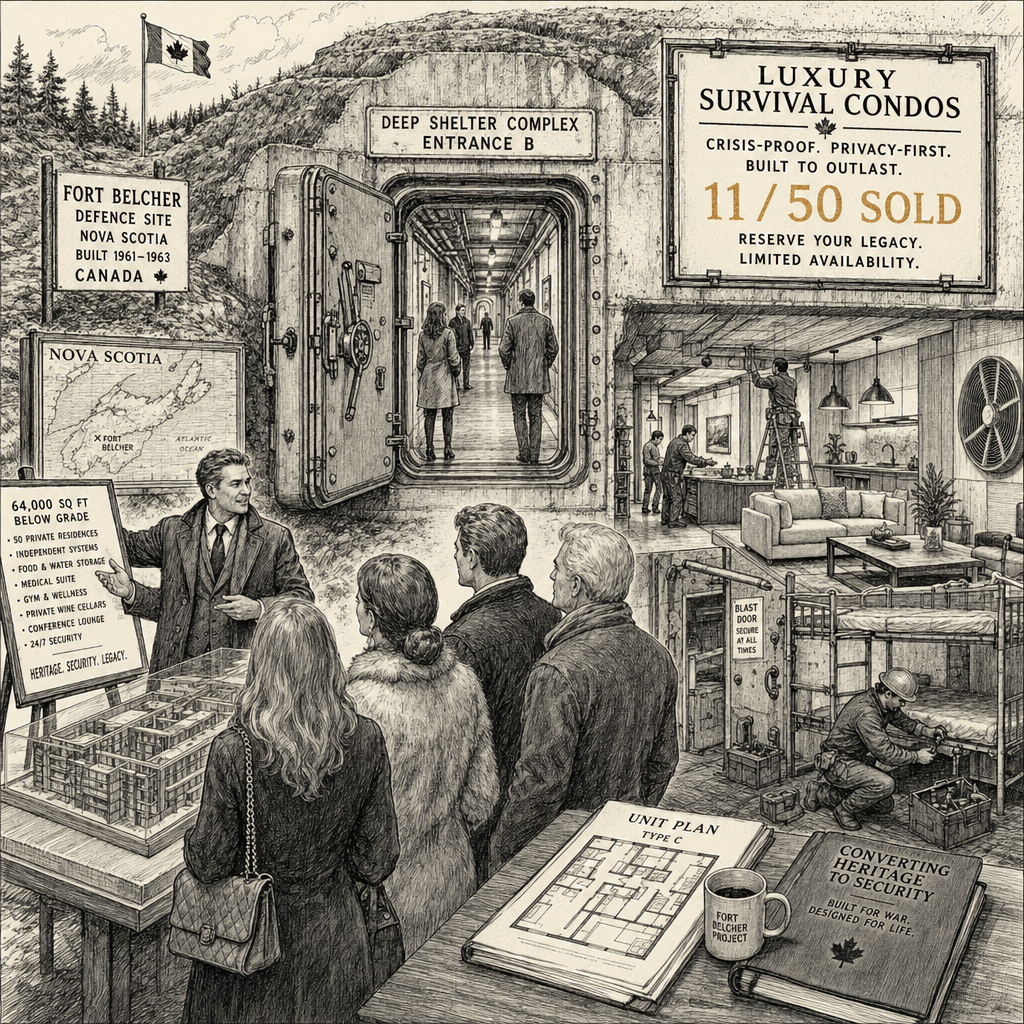
Eleven of the crisis-proof units are already sold, with purchase and rental costs kept secret
A 64,000-square-foot nuclear bunker built during the Cold War in rural Nova Scotia is being converted into a luxury condominium complex aimed at wealthy clients seeking protection from global threats, and 11 of the 50 planned units have already been sold.
Canadian crypto entrepreneur Jonathan Baha’i, whose company Fallout Complex Inc is managing the project, purchased the site — commonly known as The Diefenbunker — in 2013 for C$31,300 ($22,000 U.S.). He originally pursued a business plan that included laser tag and historical tours alongside a small data centre.
“There’s more uncertainty in the world in the last two years than in the last 30 years,” project co-owner Paul Mansfield told the local council last autumn. “It sort of led to a rebirth of people wanting to have an insurance policy — a ‘doomsday bunker’.”
The renovation plans include a spa, a yoga room, and a cigar lounge. Modern OLED lights will replicate natural daylight, and an adjacent above-ground bunker will be used to grow food. The complex will offer gourmet dining sourced from a self-sustaining food system, biometric entry, around-the-clock surveillance, and on-site medical services. Private aircraft can land at the small Debert Airport nearby.
The project has contracted the German firm Bespoke Home and Yacht Security, which Mansfield said has provided security for U.S. Vice President JD Vance and reality star Kim Kardashian, though he noted the firm’s client list is not public. Recommended measures include flying drones to survey the perimeter.
Baha’i said he does not like the term “doomsday bunker.” While the structure was built “to survive anything,” he told the BBC in an interview published July 15, “overall it’s not about the end of the world, it’s about smart, practical storm preparedness, whatever kind of storm.” He opened the bunker to coworkers and their families when Hurricane Fiona struck Nova Scotia in 2022. “If a massive storm hits our condo, the condo owners know they have a guaranteed warm, safe place with power, food, and everything they need.”
The bunker was one of seven built across Canada from the late 1950s to the mid-1960s under then-Prime Minister John Diefenbaker. It was designed to withstand a near-hit from a nuclear explosion and to sustain 329 people for at least 30 days. By the time the shelters were completed, however, longer-range missile targeting and more powerful nuclear warheads had rendered them obsolete. The Debert bunker later served as a provincial emergency warning centre before being shuttered in 1996 as a cost-cutting measure. Owning the Diefenbunker now costs about C$60,000 a year to operate.
The fate of other Diefenbaker-era bunkers shows few alternative uses. The one at Borden, Ontario, is locked up; Shilo, Manitoba, is buried underground; Nanaimo, British Columbia, was intentionally flooded after attracting urban explorers; and the Penhold, Alberta, bunker was demolished over fears the Hells Angels would buy it for a clubhouse.
When condo owners are not in residence, their units will be rented as hotel rooms and the profits will be shared. “If somebody was renting it as a hotel room and something happened and they had to get kicked out, they would get kicked out,” Mansfield said. Both purchase and rental costs are secret.
The project will also expand an on-site data centre to 15,000 square feet using technology Baha’i described as “world-class” for power efficiency and security. The development is expected to create more than 40 hotel jobs and additional positions for skilled data-centre workers, ideally from the local area, and is forecast to be completed early next year.
In the United States, the disaster prepping industry is now worth at least $500 million, according to some projections, and anywhere from 20 million to more than 70 million Americans are preparing for disaster. Developers have begun building homes with pre-installed bunkers. A former Air Force base in the Black Hills of Virginia has been turned into the Vivos condominium complex, a “survivalist gated community,” while a repurposed Army missile silo in Kansas became the Atlas survival condo.
In Debert, where the population plummeted from more than 60,000 — including troops — to roughly 1,400 after the base closed, reactions to the project have been mixed. “As a museum, it breaks my heart to say, I’m sorry, that piece of history is now private property, and they’re refurbishing it for I don’t know what,” said Annette Sharpe, secretary of the Debert Military Museum, about visitors who want to see the bunker.
Councillor Marie Benoit voiced concern that the hotel’s luxury rates would be inaccessible to residents. “Looking at people’s wages, I don’t know if it will be something that they can access,” she said. Nearby apartments rent for about C$2,000, Sharpe added. Mayor Blair, however, said the project “is a novel thing and a unique thing” and that constituents have not pushed back. “They don’t have any problem with it, that we know of. We haven’t had any people saying ‘no, we don’t want this here,’” she said.
Fady Farah, owner of Angelina’s Pizzeria, said he hopes the complex will bring more business to the area, as it did when the bunker hosted laser tag. “If the situation were to pop off, you’d see me there, knocking on the doors,” he told the BBC. “Someone’s gotta cook their food while they’re in there.”