Data-center and tariff-driven demand lift warehouse leasing
The nationwide vacancy rate reached an 11-year high last year as weak leasing activity and an overabundance of space prompted developers to pull back on new construction. In 2024 and 2025, developers largely focused on completing existing projects and leasing empty space, while tenants that had snapped up excess capacity during the pandemic dialed back their commitments as consumer demand softened.
“Developers hit pause for two years and now they’re hitting play again, but this time they’re following demand, not chasing it,” said Jason Tolliver, head of logistics and industrial real estate at Cushman & Wakefield.
Companies leased more space in the second quarter than in any period since mid-2022, according to Cushman. Mark Russo, head of industrial research at real-estate firm Savills, said the market is clearly turning a corner. “We are finally at this point where the market is clearly turning a corner and has found its footing after a period where there wasn’t clarity on just how high vacancy would get,” Russo said.
Data-center operators and suppliers of components for the high-tech buildings are clamoring for warehouse space to fuel the rapid build-out of data centers nationwide, the report said. Leasing demand also is coming from retailers stocking up on inventory ahead of possible changes to U.S. tariffs, manufacturers bringing operations into the U.S., and third-party logistics providers seeking to meet the needs of companies looking to outsource fulfillment.
Prologis, the world’s largest owner and operator of industrial real estate, plans to start work on $4.5 billion to $5.5 billion of developments this year, up from $3.1 billion last year. About 40% of those starts are expected to be data centers as the company seeks to capitalize on demand for AI infrastructure.
Panattoni, one of the largest privately held developers globally, said it plans to start work on 62% more square footage this year than in 2025 and is preparing land for future development. Doug Roberts, president of North American development at Panattoni, expressed caution about the pace. “We’re still cautiously optimistic, but nowhere near what it was three, four years ago. We’re just not in that mindset at this point,” Roberts said.
The current pipeline remains far below the pandemic-era peak of more than 725 million square feet under construction in the third quarter of 2022, according to Cushman.
Jeremy Garner, a managing director with developer Trammell Crow, a subsidiary of CBRE Group, said his company continued building in fast-growing markets such as Houston even during the slowdown. Coastal markets where work had slowed are now showing signs of recovery. “Major companies have been on pause for quite some time now and are hitting a point where a decision needs to be made,” Garner said.
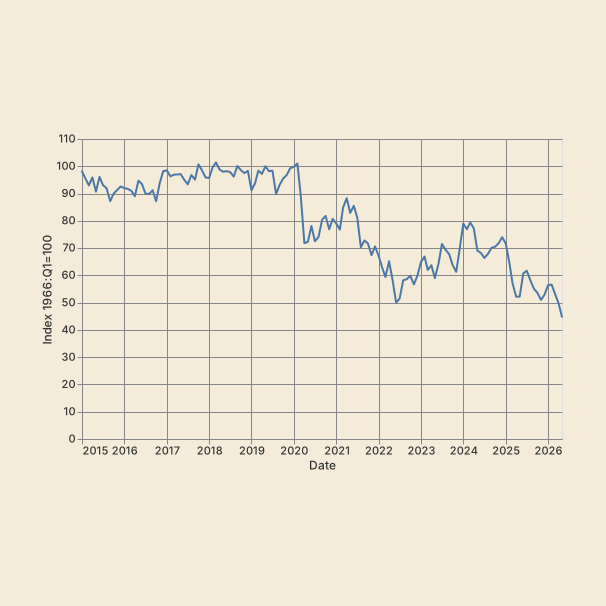
Developers starting projects now are betting that leasing demand will continue to grow despite an uncertain economic outlook. The Federal Reserve has signaled it may raise interest rates this year if inflation stays elevated. Consumer sentiment, as measured by the University of Michigan, stood at 44.8 in July, near record lows. Companies bringing in holiday merchandise early to get ahead of rising costs due to tariffs and the Iran war are expected to reduce imports later in the year, potentially softening demand.
Henry Steinberg, head of EQT Real Estate, a division of private-equity firm EQT, said companies leasing new space are in part seeking to brace their supply chains against further disruptions. “Tenants are realizing that with supply-chain volatility comes risk, and the best way to mitigate that risk is to create more diversity in the supply chain,” Steinberg said.