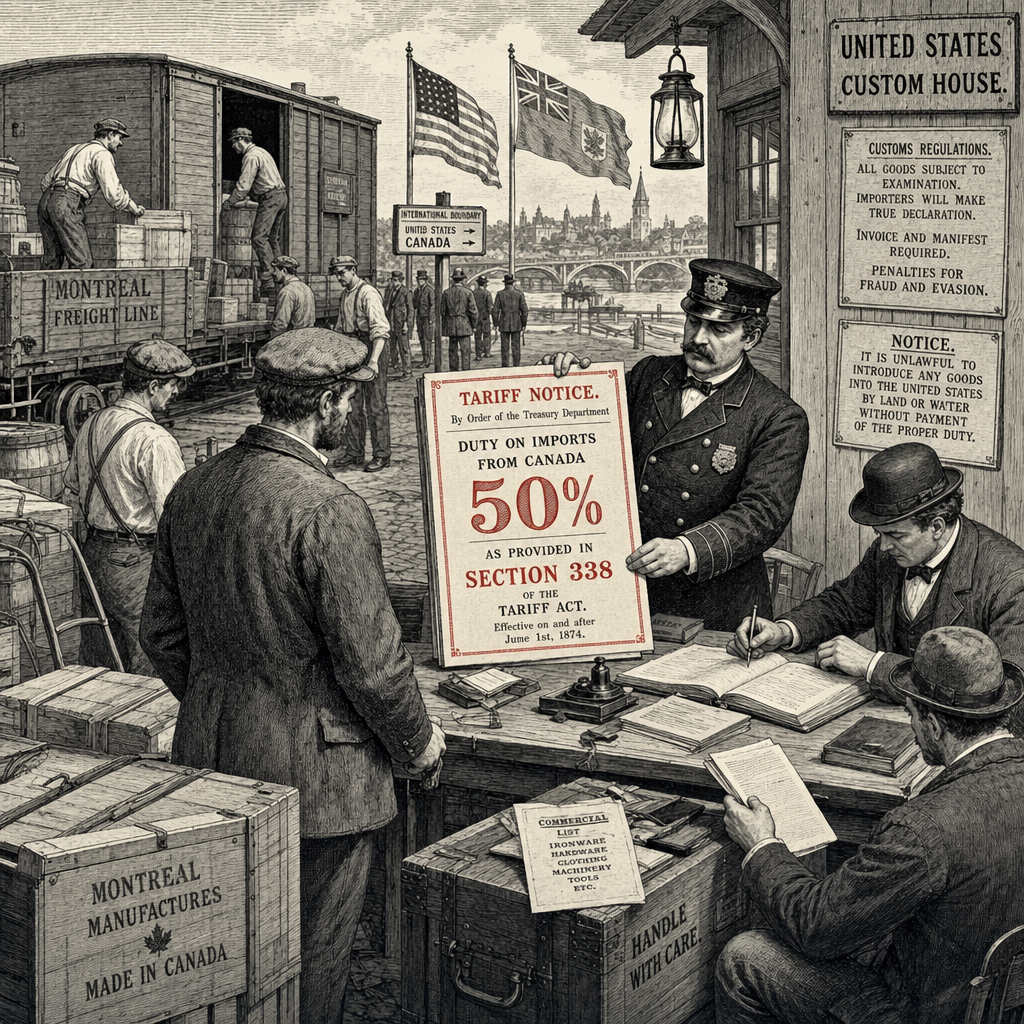
Section 338 of Smoot-Hawley law lets president retaliate when US is put ‘at a disadvantage’
President Donald Trump imposed a 50 percent tariff on imports from Canada on July 27, using a provision of the Smoot-Hawley Tariff Act of 1930 that had never before been used to levy duties, according to a report by The Guardian. The tariff came the Monday before the administration imposed a separate round of tariffs on America’s trading partners under Section 301 of the Trade Act of 1974, citing the argument that foreign countries unfairly undercut U.S. companies by importing goods made with forced labor.
The Canada tariff is the latest move in the administration’s search for new tariff authority since the Supreme Court struck down its global tariffs in February. The court ruled 6-3 that the International Economic Emergency Powers Act, or IEEPA, could not be used to impose taxes, which the justices said are the preserve of Congress, The Guardian reported. Two Trump-appointed justices joined the majority.
The White House said the Canada tariff was a response to Canadian discrimination against American dairy, booze and cars. The Guardian noted that those Canadian policies were themselves enacted in retaliation for tariffs Trump imposed last year. The report also noted speculation from observers that the duties could be aimed at punishing Canada for forest-fire smoke that drifted into the United States, softening Canada before talks to renew the USMCA trade pact, or pressuring Canadians to become America’s 51st state.
Section 338 grants the president authority to retaliate against countries that do anything to put the United States “at a disadvantage compared with the commerce of any foreign country,” The Guardian reported. Once the president determines such a disadvantage exists, the provision says he is authorized to “declare such new or additional rate or rates of duty as he shall determine will offset such burden or disadvantage.”
Until Trump’s action, Section 338 was used mostly as leverage to guarantee that other countries treated American products the same as imports from anywhere else, The Guardian reported. That principle is now called “most favored nation treatment” and is central to the multinational trade rules enforced by the World Trade Organization.
Since the Supreme Court ruling in February, the administration has drawn on several other statutes to impose tariffs. Trump imposed a 10 percent tariff on all countries under Section 122 of the Trade Act of 1974, which allows tariffs to address balance-of-payments crises — a category The Guardian said no longer applies because the dollar’s exchange rate now floats. That authority carried a statutory limit of 150 days. According to The Guardian, Trump’s own lawyers had argued in the IEEPA case that Section 122 could not serve as a substitute.
The separate round of tariffs imposed last Friday was drawn from Section 301 of the 1974 act. The Guardian reported that Section 301 is intended to retaliate against specific “acts, policies and practices” that are “unreasonable” and “burden or restrict” U.S. companies. A blanket charge that every foreign country enables forced labor could be challenged in court as “arbitrary, capricious, an abuse of discretion, or otherwise not in accordance with law” or as “unsupported by substantial evidence,” the report said. Section 301 has been used before, including by Trump in his first term against China over industrial subsidies. The administration has also relied on Section 232 of the Trade Expansion Act of 1962 to impose tariffs on steel, aluminum, lumber, semiconductors and automobiles on national-security grounds.
The Guardian reported that prior executive use of trade statutes has tested the boundaries of the law. In 1975, President Richard Nixon invoked the Trading with the Enemy Act of 1917 to impose tariffs on a zipper company from Japan, a country with which the United States was not at war. Trump’s lawyers cited that precedent before the Supreme Court as support for broad emergency tariff powers, the report said.
The Guardian reported that none of the other authorities the administration has relied on — Section 122, Section 232 or Section 301 — grants the president the breadth available under Section 338. In an analysis for The Guardian, journalist Eduardo Porter wrote, “With such a sprawling mandate, he may be difficult to stop.”