Solnit cites New Yorker on 220,000 evacuated west of Bordeaux
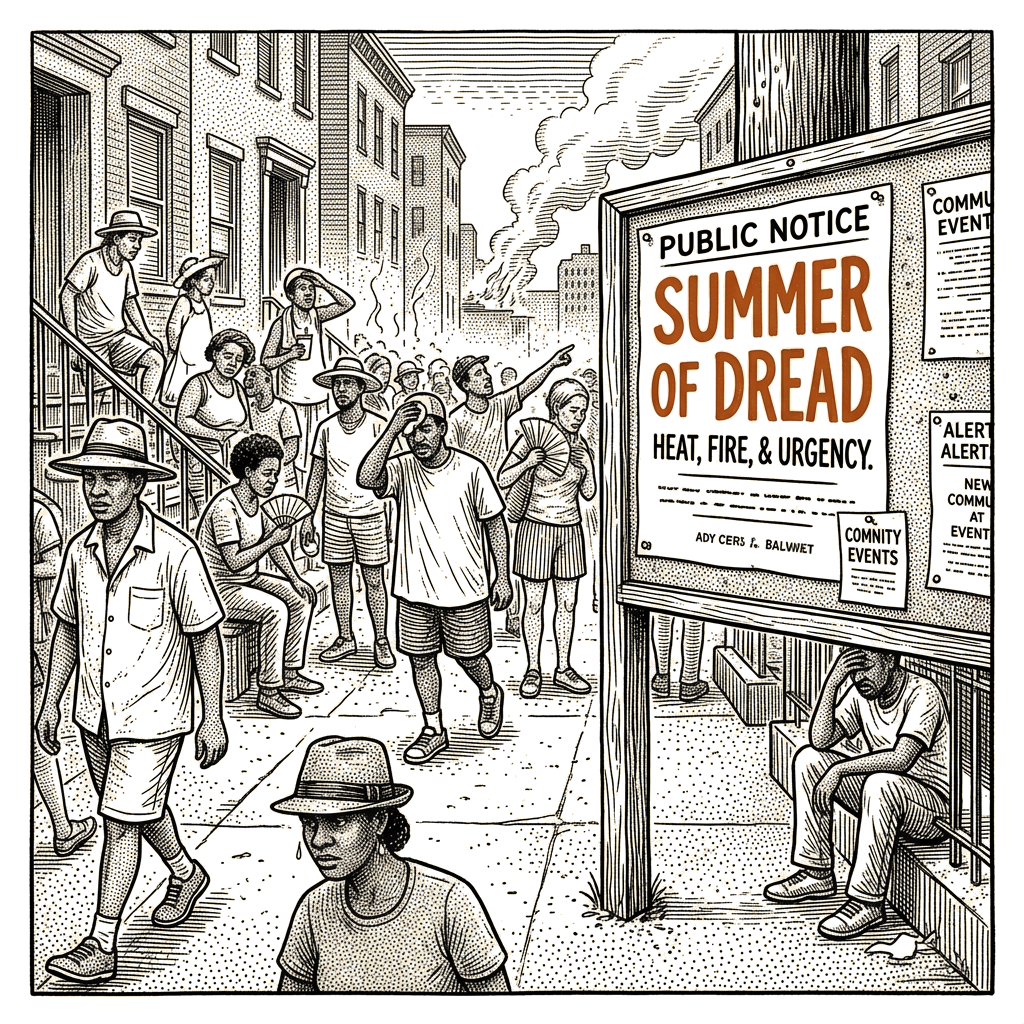
Rebecca Solnit, a Guardian US columnist and the author of “Orwell’s Roses,” published an essay August 4 headlined “We launched a war on nature. Now we are in a climate warzone.” In it she argues that climate change has remade summer across much of the temperate world — once looked forward to as “a time of delights,” with fruits, long days, warmth, school holidays, camping and swimming, travel and adventure — into something many people now dread. The piece opens with smoke from fires raging across Europe and North America hanging in the air, dimming the view and “changing the very color of sunlight into something grimly unsettling.”
At the center of the essay is a claim about loss that is not primarily physical. “Summer was an immaterial treasure and joy that belonged to all of us,” Solnit wrote. She described the season as one that too often has become “to brace against, prepare for, and dread: the season of danger, heat, fire, misery.” She framed the broader situation as a war: “It’s as if we launched a war against nature, and that has turned place after place into something that resembles a war zone.” The climate movement, she wrote, “is a peace movement, a movement to end this war and its casualties.”
Solnit cataloged the season’s toll across Europe and North America. “An estimated 20,000 are said to have died in the extreme heat in Europe earlier this year, and heat is climate change’s quiet killer, compared to the dramatic violence of death by fire or flood,” she wrote. She noted that 600 homes have just burned down in eastern Washington and that, in both Europe and North America, firefighters have died in the effort to contain climate-fueled firestorms.
Drawing on The New Yorker’s reporting, Solnit wrote: “A conflagration west of Bordeaux, described as four times the size of Paris, prompted the largest peacetime evacuation in the country’s history: 220,000 people.”
Much of the essay rests on Solnit’s own three decades of summer travel in the American West. She wrote that she has driven to New Mexico almost every summer since 1989 and was writing from there, now 37 summers after she first started coming. “It’s hotter,” she wrote. The monsoon rains there, she said, are less reliable and often more violent when they come, and Ruidoso, New Mexico, has over the past few years been “beaten up repeatedly by flood and fire.” She wrote that she has too often breathed the toxic smoke of burning forests and has seen friends’ homes reduced to ash and rubble.
Solnit recalled fearing heat for the first time when the forecast for Needles, California — a desert town on the Colorado River near the Arizona border — was 116F (46.6C), and she worried whether her car could survive such temperatures. She wrote that she managed the crossing by staying on the edge of the Mojave Desert the night before and darting across the low desert to Flagstaff, which at 7,000ft elevation stays cooler. Even in Phoenix, where her friend Mark Klett, a photographer, joked about 20 years ago that “Phoenix has two seasons: summer and hell,” she wrote that summer is now more intense, and people get severe burns from falling down on superheated asphalt.
Solnit invoked Bill McKibben’s 2011 book “Eaarth,” which she described as proposing that climate change can be understood as equivalent to moving to a more perilous, unwelcoming planet than the gentle, stable one humans evolved on over the 12,000 years since the last ice age.
The essay connects the loss of summer to the legal fight over climate accountability. Solnit wrote of “youth-led lawsuits against the producers of climate chaos and the governments who’ve refused to act adequately,” which she said were “essentially for robbing them of their future.” The erosion of summer, in her account, belongs in the same ledger. “Robbing us all of the immeasurable joys of summer as it was is part of that theft,” she wrote, adding that it is not the main reason climate action matters but a reminder that what is being lost “is not only the terms of our survival and our safety, but our freedom and pleasure.”
Solnit also considered how seasonal routines might shift, asking whether travelers will move peak vacation times to spring and fall and whether schools will change when students have their holidays. Keeping students indoors in air-conditioned spaces, she wrote, “may be even a safety measure for those who lack such protection at home.”
Solnit is the author of “Orwell’s Roses” and, with Thelma Young Lutunatabua, co-editor of the climate anthology “Not Too Late: Changing the Climate Story from Despair to Possibility.”