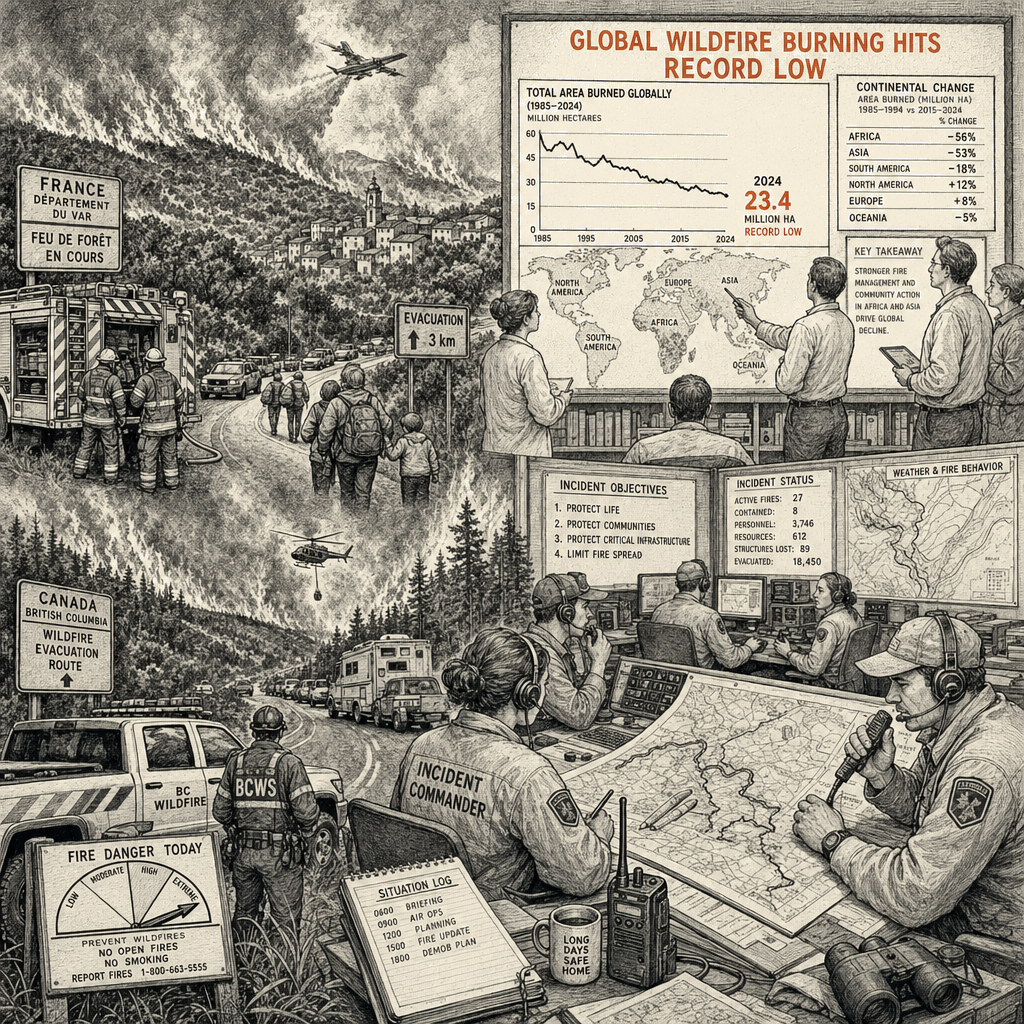
Africa and Asia control more fire, pushing global burning to record lows
Wildfires in Europe and North America are growing more extreme this summer, even as global wildfire statistics have fallen to record lows largely because Africa and Asia are controlling fire more, according to scientists and national wildfire agencies.
These seemingly opposite trends are happening at the same time because of what humanity is doing to the planet, experts said.
Spain is battling its largest wildfire on record, which has burned more than 193 square miles (500 square kilometers), according to the Associated Press. Europe’s wildfire season has burned just below the all-time high set in 2025.
In Canada and the United States, land burned by wildfires this summer is at least 25 percent higher than the 10-year average and more than double what it was decades ago, according to national wildfire centers. Smoke from the blazes has caused unhealthy air quality across large stretches of the continent.
Fires in the United States, Canada and Europe are worsening in terms of size, intensity, speed and frequency, said Jennifer Balch, a fire scientist at the University of Colorado.
“Extreme wildfires are on the rise globally in different parts of the world. And that’s the piece that you know has us shaking in our boots,” Balch said.
Mike Flannigan, a fire scientist at Thompson Rivers University in Canada, described the simultaneous trends as a paradox.
“It does seem like a paradox because we’re talking increases in fires, yet the global numbers have been going down and down. But they’re both true,” Flannigan said.
The decline in total global burning has been driven largely by Africa and Asia, where fire is being controlled more. Scientists attribute the diverging fire patterns to what humanity is doing to the planet.