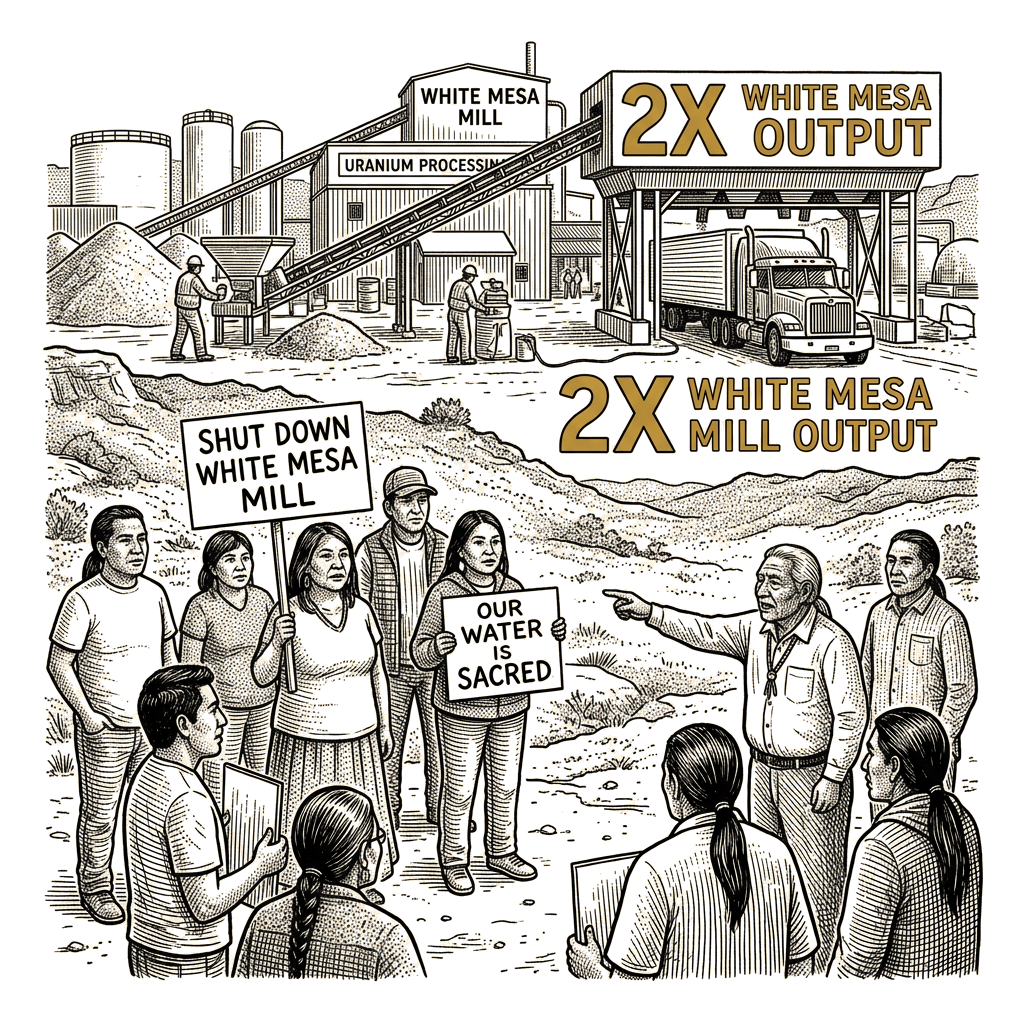
White Mesa Mill, the nation’s only remaining conventional uranium mill, sits in southeastern Utah about 5 miles south of the White Mesa Ute Community, where roughly 200 members say they do not trust the local water. Built in 1980 near what is now Bears Ears National Monument and owned by Energy Fuels since 2012, the mill produces yellowcake for nuclear power fuel and stores its radioactive waste in five lined pits, called tailings cells, that occupy 284 acres.
The renewed activity follows federal policy aimed at rebuilding a domestic uranium supply chain. A federal law passed in 2024 bans imports of Russian uranium by 2028, and President Trump has set a goal to quadruple U.S. nuclear energy capacity by 2050, issuing orders to prioritize mining on federal lands and fast-track approval of mining projects. The Velvet-Wood uranium mine in Utah cleared federal environmental review in 11 days; local tribes were given one week to offer input.
Meeting that goal would be hard because it would require constructing more reactors, which are difficult to build and often meet local opposition, said David Hart, a senior fellow for climate and energy at the Council on Foreign Relations. Data centers and rising electricity demand have intensified interest in nuclear power as a low-carbon energy source, he said.
The mill receives 10 to 15 trucks each weekday, said Curtis Moore, senior vice president of marketing and corporate development at Energy Fuels, and the majority pass through White Mesa. Ore arrives from regional mines, including one near the Grand Canyon where the Havasupai Tribe lives, and is trucked through the Navajo Nation. Those routes have linked the Havasupai, Navajo (Diné), and Ute Mountain Ute tribes in shared concern that toxic wastewater could move through the ground and poison drinking water for future generations.
The mill’s business is picking up after a quiet 15 years, Moore said. It produced 1 million pounds of yellowcake last year, and the company plans to more than double that this year. The mill has also diversified into processing radioactive waste from as far away as Estonia and Japan, and received a $725 million conditional loan commitment from the Defense Department to scale up its domestic processing of rare earth elements — work Moore said could create 100 permanent jobs. About half of the mill’s 105 workers are Indigenous; Moore estimated that no more than two belong to the Ute Mountain Ute Tribe.
“When it comes to tribes in the area, I do very much understand their skepticism of uranium,” Moore said. “They’ve been lied to before.”
That skepticism is rooted in a federal uranium boom from the 1940s through the 1980s, much of it concentrated around the Four Corners area of Arizona, New Mexico, Utah, and Colorado, which exposed miners to heightened rates of mortality from lung and other cancers. Federal reviews found that the miners, many of them Navajo (Diné), were not warned about radiation risks even after government scientists understood the dangers. Mining companies left behind thousands of abandoned waste sites that have leached contamination into surrounding soil and water, including over 500 spots on and near the Navajo Nation.
Moore said conditions have changed since the 1950s: workers today are exposed to 15% to 20% of allowable radiation limits, and outside the mill radiation is “effectively zero.” Government agencies and Energy Fuels officials have said there is no evidence the mill is affecting White Mesa’s drinking water supply, which comes from a deep aquifer protected by a thick rock barrier known as an aquitard. “It really is the perfect site for a uranium mill,” Moore said.
Scott Clow, environmental programs director of the Ute Mountain Ute Tribe, said that deep aquifer does have quality issues — including arsenic, iron, and manganese — but the public drinking water is filtered and safe to drink. Adam Wingate, uranium recovery manager at the Utah Department of Environmental Quality, said he understands why residents are concerned: White Mesa sits downslope from the mill in terms of underground water flow, and a plume of contamination pollutes a different, shallower aquifer beneath it. Based on available evidence, Wingate said, locals’ “health is not at risk because of the mill.”
Lehi and Badback said the tap water smells of sulfur and has a milky color, and that people in White Mesa typically don’t drink it. “I don’t trust it,” said Badback, whose family has been fighting the mill for decades. “My main goal is to shut the mill down.” Both have complained of odors from the mill that smell like chemicals or rotten eggs; Moore denied that any odors could be smelled beyond the mill’s parking lot. Utah air quality officials said the state does not conduct ambient air monitoring in White Mesa and does not regulate odors.
Federal regulators have documented one Clean Air Act violation at the mill. In December 2021, the Environmental Protection Agency found the mill was violating the act by failing to cover one of its tailings cells with liquid to limit emissions of radon, a known cause of lung cancer, calling the violation “egregious in nature and duration” and temporarily barring the mill from receiving waste from Superfund cleanup sites. The mill corrected the problem, according to state regulators, and passed its latest air quality review in 2025. A 2023 federal health assessment concluded that radiation levels measured at the tribe’s air monitor in the center of White Mesa between 2013 and 2019 were unlikely to harm human health, but its authors said they could not evaluate whether the mill’s radon emissions could affect bordering properties or residents, and recommended collecting air samples closer to the mill during times of heightened activity.
Badback, a Ute Mountain Ute member who leads the White Mesa Concerned Community advocacy group, has vowed to fight expansion plans that include new tailings cells located about a quarter-mile closer to the White Mesa community than the current ones. Moore said the cells will be triple-lined per modern standards. “They want to expand south towards my reservation,” Badback said. “That’s the reason why I am standing up and doing whatever I can to stop that from happening.” In 2021, the tribe passed a resolution stating that the mill “has had severe health impacts on the residents of White Mesa and should cease entirely.” At a No Kings rally in March in Moab, about 80 miles north of White Mesa, Badback gave a speech and staffed a table offering T-shirts that read “No Uranium. Protect White Mesa Ute Community.”
The tribe, the state, and the company also monitor seeps and springs, including Entrance Spring across the highway from the mill, for clues to whether the mill’s waste ponds are leaking. In the late 2000s, an EPA report found elevated contamination by radionuclides at the spring, and water samples showed uranium concentrations that at times exceeded the federal drinking water standard; EPA and U.S. Geological Survey fieldwork suggested the uranium came from dust blown off the mill’s ore storage pads rather than from leaking waste ponds. The latest tests, from 2025, showed Entrance Spring had uranium at 22.5 micrograms per liter, within the federal drinking standard of 30 µg/L but still elevated. “We’re concerned about the pollution of those springs,” Clow said. “We are looking towards many generations in the future here.”
Clow is also closely watching the Burro Canyon Aquifer, which lies beneath the mill’s toxic waste cells and feeds the local springs. Wingate said a plume of chloroform and another of nitrates already pollute the aquifer, and that Energy Fuels is pumping out the contamination. He said it is hard to prove whether rising contaminants stem from natural causes or mill activity, since substances such as sulfate and manganese occur naturally in the local bedrock. What is not in dispute is that the mill produces radioactive waste — and once that exists, it can linger for tens of thousands of years. Lehi, a former tribal councilmember who said he feels a duty to protect the landscape as his ancestors did, described the spring as a place the tribe doesn’t rely on for drinking water but watches closely. “Water is life,” Lehi said, “because that’s where we all began.”