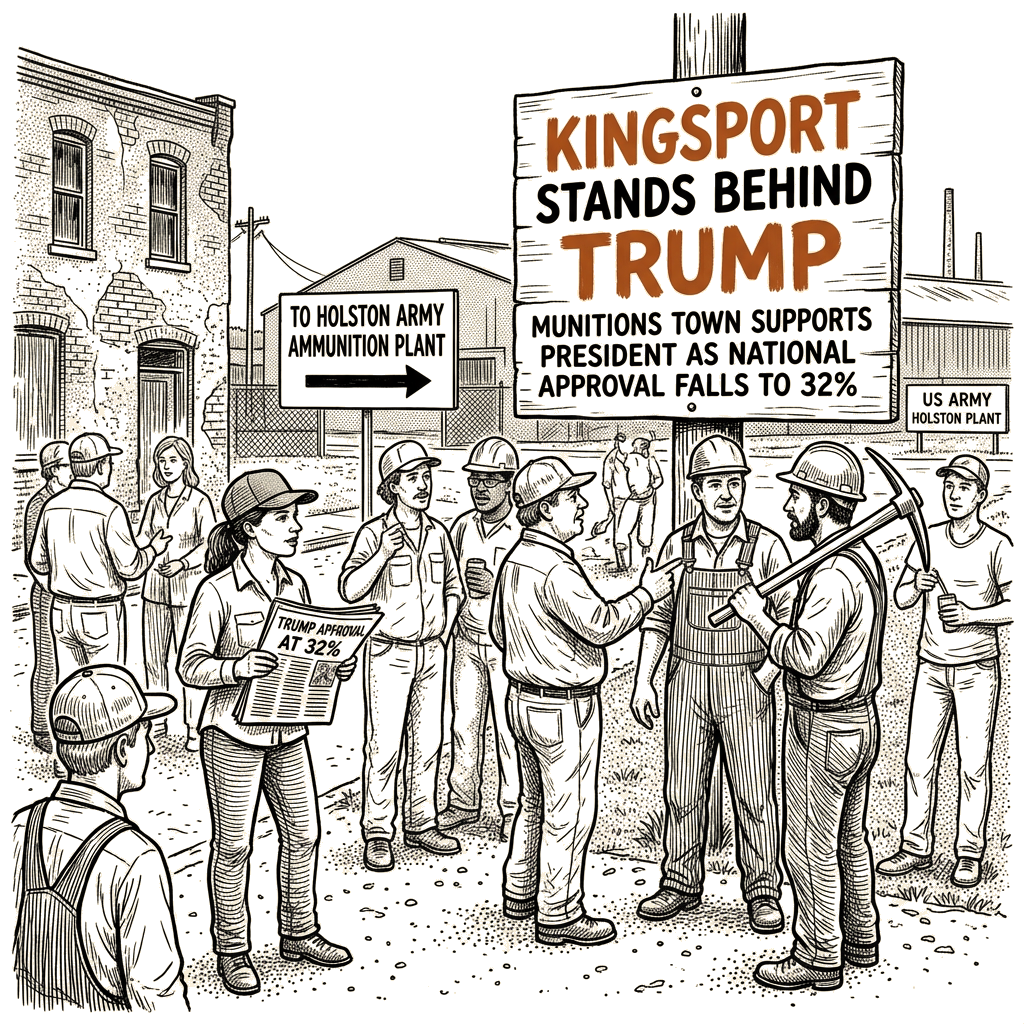
Holston plant is only US supplier of some military explosive parts
The town of Kingsport sits in the Appalachian Mountains of northeast Tennessee, a working-class community of about 58,000 where more than 300 churches dot a landscape that one local describes as having “a church on every street.” Above downtown’s historic Lamplight Theatre, a sign proclaims “Jesus first in all things.” What sustains the town economically, however, is not a congregation but a sprawling industrial complex: the Holston Army Ammunition Plant, which churns out explosives used in Patriot missiles, warheads and other heavy weaponry in the midst of the ongoing war with Iran, which began in February 2026.
Trump’s decision to strike Iran, announced in an eight-minute video posted to social media after failed negotiations, has coincided with a steep decline in his approval. Recent polling places his approval at a historic low of 32%, down 14% from when he took office in January 2025, with many Republican respondents citing disillusionment with the president’s policies. The two drags on his popularity are the cost of living and the Iran War, one bleeding into the other — the conflict has pushed gas prices above $4 a gallon, a painful hike for businesses that rely on transport.
In the video, Trump said “the objective is to defend the American people by eliminating imminent threats from the Iranian regime” and claimed Iran “will never have a nuclear weapon.”
In Kingsport, residents continue to express strong support for the president. The city voted overwhelmingly for Trump in all three of his elections, and Tennessee has been a Republican state for more than 25 years. When it comes to the Iran conflict, most residents either outright support the military action or describe the war as necessary — despite Trump’s repeated campaign promise of “no more wars.”
“If he can stop anyone from having a nuclear bomb, then I’m for it,” said Pam Robinson, 65, who spent 20 years working at the local chemical plant. David Carter, a 66-year-old veteran, said “the whole reason we go over there, and we keep everything under control there, is [so that] we don’t have it on our doorstep.” Another veteran, James Camper, 63, was more blunt, saying: “Honestly, I think we should turn them into a parking lot and don’t worry about it anymore.”
Veterans account for around 10% of the region’s population, and many other households have active-duty family members. Robinson, a Christian and independent voter who said her faith informs her candidate choices, suggested the remote nature of the war may be preventing more local upset with Trump. “If it was hand-to-hand and more people were getting killed, people would be banging the doors down,” she said.
The plant’s role as a main munitions manufacturer gives residents a unique perspective on the conflict. It employs around 1,000 people and stands as the only domestic supplier of some essential explosive and propellant components. “The plant’s going to be open regardless of whether we’re at war or whether we’re not. It is what it is,” said Daniel Overstreet, 53. He said he believes the administration is “doing a great job” but that there are “too many people trying to fight him,” describing the president as “basically a puppet for Congress and the Senate.” His hands, Overstreet said, “are tied, to a certain extent.”
Residents complain about high gas and food prices and other economic woes, but they largely do not blame Trump. Robinson said the president has “done good on some things” but needs to check his advisers — “I think he’s advised wrong on some things.” Evangelist William Bogle, 75, who voted for Trump every time he ran, said the president is “doing a good job” even though his wife “has to stretch a grocery dollar until, you know, it’s big as a bedsheet.” Trump is “just gonna have to do a little bit better in some things than he’s doing right now,” Bogle said, adding, “I know he wants the country to prosper.”
Continued local support reflects a dynamic sometimes hidden in the polling headlines: while Trump has lost favor among more traditional Republicans and independent voters, his base — those who identify with his “Make America Great Again” mantra — remains far more steadfast. That loyalty shows in local politics. In last week’s local elections, the ballot included a single Democratic candidate, and of the county commission’s 11 districts, seven featured only Republicans running, with some unopposed.
Many residents said they cannot and will not cross party lines for moral reasons, citing abortion as the single biggest deciding factor, with opposition to socialism and “woke” issues too hard to ignore. Carter conceded that Trump needs to humble himself more, but said he would only consider a candidate who “supports the morals” of the population — which means opposing abortion, for example.
Liberal views exist in Kingsport but are vastly in the minority and less vocal. Adam Teague, 44, a gay, heavily tattooed Democrat who works as a piercing artist downtown, said he toned down his appearance after Trump took office. “Before Trump took office, I was wearing, like, rainbow shirts and everything,” said Teague, who was raised Baptist. “I kind of toned it down, just to feel safer.”
Trump was triumphant in the 2024 election in part because of his ability to attract a diverse coalition, but polling suggests many young people who helped him beat Kamala Harris are now disillusioned. Mary Herron, 21, a student who works part-time, said she has noticed a shift among her contemporaries. “I am seeing a shift in the support … that’s kind of rare around here,” she said. “But I’ve seen a handful of people who have been like, ‘Oh yeah, well, I voted for him, and now I’m not with him anymore’.”
Her friend Emily Villalpando, 21, a biomedical science student who wants to be a doctor, said Trump first entered politics when she and her friends were in middle school, and many in her generation initially took on their parents’ political views. Now that they are taking on more responsibilities, she said, “the economy affects us a lot more.” The three friends — including Caden Bayless — cited women’s rights and heavy-handed immigration agents as major concerns, though they are skeptical of major shifts in the region. Bayless said she hopes the younger generation can make a change, but “given where we live … it would be a very difficult change.”
Bogle, summing up the region, inadvertently spoke to those fears. “We live in a great place, and if you’re not conservative, don’t come here,” the preacher said. “Because you wouldn’t be a good fit. But if you’re conservative, come here, and we’ll embrace you.” He said he will be praying for Trump, as will the more moderate Robinson. “All you can do is pray for your leaders, and God will give you what you want in the end,” she said.