US Treasury finds virtually all Western parts routed through China
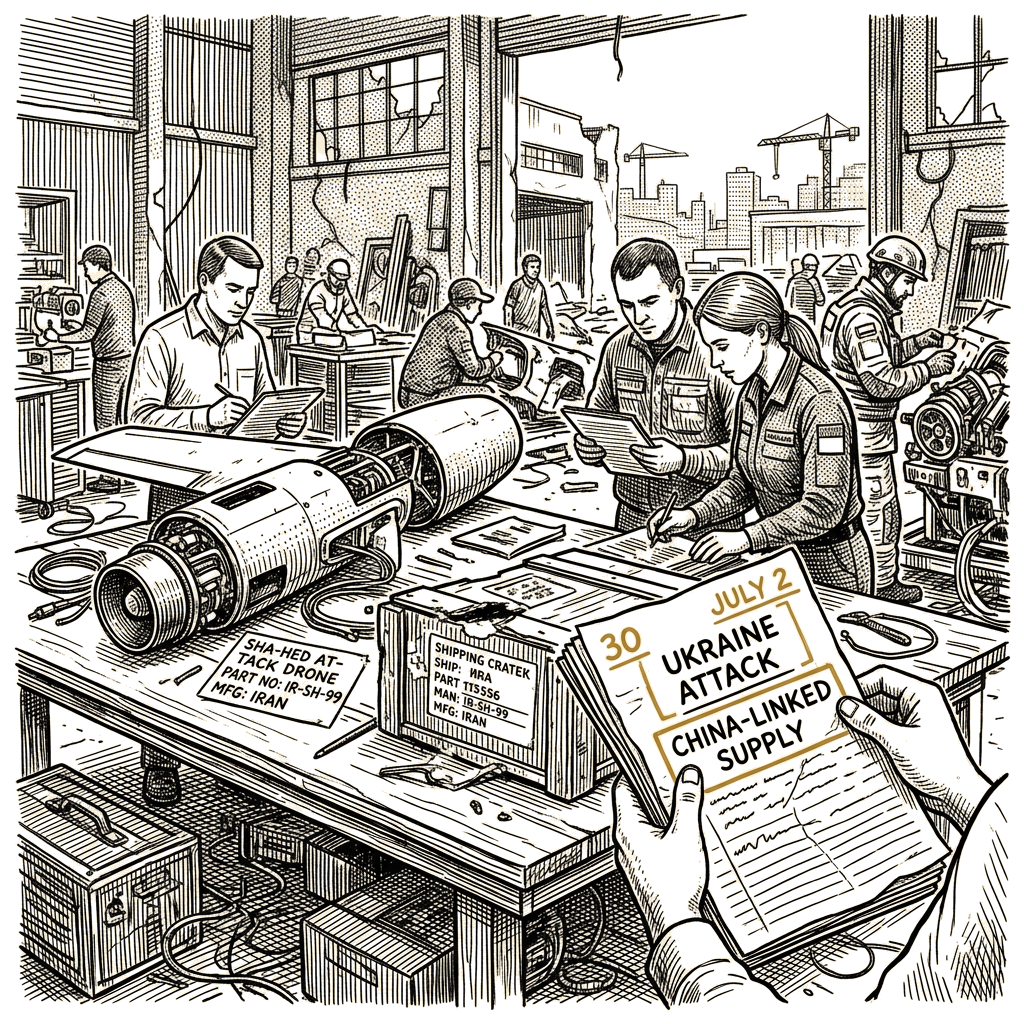
A Wall Street Journal investigation published on August 26 traced Iran’s Shahed attack drone program to a China-linked global supply chain, including a turbojet-powered variant that Ukrainian officials say was used in a July 2 attack on Kyiv that killed some 30 people. The reporting details how Iran draws on Chinese manufacturers, Hong Kong-based shell companies, and Western components rerouted through Chinese intermediaries to produce a weapon that costs as little as $20,000 per unit.
The turbojet-powered Shaheds now fly at roughly 300 miles per hour, about three times the speed of older versions, and can outrun the interceptor drones Ukraine typically uses to shoot them down, according to the Journal. Russian forces launched the faster drones, along with ballistic and cruise missiles, in the July 2 attack on Kyiv that killed some 30 people.
Ukrainian officials who examined debris identified Telefly Telecommunications Equipment, a Shenzhen-based company founded in 2010 that is primarily a maker of computer hardware and communications equipment, as the source of the turbojet engines. After Ukraine publicized the discovery, the turbojets section disappeared from English-language pages on the company’s website, though it remained on its Chinese-language pages and on other Chinese vendors online, the Journal reported. Telefly did not respond to requests for comment.
A broader pattern has emerged over years of U.S. and Ukrainian investigations. Treasury Department probes found that virtually all American and European parts found in Iran’s and Russia’s one-way drones were diverted through Chinese intermediaries, with shell companies — often in Hong Kong — ordering parts from Western suppliers while disguising the ultimate destination. Parts identified in teardowns include microcontrollers from Texas Instruments and linear regulators from STMicroelectronics of Switzerland. Texas Instruments said it “strongly opposes the use of our chips in Russian and Iranian military equipment and the illicit diversion of our products to Russia and Iran.” STMicroelectronics said it “doesn’t support or condone the use of its products in applications outside their intended purpose.”
“For a long time the focus for making the Shahed was about getting Western parts. They focused on that a lot,” Kerri Bitsoff, a former Treasury Department official, told the Journal. “Now I think that has shifted as China has become better at manufacturing parts and technology like this.”
The Shahed-136 first drew international attention in July 2021, when drones struck the MV Mercer Street, an oil products carrier off Oman’s coast, killing a Romanian captain and a British security officer. They were the first known victims of a drone whose precursors had appeared in Iranian state media and in 2019 strikes on Saudi oil facilities. Iranian engineers likely benefited from Western designs, analysts told the Journal; in the 1980s the United States and West Germany collaborated on a drone intended to take out radar systems, and an Israeli company later built a similar drone known as the Harpy.
Iran may have had some access to Harpy drones used by Israel in Syria or Lebanon, Farzin Nadimi, a senior fellow at the Washington Institute for Near East Policy, told the Journal, but the design had also been widely known for years in military journals. The development of a sustained high-speed engine remained a major obstacle for Iranian engineers, and the best option was a German-designed engine known as the L 550 E, made by Limbach Flugmotoren. A 2008 WikiLeaks cable from U.S. diplomats to their German counterparts described how Iran obtained the engine, possibly with the help of intermediaries using fake documents to throw customs inspectors off the scent.
In 2012, a Chinese company began distributing Limbach’s engines and bought the German company outright in 2017, making it easier for Iran to import them. The Treasury Department later sanctioned the Chinese affiliate, Xiamen Limbach Aircraft Engine, for supplying engines to Russia for its drone program. Xiamen Limbach did not respond to requests for comment. Iran eventually developed its own engine based on the Limbach models, led by Oje Parvaz Mado Nafar Company, a firm U.S. officials link to the Islamic Revolutionary Guard Corps. The U.S. sanctioned Mado in 2021.
Ukraine later said the company’s co-owner and chairman, Brig. Gen. Abdollah Mehrabi, was directly responsible for a 2022 deal that sold more than 13,000 Shaheds to Russia, along with components and manufacturing equipment, for $324 million. Iranian and Russian officials did not respond to requests for comment. The U.S. sanctions against Mado also targeted a Chinese businessman named Ma Jie for allegedly helping supply parts, including arranging meetings between Iranian defense officials and Chinese suppliers and using companies in mainland China and Hong Kong to buy parts for the drones, such as aluminum alloy castings for engines.
The weapon’s reach has spread well beyond Ukraine. According to the U.S. Defense Department, Iran has sold its drone technology to Venezuela, Syria and Ethiopia, while Russia’s Africa Corps has used Shaheds in Mali. The weapon also helped devastate a U.S. base in Bahrain at the start of the war with Iran, according to the Journal, fueling Navy logistics problems. Ukraine’s air force says Russia has launched Shaheds every night this month. China and India have also revealed their own versions of the drone.
Col. Oleksandr Zaruba, a senior Ukrainian government researcher, told the Journal in June that newer Shaheds carry more antennas, modems and SIM cards to correct flight paths using local networks, and that the components increasingly come from China. Some drones have been found with antiaircraft weapons attached — one photograph shown to reporters in Kyiv showed a large antiaircraft missile strapped to the top of a Shahed, an echo of the antitank weapons Iranians attached to early drones in the 1980s. Zaruba said the missile was not functional and was likely intended to scare off aircraft attempting to shoot the drone down.
China’s foreign ministry did not respond to a request for comment. It previously said it strictly regulates the export of “dual use” components and rejects unilateral U.S. sanctions that punish unauthorized trading of such parts, saying they violate international law. Hong Kong’s government said it vigorously enforces United Nations sanctions but not those imposed unilaterally by individual nations.
The U.S. military was inspired by Shahed technology to develop a low-cost drone that it has used in the war with Iran, according to the Journal. Ukraine’s President Volodymyr Zelensky singled out Russia’s use of turbojet-powered Shaheds after the July 2 attack. Ordinarily, Ukraine stops more than 90% of the older one-way drones Russia sends, but the new turbojet models can outrun interceptor drones and must be downed by jet fighters or Ukraine’s limited supply of interceptor missiles, Ukrainian officials said. Russia sometimes launches Shaheds — which it calls Geran — alongside ballistic missiles in an effort to overwhelm defenses.
“We’re going to see these things everywhere,” Mick Ryan, a retired Australian Army major general and military analyst, told the Journal.