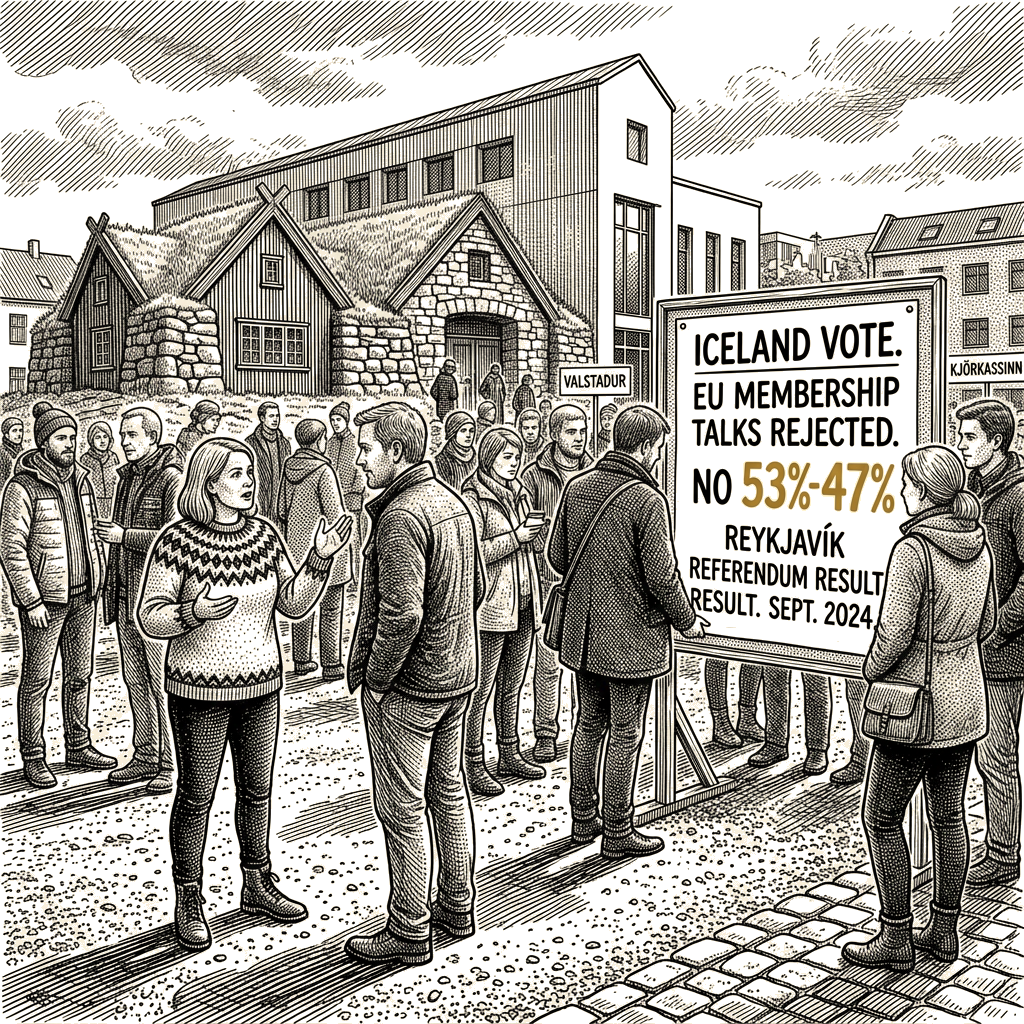
Analysts cite fish, sovereignty and inflation as central to voters’ decision
BRUSSELS — Icelanders voted 53%-47% on Saturday against resuming European Union membership talks, with Prime Minister Kristrún Frostadóttir saying her government will not pursue membership during its four-year term that ends in 2028. It was the first time Icelanders were asked about EU membership talks in a referendum. A previous Icelandic government suspended negotiations with the bloc in 2013, after earlier talks that followed the country’s 2008 financial crisis.
More than 80% of eligible voters cast ballots, according to Frostadóttir. The vote came against the backdrop of President Trump’s tariff policies and his pressure campaign regarding Greenland — pressures that some ‘yes’ supporters had cited as reasons to seek protection from within the bloc.
Others worried that joining the EU would hand too much power to Brussels. “A ‘yes’ vote would have shown that countries—particularly rich countries in the north—are buying what the EU is selling as a source for stability,” said James Batchik, deputy director of the Atlantic Council’s Europe Center. Instead, Batchik said, Icelanders decided that the potential benefits of membership were not enough to override concerns that joining the EU could undermine the country’s sovereignty.
The referendum asked voters to weigh whether a country of 400,000 inhabitants, with no military and little economic clout, could gain strength by casting its lot with the EU’s 27 countries. It is a dilemma many countries have grappled with since Trump’s return to office. Canadian Prime Minister Mark Carney has sought to rally so-called middle powers to push back on U.S. tariffs and threats. The EU, itself a collection of small and middle powers, has struck free-trade deals with India and Australia while drawing closer to Latin American economies and to East Asian allies including Japan and South Korea.
Frostadóttir, who had advocated for Iceland to negotiate with the EU, said many voters gave priority to economic issues and sovereignty over security and tariffs. “For a lot of people, this discussion was around currency, interest rates, inflation,” Frostadóttir said. “You know, kitchen-table matters.”
Fish were also a factor. The EU typically requires members to participate in its common fisheries policy, although EU officials had suggested they could offer some flexibility. Iceland’s fishing industry wanted the country to maintain full control over when and where fishing takes place.
Iceland, a founding member of the North Atlantic Treaty Organization, is wealthy and politically stable and would have had a relatively easy path to becoming an EU member. A successful bid could have benefited the bloc, which hasn’t added a new member since 2013, by showing that it remains capable of growing after the U.K.’s exit. The country is already part of the European Economic Area, which extends the EU’s single market to a handful of non-EU countries, and is a member of the EU’s Schengen visa-free area. Iceland signed a security and defense partnership with the EU earlier this year.
Still, the effects of Iceland’s rejection for the EU are mostly symbolic. With a population equivalent to less than 0.1% of the current EU’s head count and deep ties to the bloc for decades, Iceland’s membership would not have significantly increased the EU’s economic or political heft.
The bloc will miss an opportunity to be a bigger player in Arctic security and to boost the international standing of the euro currency, said Steven Blockmans, deputy director of the Estonia-based International Centre for Defence and Security. He said the bloc could also have benefited by gaining a net contributor to the EU’s budget. Iceland’s rejection could reinforce a view that membership “is attractive only to poorer and conflict-ridden countries, not to affluent European democracies,” Blockmans added. Ukraine and several Balkan countries are eager to join.
Kristinn Árni Hróbjartsson, co-founder of the Icelandic think tank Varda, cautioned against overinterpreting Icelanders’ decision as damaging to the EU, noting that the question about joining the bloc was hotly debated and the referendum was always going to be a tight race. Part of the reason Icelanders rejected the talks, he said, is likely that they feel well-protected through the country’s NATO membership and a defense pact with the United States.
EU officials said on Sunday that they respected Icelanders’ decision and that the country remains a close partner. Icelandic Foreign Minister Thorgerdur Katrín Gunnarsdóttir, who has long supported reopening EU talks, said the rules-based order had come under attack. “It is obvious that the world has changed dramatically,” she said. “Right now, this government is not putting this case forward,” she said of EU membership talks. “But what happens in two years’ time or three years’ time, I will not anticipate.”
Politicians who campaigned against EU enlargement celebrated the outcome. “Congratulations to Iceland on voting to keep their independence,” said Nigel Farage, who led the U.K.’s Brexit campaign and now heads Reform UK. French presidential hopeful Marine Le Pen said the vote “reminds us that another Europe is possible.”
Saturday’s vote was not the first time a Nordic country has rejected the EU. Iceland previously held membership talks with the bloc after its 2008 financial crisis, before a new government suspended them more than a decade ago. Norwegians rejected EU membership in a 1994 referendum.