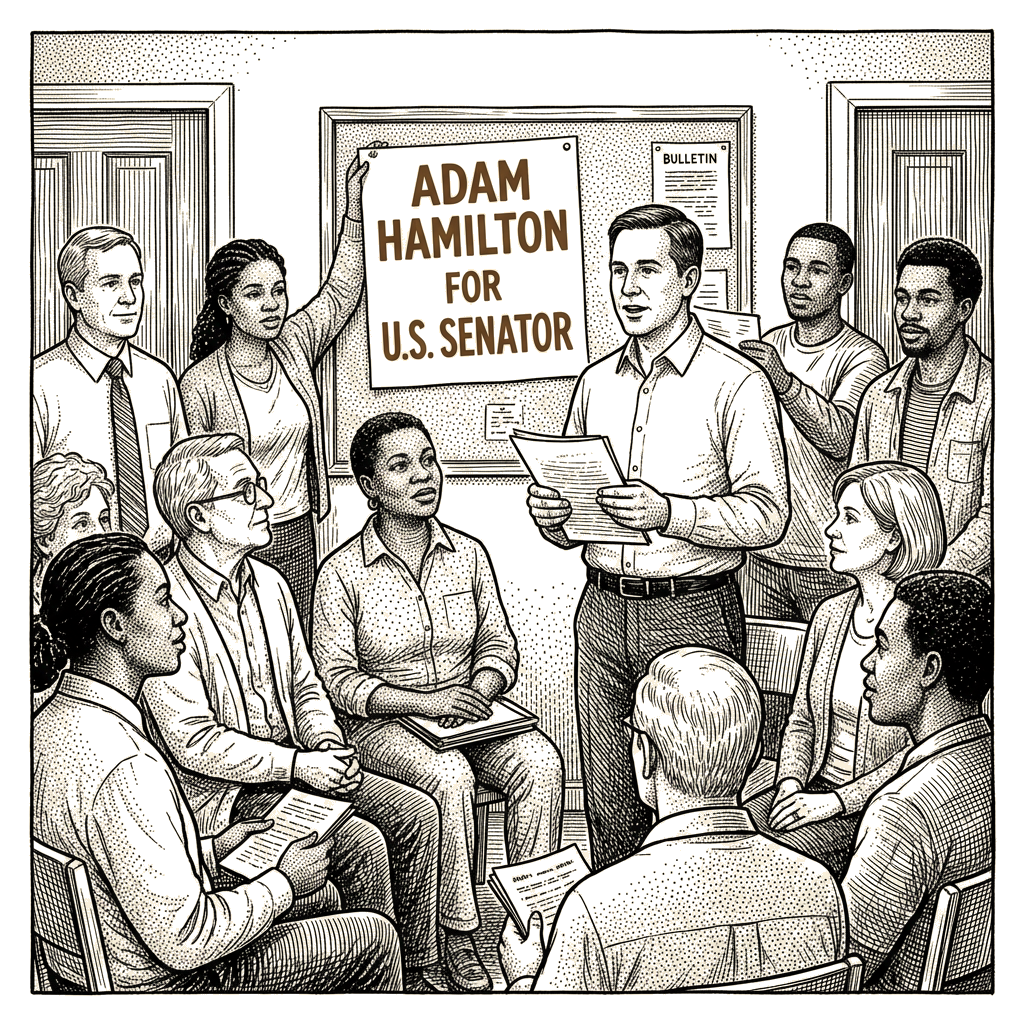
Marshall calls Hamilton ‘too woke for Kansas’ as conservatives attack his faith
The Associated Press reported that Hamilton, a first-time candidate, faces Marshall in the Kansas Senate race. Hamilton is seeking to bring voters to the polls while maintaining a pastoral role that has given him unusual prominence for a Democratic candidate in the state.
Hamilton founded the Church of the Resurrection. The congregation has roughly 25,000 members in the Kansas City area, and the AP described it as the nation’s largest United Methodist church.
Hamilton has made clear that he would keep serving as senior pastor if elected. He said he would preach at the church 12 to 18 times a year while serving in the Senate.
That arrangement would place Hamilton in a small group. The AP reported that, during the past 100 years, only Warnock of Georgia has served in the Senate while continuing to lead a congregation.
Warnock has preached regularly as senior pastor of Ebenezer Baptist Church in Atlanta since his election as Georgia’s first Black senator in 2021. In a video posted to U.S. Senate Democrats’ Facebook page, Warnock described the relationship between his political and pastoral work.
“They are both about working for people even as you walk alongside them,” he said. “I have always been engaged in a kind of ministry that takes you far beyond the sanctuary to the streets, far beyond preaching to the public square.”
Hamilton’s pastoral role has also made him a rare prominent Democrat in a state where Republicans have won every Senate race for nearly a century. Some in his party are hoping for an upset victory over Marshall.
Conservatives are trying to use Hamilton’s religious leadership against him. They suggest that his sermons show he is too liberal for Kansas or that he is a heretic for suggesting that non-Christians have a path to salvation after death. Marshall’s characterization of Hamilton as “too woke for Kansas” is one example of that line of criticism.
The Kansas election will determine whether Hamilton joins Warnock in combining service in the Senate with continued leadership of a congregation.