Crude oil rises 7% this week, 50% on the year; gasoline averages $4.10 a gallon
WASHINGTON — U.S. Central Command said Tuesday evening it had completed a fresh round of strikes against Iranian military targets — air defense sites, radar systems and maritime assets — ending a month without military action in a conflict that has now lasted more than six months.
The Tuesday barrage followed strikes on Sunday against Iranian rocket launchers that, according to Central Command, had been positioned to fire sea mines into the Strait of Hormuz. Tehran has effectively closed the waterway since the war began; roughly 20% of the world’s oil is normally shipped through the narrow corridor off Iran’s coast. After the Sunday strikes, Iran fired missiles at U.S. sites in Jordan — which Jordan said it intercepted — and the United Arab Emirates said it stopped an Iranian drone over its waters. Trump acknowledged Monday that more strikes might be necessary.
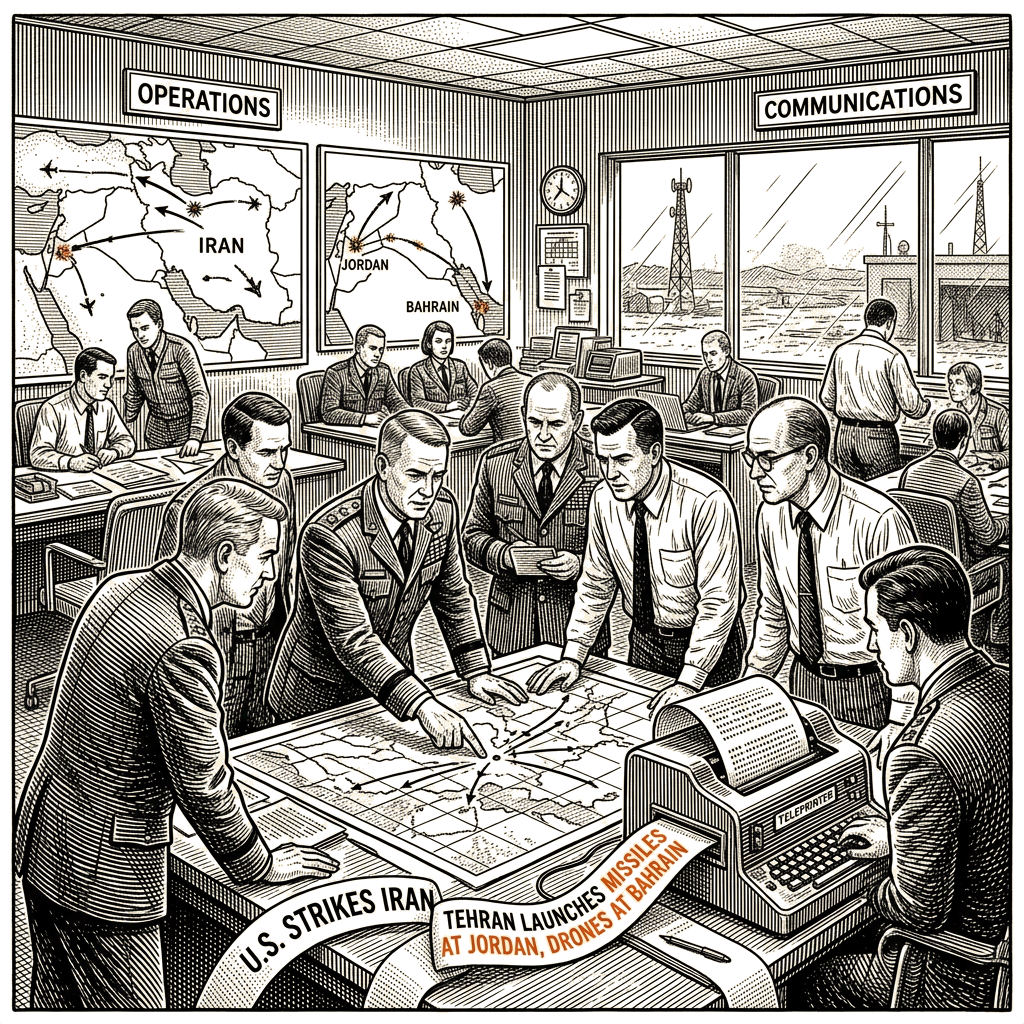
Iran’s response to Tuesday’s strikes came within hours. Iran’s Armed Forces General Staff and joint military command said the armed forces would deliver “crushing and devastating blows” against the United States, according to the state-run IRNA news agency, which cited a separate statement from the paramilitary Revolutionary Guard warning that the attacks had tightened Iran’s effective closure of the strait. State media reported that Iranian ballistic missiles were fired at Jordan, with the Revolutionary Guard claiming to have targeted a U.S. base along the Gulf of Aqaba coast.
Jordan’s military said it shot down 10 of the missiles; the three that remained landed in unpopulated areas, according to the military. Witnesses reported explosions over Aqaba that appeared to be interceptions of incoming weapons. Iran said it separately launched drones at U.S. forces in Bahrain and at Kuwait. Bahrain said all attacks on its territory had been intercepted. Kuwait’s army said on X that its air defenses had repelled what it described as “the criminal Iranian aggression.”
Iranian state media reported multiple civilian sites hit along Iran’s southern coast. State television said a fishmeal factory on Qeshm Island in the Strait of Hormuz was struck, along with a fishing pier and a Ports and Maritime Organization tower in Sirik. State television also reported that a projectile struck an area outside the runway at Jiroft Airport in central Kerman province, causing no casualties and no damage to airport infrastructure.
Separately, Iranian state television reported that a U.S. strike hit a home where a wedding ceremony was being held in Kuhestak in southern Iran, killing five people, including a child, and wounding at least 68 others, according to Ahmad Nafisi, deputy governor of Hormozgan Province, who spoke by phone with Iranian state media.
“Make no mistake: these crimes will not go unpunished,” Ebrahim Azizi, chairperson of the Iranian parliament’s National Security and Foreign Policy Committee, said on X.
Central Command said it was aware of the civilian-casualty reports. Capt. Tim Hawkins, a Central Command spokesperson, noted that the reports “originated from Iranian state media.” “The U.S. military never targets civilians, unlike the IRGC,” Hawkins said.
President Donald Trump signaled in social media posts late Tuesday that he saw no immediate path back to diplomacy.
“I couldn’t care less if they sign a worthless, to them, agreement,” Trump wrote. “I like our position now much better, with almost total control of the Hormuz Strait, and their economy totally collapsing. They are just playing out the inevitable. When are the Iranian people going to rise up and fight?”
Earlier in the day, Trump had warned that any Iranian retaliation would draw further U.S. strikes. In a phone call with Fox News, Trump said U.S. forces had moved against Iran’s radar installations as they were being rebuilt. “They tried to rebuild their radar because they can’t see anything,” Trump said. “We waited until it was almost built and then we hit it.”
The renewed fighting has tracked the broader economic shape of the conflict. Crude prices rose about 7% this week and are up more than 50% this year, according to market data cited by The Associated Press. The U.S. national average for a gallon of regular gasoline ticked higher overnight to $4.10, AAA said, compared with $3.19 a year earlier.
State television reported that Tavanir, Iran’s electricity grid management company, said several parts of Hormozgan province’s power network had been struck and that authorities were working to restore outages. Explosions were reported across several southern Iranian coastal areas, including the port city of Bandar Abbas — home to naval and air force facilities — and on Qeshm Island. Witnesses in Bandar Abbas told The Associated Press that the explosions were stronger than those on Sunday and said they saw smoke rising from the eastern part of the city on the strait.
Central Command said its latest attacks were in response to Iranian attempts to hit commercial ships and U.S. forces in the Middle East. Before the most recent military action, the Trump administration had argued that a campaign of financial isolation aimed at the right economic pressure points could get Tehran to its breaking point without further strikes. U.S. stockpiles of advanced interceptors have been diminishing through the months of fighting, and the war has been unpopular among many Americans.
Earlier Tuesday, before the latest strikes, Iranian President Masoud Pezeshkian said at the Shanghai Cooperation Organization summit in Kyrgyzstan that the Islamic Republic was prepared to return to the interim ceasefire deal reached with the U.S. in June if Washington did the same.
“If the U.S. returns to its commitments in the memorandum of understanding, the Islamic Republic of Iran will immediately reciprocate,” Iranian state media quoted Pezeshkian as saying.
The June interim deal called for an immediate ceasefire and began a 60-day period of negotiations aimed at reaching a wider agreement. The deal collapsed soon afterward.