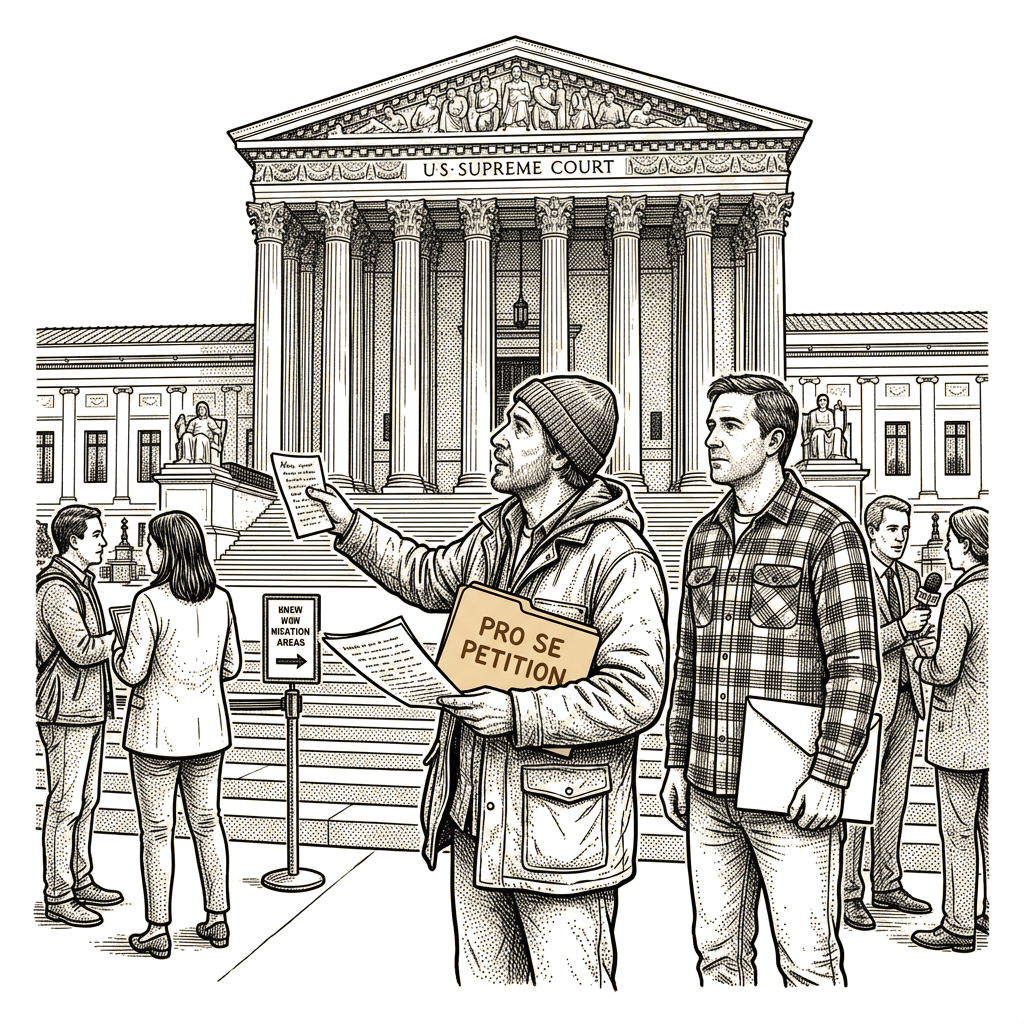
Both cases now have elite counsel at the lectern
The Supreme Court will hear two cases this fall from petitioners who drafted their own cert petitions without legal representation — the first time in five years the justices have agreed to consider self-represented cases, and the first time they will do so in tandem.
Daniel Grand, a 43-year-old Orthodox Jewish father of five from Ohio, used artificial intelligence to learn the court’s procedural rules and prepare his appeal in a religious-rights and zoning dispute. William Maxwell, a disbarred former lawyer incarcerated in Texas, prepared his from a prison library in a case about transfer eligibility under the First Step Act, the 2018 criminal-justice reform law.
The last self-represented case the court heard was in 2021, when the justices took William Wooden’s appeal challenging burglary convictions. Wooden, who like Grand and Maxwell quickly secured experienced counsel after cert was granted, won his case 9-0.
Grand’s case concerns the interaction between religious rights and land-use regulations. He says the Cleveland suburb of University Heights used zoning rules to stop him from hosting small prayer groups in his home. Grand, 43, attended law school briefly but did not graduate. He has also worked in real estate, plays rock music in his spare time, and previously filed his own lawsuits, including a dispute over a Michael Jordan rookie card purchased on eBay.
After a federal appeals court ruled against him and Grand parted ways with his prior lawyers, he turned to artificial intelligence tools to learn the court’s intricate procedural rules and study the work of top Supreme Court advocates. “You really can’t copy the subject matter, but you can copy the formulation,” Grand said in an interview, describing how he analyzed successful petitions.
His legal team now includes Josh Rosenkranz, who has argued more than 20 cases before the court, and the Alliance Defending Freedom, a conservative advocacy group that frequently represents religious plaintiffs at the high court.
Maxwell’s path was different. He worked as a lawyer in Texas before being disbarred following his 2014 conviction for helping members of the Lucchese organized crime family drain money from a mortgage company. He is not challenging that conviction. His case concerns the procedural mechanism prisoners must use to seek transfer to a halfway house or home confinement under the First Step Act.
Even with a legal background, Maxwell faced significant constraints preparing his petition from behind bars. He had access to a digital legal database but sometimes relied on acquaintances outside prison to look up cases or send him physical printouts. He has spent much of his time in custody helping other prisoners with their legal needs.
Masha Hansford, a veteran Supreme Court advocate who now represents Maxwell, said she has seen petitions written by practicing lawyers that are “far weaker” than the 35-page petition Maxwell put together.
Both cases attracted interest from prestigious law firms after the Supreme Court signaled on its docket that the justices were taking a closer-than-usual look at the men’s petitions. The new legal teams filed additional briefs supporting the petitions. In June, the court announced it would hear both cases in its upcoming term.
The court receives thousands of cert petitions annually and grants fewer than 60. The justices often give special weight to petitions filed by elite appellate attorneys whose credibility earns the appeals attention — attorneys the justices know on a first-name basis. “There’s a kind of art to getting the Supreme Court to pay attention to a cert petition,” said Tommy Bennett, a law professor at Southern Methodist University who tracks the petitions process.
Despite Wooden’s 9-0 victory and a few other self-represented wins in recent decades, the court has taken a guarded approach to do-it-yourself litigants. In 2013, the court enacted a rule barring nonlawyers from conducting oral arguments. Two years later, the court had to dismiss a case brought by an unrepresented petitioner after the petitioner disappeared.
Kyle Persaud, an Oklahoma lawyer who studied the history of self-representation at the Supreme Court, said he understands why justices might be wary of individuals who lack lawyers but might not lack for unconventional legal theories. He added that such cases can still raise important, little-noticed legal issues. “There are many people whose rights have been violated, and whose rights need to be vindicated, who either cannot afford lawyers or who choose not to have lawyers,” Persaud said. “Those people need to have their rights protected.”