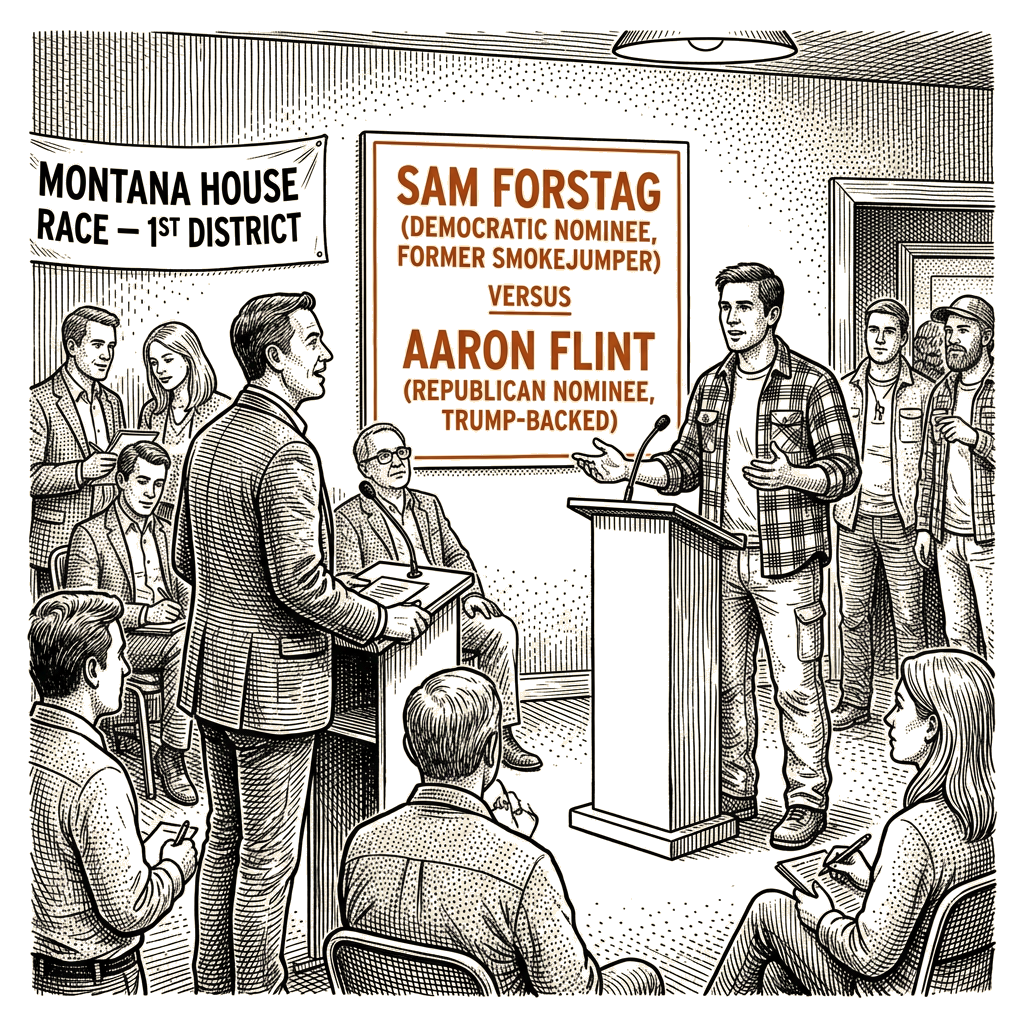
DOGE cuts to wildland firefighters drove Forstag’s congressional run
Forstag’s campaign hinges on a single proposition: that economic strain in the United States has done more than thin wallets — it has thinned the time Americans have left for one another. “There are a lot of people in this country who don’t have the time,” Forstag told The Guardian. “It’s much harder to extend the kind of compassion your neighbors deserve when you’re working three jobs just to get by.” He traces his decision to run for Congress to a winter evening in 2013, when the college student was driving through an Oregon snowstorm toward his third job of the day, making sandwiches at the Subway inside a Walmart. He watched the car in front of him lose traction and slide nose-first into a ditch — and kept driving. “I remember thinking, ‘I should stop – but I don’t have time,’” Forstag said.
Forstag, 32, is the Democratic nominee for Montana’s first congressional district, a seat in the western half of the state that includes the liberal college towns of Missoula and Bozeman. The seat is open after Representative Ryan Zinke, a Republican, announced his retirement. Forstag faces conservative radio host Aaron Flint, who holds President Donald Trump’s endorsement, in the November midterm.
The candidate’s argument is rooted in his own household history. Forstag grew up in North Portland, Oregon, and later in Montana, in a single-parent household. His mother, an intensive care nurse, worked overnight shifts to raise him and his sister. Forstag has said he remembers worrying about her workload as a 9-year-old and noticing that, after her shifts, she never treated caring for others as extraordinary. The contrast between that ethic and the scarcity he now sees in his neighbors — including those who work multiple jobs and cannot stop to help a stranded motorist — animates his pitch.
That scarcity began to hit Forstag’s professional world directly after Trump returned to the White House in 2025 and appointed Elon Musk to lead the Department of Government Efficiency, which oversaw sweeping reductions in the federal workforce. Forstag had spent eight fire seasons as a smokejumper — parachuting into remote fire zones to battle wildfires — and during that time held health insurance, a retirement account and a paycheck steady enough to cover his mortgage and student loans. He led his union, the National Federation of Federal Employees (NIFF),1 as vice-president. After the cuts, friends and union members who had spent years fighting wildfires lost their jobs and health insurance, Forstag said. “That pissed me off,” he told The Guardian, voice trembling.
Forstag said he reached out to Zinke and other elected officials during the cuts and found little response. “I was pissed off at [retiring incumbent] Ryan Zinke when he was holding his seat,” Forstag said. “When we were going through those cuts, we reached out to him time after time. And I got crickets. That’s a failure of representation.” The Guardian reported it could not independently verify Forstag’s specific claim that Zinke “got $20m richer while sitting in office.” Zinke’s financial disclosures showed significant wealth accumulation while holding public office, according to The Guardian. Zinke faced 18 federal investigations during his tenure as interior secretary from March 2017 to January 2019, including into real estate dealings in his hometown. The Guardian said it reached out to Zinke’s office multiple times for comment but did not receive a response.
Running for Congress, Forstag said, meant abandoning the first stable life he had built. “I have to leave the only career I’ve got to risk it all on this,” he told The Guardian. He spent weeks discussing the decision with NIFF colleagues before driving alone to one of his favorite lakes in Montana’s Swan Valley and camping overnight beyond cell service. “I woke up in the morning and decided to do it,” he said. The campaign that followed hardly resembled a congressional operation. Its headquarters was Forstag’s 900-square-foot house in Missoula; staff crowded onto a shared couch in the living room and volunteers pitched tents in the front yard.
The campaign attracted early national attention. Senator Bernie Sanders endorsed Forstag almost immediately. In May, Representative Alexandria Ocasio-Cortez and Sanders traveled to Montana to campaign for him, an event that galvanized young voters across the state, according to The Guardian. Four months after entering the race, Forstag defeated the Democratic establishment’s preferred candidate by nearly five percentage points — one of the biggest primary upsets in recent Montana politics, according to The Guardian.
The endorsements have since stretched in directions that have unsettled some of his base. The Blue Dog Coalition, the moderate and centrist Democratic caucus in the House, endorsed him earlier this month. More than five Republican former or current state legislators have also endorsed him. Brian Putnam, a former Republican legislator from Kalispell who represented one of Montana’s most Republican-leaning districts, said he first met Forstag during the 2021 legislative session when Forstag was lobbying for the ACLU. “He’s a straight shooter,” Putnam said. “He’s a guy you could come to and ask about something, and whether it’s good for him or not, he’s going to give you the correct answer.”
On policy, Forstag has rejected support from the American Israel Public Affairs Committee and called for conditioning U.S. assistance to Israel on what he described as “strictly enforced humanitarian requirements.” He has also connected increases in military spending to domestic quality of life. “We’re in another war, in Iran, that nobody wants, talking about hundreds of billions of dollars,” Forstag said. “That is not helping anybody’s life here in the States.”
Forstag argues both parties have failed working-class voters. “One party was saying the economy’s better than you think it is,” he said. “The other was saying the system’s broken. Unfortunately, the latter was lying about everything they were going to do to fix it.” He has also been critical of his own party for what he calls years of misplaced priorities. “Six months ago, everybody said affordability is the thing to talk about,” Forstag said. “Well, where the hell have y’all been living for the last 10 years? Here in Montana, every time I go to a bar, that’s what people are talking about. ‘My rent went up $100.’ ‘Mine went up $150.’ This isn’t new.”
A poll conducted in late April and early May showed 62% of Montana voters reported difficulty affording healthcare, and 61% struggled with gas and transportation costs, according to The Guardian. A March Gallup poll found 51% of Americans worried about the economy “a great deal,” and another poll found 77% rated the economy poorly. Mary Brower, 62, a retired high school teacher in Bozeman and a lifelong Democrat, said Forstag has struck a chord with younger voters but worried about the limits of progressive politics in Montana. “I just worry that Sam will be seen as too liberal,” Brower said. “Most Montana voters are still more centrist.” Shannan O’Brien, the Montana Democratic Party chair, said Forstag’s message reflects a broader frustration with politics as usual. “People are ready for a change,” O’Brien said. “People are exhausted hearing the same thing in Washington over and over again, and they heard something different from Sam.”
Aaron Flint, Forstag’s Republican opponent, has sought to portray him as a radical. “Is it radical that you should be able to work one good job and afford a roof over your head?” Forstag responded. “I don’t think any of that’s radical. I think those are fundamental to what the American dream actually is.” In November, Montana voters will decide whether they believe him. “The American dream was not ever supposed to be something that was a game of chance,” Forstag said. “It was supposed to be something that was open to everybody.”
Footnotes
-
The source article spells the union acronym “NIFF.” The union’s standard public-facing acronym is “NFFE” (National Federation of Federal Employees); MSI preserves the source’s spelling here. ↩