Europe summer heat linked to more than 14,000 deaths, mayors say
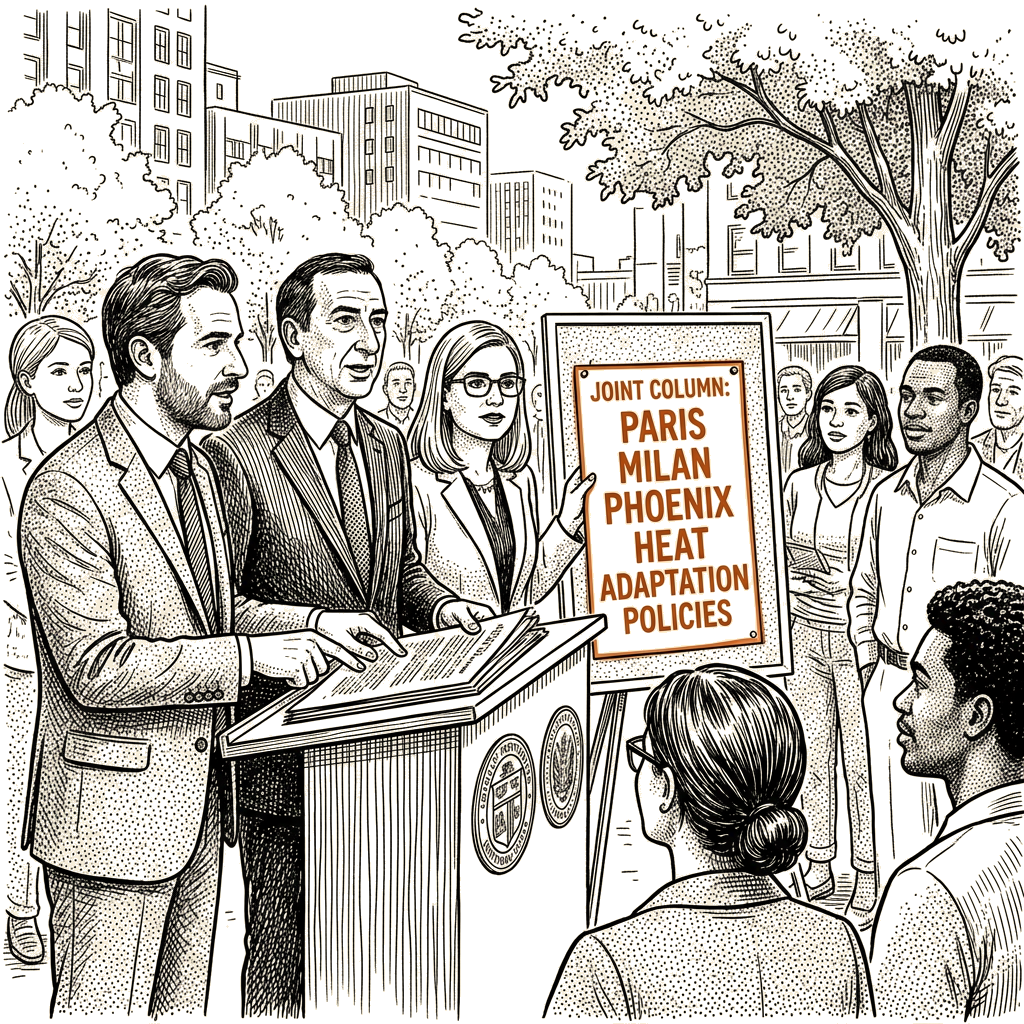
The mayors of Paris, Milan and Phoenix — Emmanuel Grégoire, Giuseppe Sala and Kate Gallego — published a joint opinion column in The Guardian on Monday detailing how their cities are adapting to increasingly severe heat and urging greater cross-city coordination on extreme heat response. The column comes as Europe experiences record-breaking temperatures this summer, with the three mayors noting that more than 14,000 people across Europe have lost their lives due to the heat.
Phoenix’s approach to extreme heat has shaped city government for decades, according to Gallego’s contribution to the column. The city established one of the world’s first municipal offices dedicated to heat response and mitigation. Phoenix requires 75% shade coverage in new developments in areas with high pedestrian activity, and has applied cool-surface treatment to buildings and roadways, including on more than 300 kilometers of neighborhood streets, to reduce the urban heat island effect. Landlords are required by law to maintain a safe indoor temperature of 28°C (82°F) or lower, and companies that contract with the city must implement heat safety plans to keep workers healthy. The city operates a 24-hour cooling center with wraparound support connecting visitors with housing, medical services and job placement. During the summer of 2024 — described in the column as Phoenix’s hottest on record — the city’s coordinated heat response contributed to a 20% year-over-year decline in heat-related 911 calls.
In Paris, Grégoire detailed a network of more than 1,400 “cool spots” — parks, gardens and other public facilities where residents can cool down during a heatwave — ensuring every Parisian lives within a seven-minute walk of one. The city extends opening hours for parks, swimming pools and public baths during high temperatures and has mobilized a network of 27,000 climate volunteers to raise awareness within their communities about heatwave adaptation strategies. In October 2023, Paris organized a “Paris at 50°C” exercise to test the responsiveness of the municipality and its partners; the column says the exercise directly inspired Barcelona to plan the same in 2027.
Milan is expanding its Piazze Aperte (Open Squares) and School Streets programmes to integrate cool spaces by planting trees, replacing hard surfaces with permeable green space and creating shaded areas, Sala wrote. The municipality provides a helpline and support services for elderly and vulnerable residents through Milano Aiuta (Milano Helps). Milan’s Air and Climate Plan sets a binding goal to limit local temperature increases to 2°C by 2050 — a target Sala described as “very ambitious” and among the only temperature-related targets adopted by a major city.
The three mayors wrote that no city can simply import another’s model — geography, history and politics are different everywhere — but argued that cities have always learned from one another and heat adaptation should be no different. Through the C40 Cities network, nearly 100 of the world’s biggest cities are sharing climate solutions for residents and businesses, they said. “Good ideas should travel,” they wrote.
Citing public health data, the column states that extreme heat already claims more than half a million lives globally every year, making it the deadliest climate hazard. Older residents, young children, outdoor workers and lower-income communities face the greatest risks, the mayors wrote. Heating and cooling account for nearly half of all energy use in Europe, with about 70% of heating still generated by fossil fuels, according to the column.
The three mayors called on national governments to work with cities on adaptation strategies, expand early-warning systems and make it easier for local leaders to access the finance needed to protect residents. “Extreme heat is not an individual burden; it is an existential challenge we must all rise to,” they wrote. “The climate crisis is redefining what our definition of ‘normal’ is at a rapid rate. Our ability to learn from one another must move even faster.”