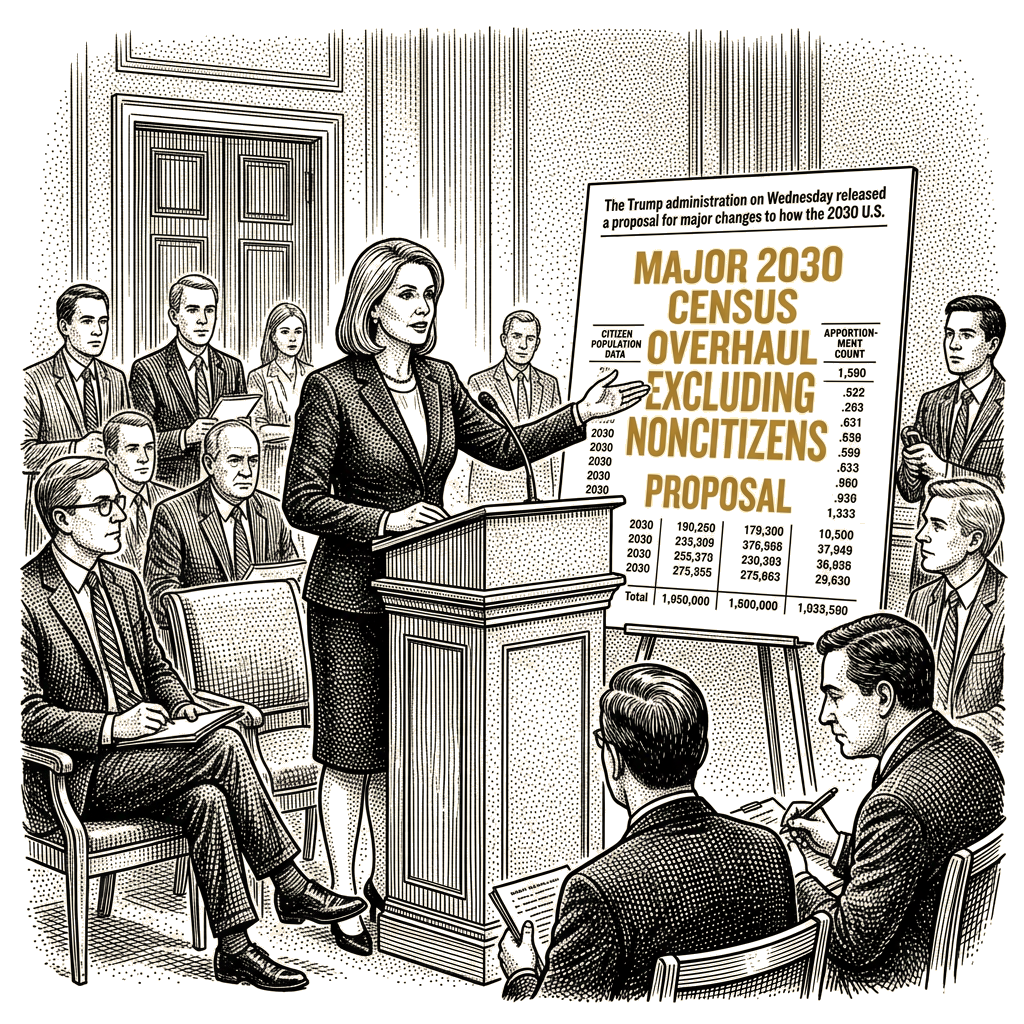
Plan would also drop race and ethnicity questions from national count
The Trump administration’s proposal, released online on Wednesday, would represent an unprecedented departure from how the United States has conducted its once-a-decade head count since the first tally in 1790. Beyond excluding residents without legal status from the apportionment results, the plan calls for ending the census’s questions on race and ethnicity and prohibiting any question about sexual orientation on the form. The 2020 census asked couples living together to describe their partners as either “opposite-sex” or “same-sex.”
The proposal comes months before the administration is scheduled to deliver a report by April 1 on proposed topics for the 2030 census to Congress, which holds final authority over the count under the Constitution. The president’s August 2025 social media post directing his administration to begin work on a “new” census came amid a congressional gerrymandering fight that Trump himself started. According to the Constitution, the president does not have final authority over the census.
The exclusion of noncitizens without a green card would mark the first time in U.S. history that a census has left out residents based on immigration status. Past tallies included specific instructions about how to count enslaved people and not to count “Indians not taxed,” but no census has ever excluded residents because of their immigration status. The change would have downstream effects on public policymaking, scientific research, and business decisions that rely on decennial census data.
Several Republican-controlled states have filed lawsuits calling for residents without legal status, and those with nonimmigrant visas, to be left out of census numbers. In Missouri, such a change could lead to a shift in state legislative redistricting that moves political power away from younger, more racially diverse urban areas and toward older, whiter rural areas.
Before Trump’s first term ended in 2021, his administration tried and failed to add a census question about U.S. citizenship status. Trump also failed in his bid to subtract U.S. residents without legal status from the 2020 census apportionment counts that determine how congressional seats and Electoral College votes are distributed among the states. Republican lawmakers in Congress have backed similar proposals to exclude some or all noncitizens in recent years.
The proposed ban on sexual orientation questions also has a history. While the government has not previously asked directly about sexual orientation on census forms, the first Trump administration blocked an earlier effort to add such a question to the Census Bureau’s American Community Survey. The Justice Department under Democratic administrations has said that question, along with one on gender identity, is needed to generate statistics that could help protect LGBTQ+ people from discrimination.
The race and ethnicity changes would reverse Biden-era revisions to federal survey standards that took effect for the first time in more than a quarter-century. Those revisions introduced new checkboxes for “Hispanic or Latino” and “Middle Eastern or North African” under a combined question that asks survey participants: “What is your race and/or ethnicity?” The revisions also stopped requiring the government to automatically categorize people who identify with Middle Eastern or North African groups as white, and ended the use of a separate question about Hispanic or Latino identity that was long treated as an ethnicity that can be of any race.
Census Bureau research has suggested the combined question better reflects many people’s identities and produces statistics that more precisely represent the country’s demographics. The change was driven in part by the rise of “Some other race” as the preferred response to past race questions among many Latinos, a trend that had produced imprecise racial data and made it harder to enforce anti-discrimination laws. Some researchers have raised concerns about the combined question’s potential to blur distinctions between race and ethnicity and to flatten statistics about Afro Latinos. The revisions faced vocal opposition from the Heritage Foundation, whose Project 2025 policy agenda called on a “conservative” administration to “thoroughly review any changes” to census race and ethnicity questions because of “concerns among conservatives that the data under Biden Administration proposals could be skewed to bolster progressive political agendas.”
Last year, the White House’s Office of Management and Budget pushed back the deadline to Sept. 28, 2029, for federal agencies to bring their forms into line with the Biden-era revisions. OMB has also extended the deadline twice for agencies to release public action plans for those forms. In May, the Census Bureau stopped plans to revise its largest survey, the American Community Survey, in 2027, citing the Trump administration’s latest deadline extension. The form for the “2026 Census Test,” which the bureau concluded on Aug. 31 in Huntsville, Alabama, and Spartanburg, South Carolina, to prepare for the 2030 census, used the same race and ethnicity questions from the 2020 count.
Many census advocates are concerned that the Trump administration’s latest call for major changes could further dampen public participation in the 2030 census, particularly among Latino residents whom the Census Bureau has historically undercounted. Earlier this year, the administration made last-minute changes to a field test of the upcoming tally with little explanation, including using a survey form unrelated to the census that contained a citizenship question the bureau’s own research shows is likely to hurt the count’s accuracy.
The proposal faces constitutional hurdles as well as the possibility that a new presidential administration in 2029 could reverse any changes to 2030 census plans.