Rule would revise the long-used usual-residence standard
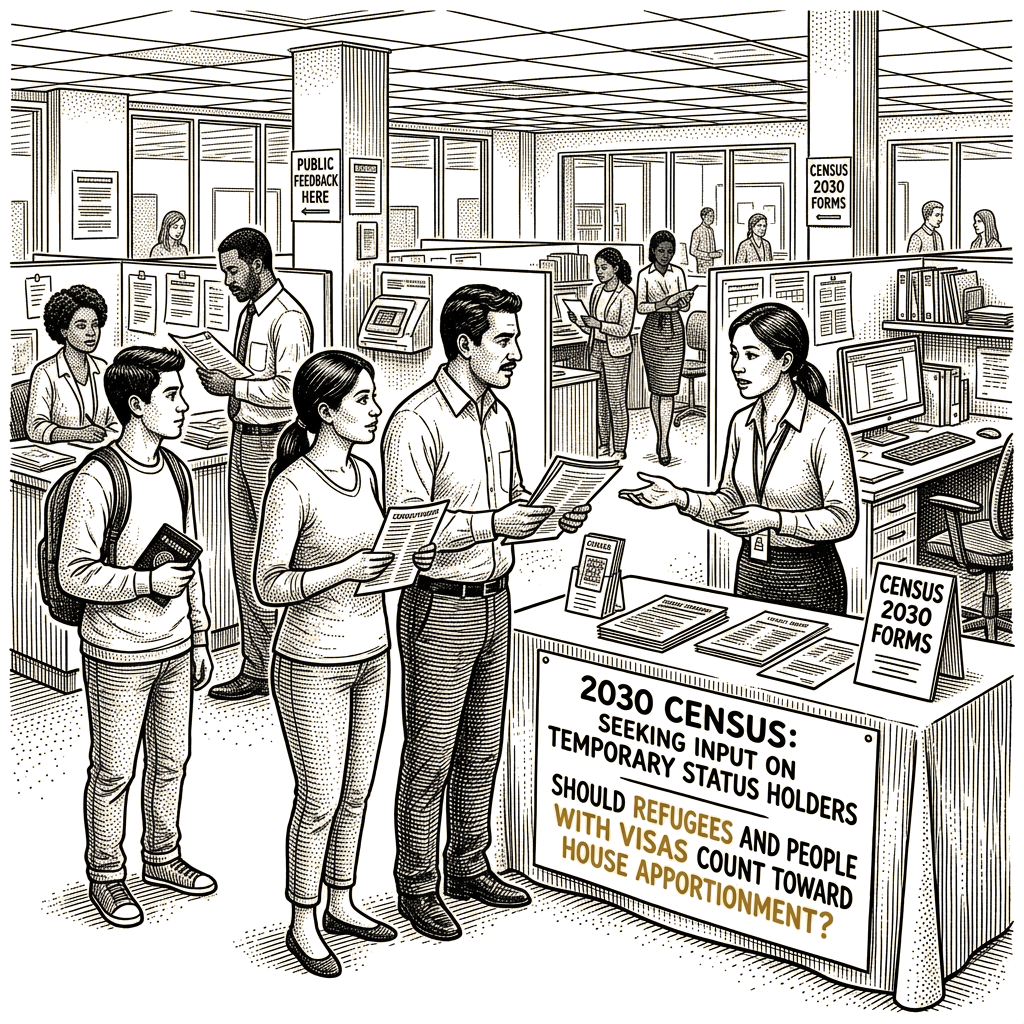
The Trump administration will seek public feedback on whether immigrants with temporary legal statuses should count toward House apportionment under its proposed rules for the 2030 census. The groups identified for consideration include refugees and people with work or student visas.
The proposal would also change residence rules used in recent censuses and revise the definition of “usual residence,” which has long been the standard. It outlines arguments from several past lawsuits that the “whole number of persons” to be counted should be defined more narrowly than in the past.
Census results determine more than the apportionment of House seats. They are also used to distribute federal funds and, within each state, redraw congressional, legislative and local election district lines. The proposal does not mention excluding immigrants from those census results.
The Commerce Department, which oversees the census, posted the proposed rules to the Federal Register on Wednesday. The proposal will be open for public comment. The Wall Street Journal reported that the rules will not take effect for several months and are likely to face legal challenges once finalized.
The temporary-status question is part of a broader proposed change in how immigrants would count for House apportionment. The Commerce Department proposed not counting most immigrants toward the apportionment population unless they have become citizens or hold permanent resident status.
The proposed calculation would exclude immigrants in the country illegally, a population various analyses estimate at about 15 million. The proposal attributes that exclusion to a preliminary Census Bureau determination that those it describes as illegal aliens, among others, should not count for apportionment under its interpretation of the constitutional mandate because the proposal describes them as not true inhabitants, not members of the body politic and not people with a usual residence in the United States due to what it considers insufficient ties and allegiance to the United States.
The proposed rule would separately prohibit the Census Bureau from including race or ethnicity questions on the census form sent to all households. The proposal calls that data “immaterial” to the constitutional mandate to conduct an actual population count.
Removing those questions would eliminate the most complete counts of the country’s Black, Hispanic, Asian and Native American populations, ending a key source of information used in civil and voting rights enforcement. A question about race has appeared on every census since the first was taken in 1790.
The rule would also prohibit the Census Bureau from asking about sexual orientation. Such a question has never appeared on previous census forms.
The Trump administration previously tried to add a citizenship question to the 2020 census. That effort failed in 2019 after the Supreme Court ruled that the administration had used improper procedures.
The Wall Street Journal reported that the proposed rule appears to be the administration’s latest attempt to limit the political strength of noncitizens and racial minorities, who tend to cluster in blue states and cities.
The Journal identifies Michelle Hackman as a reporter in its Washington bureau covering U.S. immigration policy, including the southern border, legal and employment-based immigration, refugee resettlement, care of unaccompanied children, immigration enforcement and relevant legislation on Capitol Hill. Hackman previously covered health and education policy in Washington, joined the Journal in 2016 and graduated from Yale University.
The Journal describes Paul Overberg as a Washington-based reporter on its data team who analyzes data and public records and collaborates with reporters covering many subjects. Overberg has taught at Northwestern University’s Medill School of Journalism, served as a senior fellow for the Center for Health Journalism at the University of Southern California, worked as a data journalist at USA Today and holds a bachelor’s degree in history from Rutgers University.