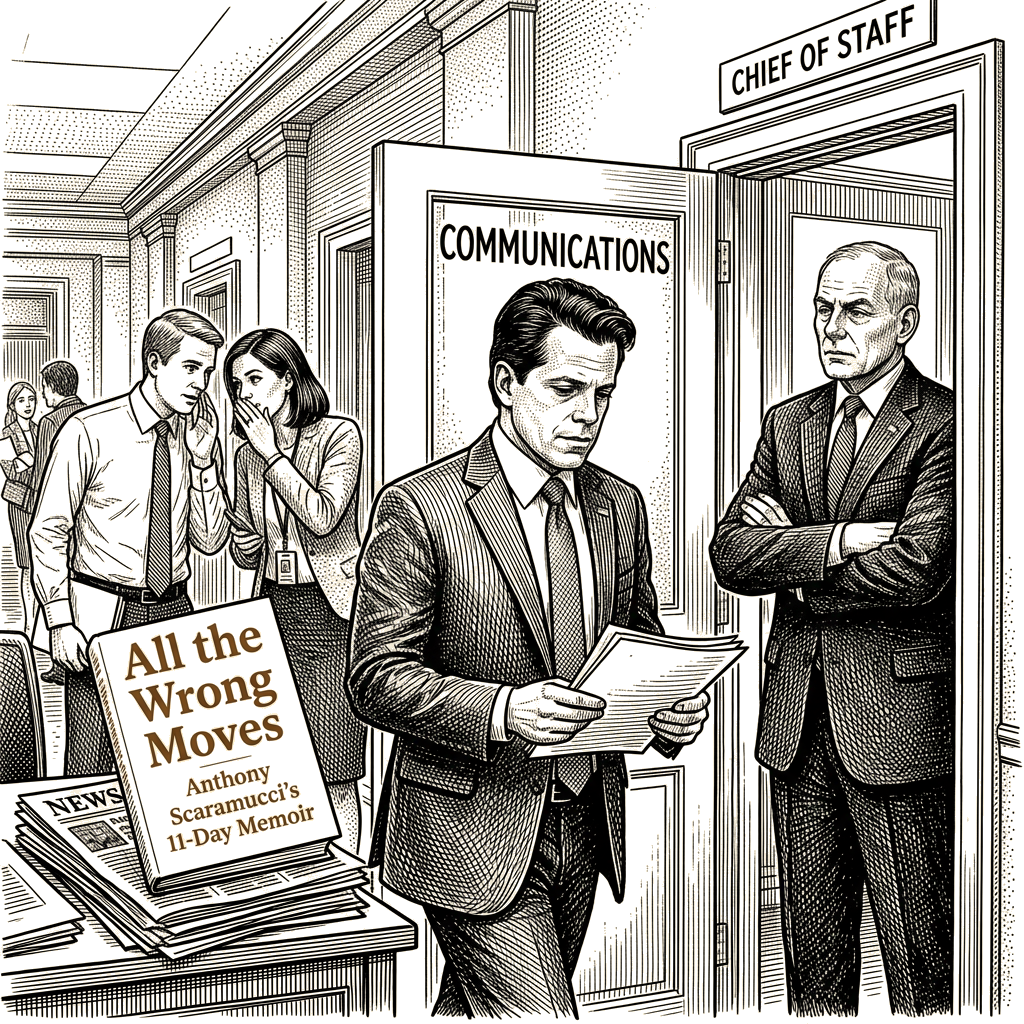
Scaramucci recounts 2019 break with Trump over ‘squad’ remarks
“All the Wrong Moves” is published September 17 by Bodley Head at £25. Scaramucci, a financier and podcaster, served as communications director from mid-July to August 1, 2017. The Guardian is publishing an edited extract ahead of the UK release.
The memoir opens with background from the previous January, Scaramucci writes. Trump had offered him the directorship of the Office of Public Liaison, the White House unit that interacts with interest groups. Chief of Staff Reince Priebus blocked that appointment, and chief strategist Steve Bannon was also against Scaramucci working in the White House. Scaramucci describes himself at the time as “a traditional moderate Republican type” with connections to Trump’s daughter Ivanka and her husband, Jared Kushner. The Kushner group made up one silo in the administration, he writes; Priebus ran a second silo at the Republican National Committee; Bannon was “Maga far right.” All three silos were mutually hostile. Priebus and Bannon leaked on each other constantly, Scaramucci writes, but they allied in not wanting Scaramucci near Trump.
After the offer was blocked, Scaramucci writes, he called Trump and told him he did not want to fight with Priebus, but that he would help when Trump had problems with Bannon and Priebus. “Call me if you ever need help with those bad guys,” Scaramucci writes he told the president. He describes the offer as one he made cavalierly and egocentrically.
On July 19, 2017, the White House operator called Scaramucci and asked him to hold for the president, according to the book. Trump invited him to lunch the next day and told him to enter the White House via the East Wing to avoid the press. In the study off the Oval Office, Trump said: “Yeah, you were right about Priebus and Bannon; I need to get rid of them. You’re a New Yorker. You and I always got along. I want to bring you in.” Trump then asked which West Wing office was open, was reminded that communications director Mike Dubke had not been replaced after his resignation, and said: “You’re going to be comms director.”
Priebus and Bannon learned of the meeting and the next morning offered Scaramucci ambassadorships — Paris, or one of his choosing — to keep him out of the West Wing. Scaramucci writes that he “basically told them to go fuck themselves,” then met them in the chief of staff’s office, where he called them “dicks who were leaking on each other and hurting the president.”
In a meeting later that morning with Trump, Priebus and staff secretary Rob Porter, Trump said he wanted Scaramucci to report directly to him. Scaramucci writes that he “would rather have reported to the chief of staff,” but Trump looked at Priebus and said: “I don’t want his filth tainting you.” The same morning, press secretary Sean Spicer announced his resignation — a development Scaramucci describes as “one less firing I’d have to do.”
Scaramucci then held a press conference — watched, he writes, by 30 or 40 million people. He writes that Trump did not see the performance as a success, describing the reaction as: “There’s one spotlight. It’s a one-man show. The better I do, the worse I’m doing, but I don’t get that.” After the press conference, Scaramucci writes, an unnamed Capitol Hill operative called him with a warning: “You can’t talk like that from the White House, telling the truth to the American people. Everyone here is upset about that. You’re getting too much attention. You’re talking in complete sentences. Trump’s gonna fucking fire you. Be careful.”
Scaramucci writes that one of the central mistakes of his tenure was how he continued to speak with Trump in the White House. During the 2016 campaign, Scaramucci writes, he would tell Trump when he thought he was doing something stupid, sometimes bluntly, including “This is fucking stupid,” and Trump would either heed him or proceed. Once in the White House, Scaramucci writes, the blunt style “irritated the hell out of him. He was president of the United States. He expected to be flattered with total obsequiousness by everybody he talked to. I didn’t see it then.”
While traveling with Trump to West Virginia for the Boy Scouts’ National Jamboree, where the book says Trump spoke for 29 minutes and “says almost nothing that’s not completely insane,” Scaramucci’s wife Deidre was giving birth. She had filed for divorce during her pregnancy — outright, not a separation, the book says — after telling him not to take the White House job. The book says the couple later reconciled and remain married eight years later.
The interview that made Scaramucci widely known came on the Wednesday afternoon of his first week, when he gave a phone conversation he understood to be off the record. The journalist later said it was not, and CNN aired the recording, which included profanity-laden criticism of Bannon and Priebus. Scaramucci writes that Trump found the comments “funny,” but other conduct irritated the president.
By the following Friday morning, Priebus had been replaced and Bannon was on his way out. In the Cabinet Room, Scaramucci writes, Trump said he intended to veto a Russia sanctions bill over election interference. Scaramucci warned that Congress had the votes to override; Trump replied, “They can’t do that. I’m the president of the United States.” White House counsel Don McGahn confirmed that a supermajority could override a veto, according to the book. The book notes that the dispute was about election interference, not the “Russia-collusion issue,” and that “everyone knows” interference occurred.
Scaramucci was informed of his firing on the following Monday morning by Kelly, hours after Kelly was sworn in as Priebus’s replacement. The book quotes Kelly as saying: “Well, there’s two things. The president doesn’t want you here any more, so that’s reason enough for you to go. But number two, Anthony, just being honest with you, you were reporting directly to him. I’m the new chief of staff. If I kept you, all the papers would write about is that there are two direct reports to the president, and I can’t have that. I’m a four-star general. You’ve got to go.”
“I bombed so cataclysmically because I did not understand Washington,” Scaramucci writes. “I was a complete amateur. I actually thought I was going to help change the world. It was pride, egocentrism and asinine stupidity. I missed the birth of my son. I almost lost my marriage. It’s all well documented. You can read a lot more about it if you want – some true, some not.”
After his firing, Scaramucci writes, he met that week with a crisis public-relations professional. The advice, he says, was that he had “completely disgraced myself and my career was basically over” and that since he had money, he should “go to Tuscany, buy a villa and hide out for five years.” He writes that he did not take the advice and adopted a posture he describes as “FBL: Fired But Loyal.” He went on late-night television — Stephen Colbert, Bill Maher — and cable news shows, the book says, owning what he thought he had done right and wrong and taking punches from the hosts.
By 2019, Scaramucci writes, he was finding it harder to defend the president. What he describes as constant policy goalpost shifting was, he says, giving him glimpses of what he had not wanted to see. “Trump was exploiting the suffering of the people for his own narcissistic and malevolent ends,” Scaramucci writes. In August 2019, on the Bill Maher show, when challenged by Washington Post journalist Catherine Rampell, Scaramucci broke with Trump over the president’s remarks telling four Democratic congresswomen — Alexandria Ocasio-Cortez of New York, Ilhan Omar of Minnesota, Ayanna Pressley of Massachusetts and Rashida Tlaib of Michigan — to “go back” to their countries. All but Omar were born in the United States, Scaramucci noted at the time. He called the remarks “a form of racism” and the kind of treatment his grandmother had been forced to put up with, and said that since Trump was the president, he wished he would not speak like that. The book says the dispute led to a Twitter exchange with Trump and a deeper break.
Scaramucci writes that he had to separate from Trump and, more painfully for him, from the Republican party, which he describes as having been “decapitated” by Trump and absorbed into a “Trump-GOP.” He frames the takeover as a “mergers-and-acquisitions transaction” against a vulnerable major party. Even as he was separating from the party, Scaramucci writes, the rebranded Trump-GOP was “magnifying itself”; figures such as Henry Kissinger and Dick Cheney, he says, were leaving the fold, while people such as Marco Rubio were going all in. He writes: “I got intoxicated by power. I went into Trump’s world for what I thought were the right reasons but were the wrong reasons. So that’s the story: a colossal series of errors in personal and political judgment.”
Scaramucci describes having undergone what the book calls a “moral reckoning” with his own role in supporting and defending the president. He writes that the experience left him more empathetic and “more psychologically minded,” aware of “the frailty of others – and my own frailty, too.” He adds: “I bought into Trump, and I almost lost myself.”
The White House, when approached for comment by The Guardian, said: “Anthony Scaramucci lasted 11 short days in the White House. He makes lightweights look credible.” Bannon declined to comment. Priebus did not respond.
Scaramucci is on a UK book tour from September 14 to 19, with tickets through Intelligence Squared.