Widow says Air Force denied benefits due to no formal war declaration
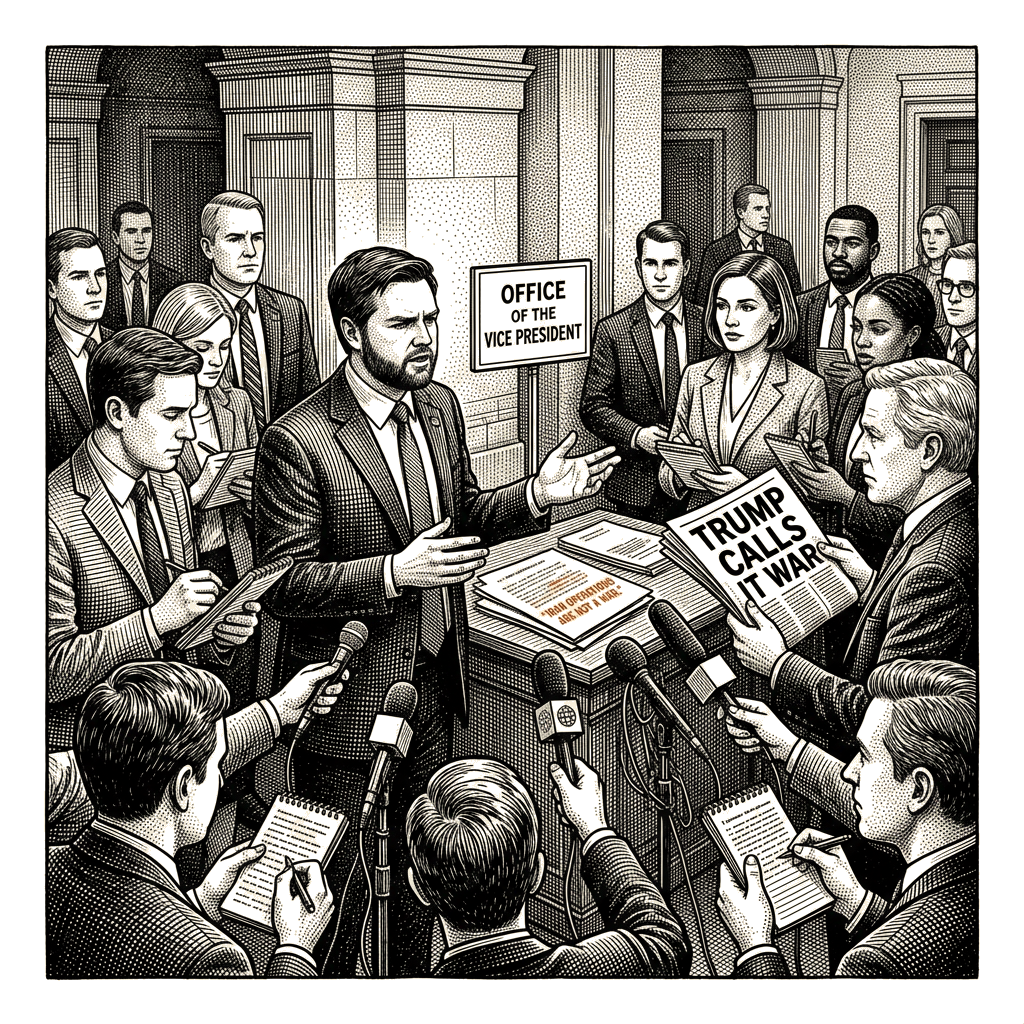
Vice President JD Vance told reporters earlier this month that US military operations in Iran are not a war, citing the absence of “active shooting.” “I wouldn’t call it a war,” Vance said. “Right now, there is no active shooting.” The characterization diverges from President Donald Trump’s own use of the term in separate public remarks.
The terminology dispute has surfaced alongside documented civilian casualties. A New York Times visual analysis by a weapons expert concluded that a US-made bomb hit a wedding at a private home in southern Iran earlier this month, killing at least four people, including a four-year-old child and a 16-year-old. Guardian columnist Arwa Mahdawi wrote in a Monday column that a US precision-guided missile strike in March hit an Iranian elementary school, killing 150 people including 120 children — a March episode she said she would file under “possible war crimes.”
When asked at a recent press briefing about the wedding strike, Vance questioned the sourcing of civilian-casualty reports. “The Iranian state media has not been a very good scribe about what’s happened in the conflict thus far,” Vance said. “So I’m extremely skeptical of this.”
Trump’s own language has shifted between appearances. At an event last Wednesday, Trump said: “The war is going to end immediately after the election.” In remarks last month, however, Trump characterized the engagement differently: “I call it a military conflict because it’s small potatoes for us.”
Trump elaborated on the calculation at a March fundraising dinner. “I won’t use the word ‘war’ because they say if you use the word ‘war,’ that’s maybe not a good thing to do,” Trump said. “They don’t like the word ‘war’ because you’re supposed to get approval. So, I’ll use the word ‘military operation,’ which is really what it is. It’s a military decimation.”
The constitutional stakes have drawn commentary from historians. Fredrik Logevall, a historian and foreign relations expert at the Harvard Kennedy School, said in an interview with the school that the administration’s posture is unprecedented. “What’s extraordinary about President Trump in the current context is that he has not really bothered to even consult with Congress, never mind seek the approval of Congress,” Logevall said. Mahdawi compared the approach to President Harry Truman’s mid-century classification of the Korean conflict as a “police action” to bypass Congress.
The terminology has produced at least one practical consequence: the widow of an airman killed in combat operations against Iran in March posted on Instagram that the Air Force had informed her she would not receive certain benefits. “The Air Force recently told me that because we haven’t officially declared war, my kids and I aren’t eligible for some benefits,” the widow, Libby Klinner, wrote. “So not only was my husband killed in a war he never wanted to participate in, but now the benefits we’re left with are being dictated by semantics and public perceptions.” After the post drew public attention, Vance said the administration would ensure Klinner receives “what she is entitled to,” adding: “We will certainly work that on the back end.”
The conflict has also carried documented economic costs. Mark Zandi, chief economist at Moody’s Analytics, has roughly estimated the conflict has cost the typical US household $1,200. An estimate from Brown University’s Costs of War project last week put the conflict’s cost to Americans in extra energy spending at $100 billion, with the bill rising by $1 million every two minutes. Oil prices climbed above $100 a barrel this week for the first time since July.
In 2024, Trump told a Pennsylvania crowd: “I will not send you to fight and die in stupid foreign wars that never end.”
According to Mahdawi, Trump’s popularity is “plummeting” and a majority of Americans are “fed up” with the conflict. The columnist reported that Trump has promised every American adult $5,000 if Republicans retain control of both chambers of Congress in November and has continued to assert that energy prices will fall “right after the election.”