SpaceX and AI IPOs could spark unprecedented startup wave, SVB says
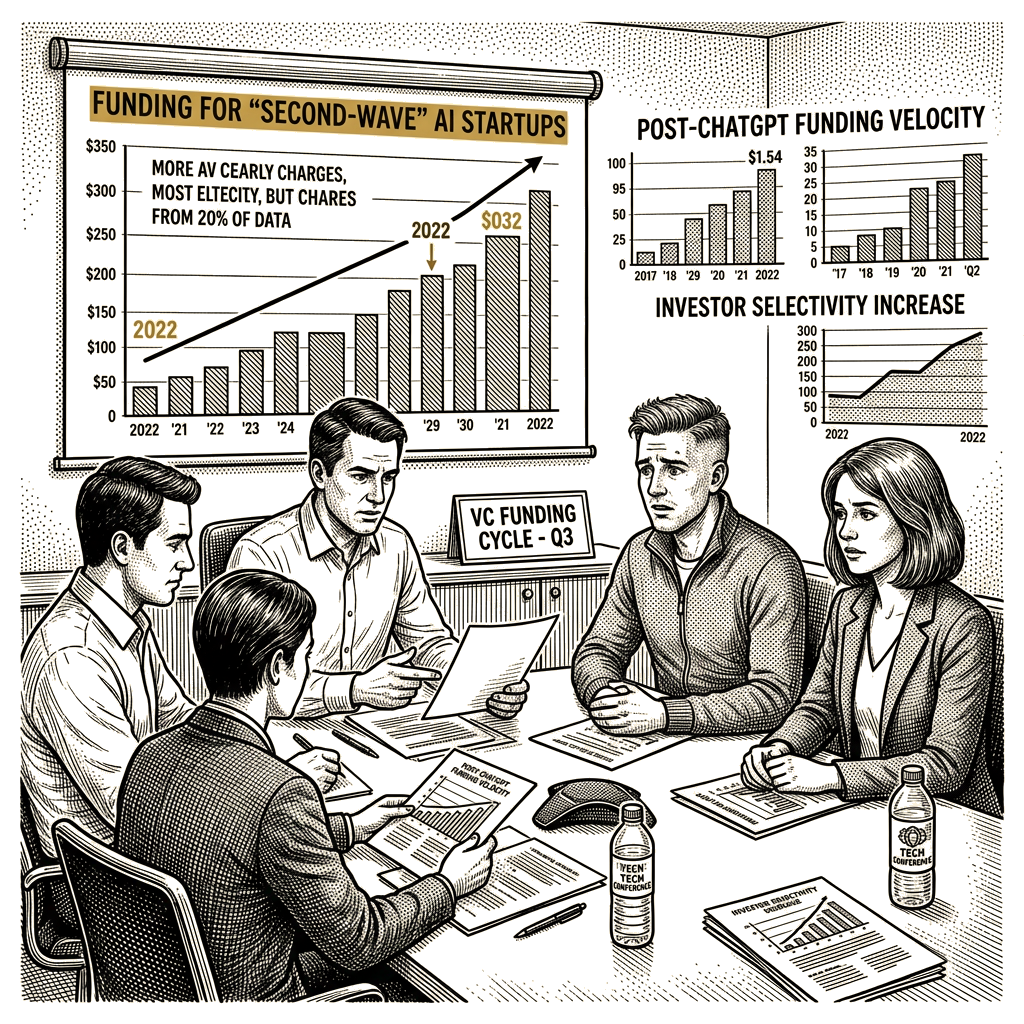
Venture capital investors have grown more selective in funding decisions for second-wave AI startups — companies that secured first-round financing after ChatGPT’s late-2022 launch — according to analysts and venture capitalists cited in a Sept. 14 WSJ Pro newsletter. The newsletter framed the cohort as the “ChatGPT generation,” a reference to the post-ChatGPT surge in AI startup financing. PitchBook data cited by the newsletter showed U.S. venture-capital first financings for AI startups rising from approximately 2,150 in 2022 to nearly 3,400 last year.
Kaidi Gao, a senior venture-capital research analyst at market tracker PitchBook, told WSJ Pro that VCs’ approach to AI investing has changed. “If anything, the bar seems to be higher, they seem to be more selective, and there just seems to be more acknowledgment among VCs about the potential expensive mistakes that will happen, especially in the AI application layer,” Gao said. AI application companies are those that build products on top of foundation models.
Ethan Kurzweil, managing partner at the venture firm Chemistry, said the situation is particularly stark for the second wave. The conventional venture progression runs from “new company” through “middle ground,” Kurzweil said, but the middle tier has vanished, and the path increasingly looks like a failure mode. Kurzweil recently posted on X that the consensus AI boom cycle has venture investors narrowly focused on the next trillion-dollar startup — what he called the “Trilicorn.”
“This is where we find ourselves today: funding as a downstream consequence—a self-fulfilling prophecy among us VCs for VCs—of the trillion-dollar pink elephant everyone is chasing,” Kurzweil wrote on X, as quoted by the newsletter.
Nick Candy, head of innovation economy insights, commercial banking at J.P. Morgan, said that even if they fail to get further venture backing, some in the ChatGPT generation will endure and even thrive because businesses built with AI tools can have better margins.
The ChatGPT generation is not done expanding, the newsletter observed, citing a recent report from Silicon Valley Bank, a division of First Citizens Bank. That report said the SpaceX listing and the expected public debuts from Anthropic and OpenAI have the potential to generate an unprecedented wave of new startups.
The newsletter separately flagged “AI anxiety,” characterizing the collision of scientific progress, moral imperative, and financial incentive as a “crisis” for the AI industry. Development of AI has fueled a ballooning stock market over the past year, the newsletter said, a phenomenon that looms even larger with Anthropic and OpenAI both on the precipice of initial public offerings that could value the companies in the trillions. Competition from China, the newsletter reported, has further raised the stakes. Warnings from inside the companies themselves, the newsletter said, are proof that the dangers of proceeding against a backdrop of what it called “almost no regulation” are potentially immense.
In other venture activity, HOF Capital — a firm known for its early investments in AI technology companies — broadened its reach into private equity by co-leading an investor group in a €1 billion (approximately $1.16 billion) acquisition of Porsche’s stake in Rimac Group and Bugatti Rimac, the automotive joint venture Rimac had formed with Porsche. HOF Capital co-founder and managing partner Hisham Elhaddad spoke to WSJ Pro about the deal and how his firm is approaching the challenges and opportunities around AI investing.
Growth-equity investor Volition Capital closed its Volition Capital Fund VI at its hard cap of $950 million, bringing the Boston-based firm’s total assets under management to more than $2.6 billion. Balderton Capital appointed Luca Bocchio as partner, with a focus on early-stage investments; Bocchio was previously a partner at Accel. Bunkerhill Health, which helps clinical and operations teams build and deploy AI agents, appointed Azita Hamedani as the company’s first chief clinical officer. Covenant, a Washington, D.C.-based defense technology startup building long-range precision strike weapons, emerged from stealth with $250 million in funding across three rounds. Investors included Andreessen Horowitz, Founders Fund, Lux Capital, 8VC, Aleph and Lightspeed Venture Partners.
Additional reporting in the newsletter noted that Kurland has joined the Anthropic investor as it expands beyond early-stage companies, raising $2.25 billion for growth-stage investments; that a new group will be made up of 1,000 forward-deployed engineers; that Pinegrove overcame a tough market and an LP base “traumatized” by SVB’s collapse to raise $1.5 billion; that venture-capital firm Luma stretched its fund from the standard 10-year limited partnership structure to 15 years; that John Borthwick’s venture firm wrote the first check Hugging Face ever received and now holds a stake that could be worth $650 million; that employee token limits have become commonplace among companies managing their AI costs; that regulators know little about an estimated $500 billion in borrowing by U.S. private-credit managers; and that a bankruptcy judge ruled that a law firm had a conflict after it represented the self-help guru’s investment entities in claims against the coal plant.
Additional funding rounds reported: Xapien, a Boston-based AI-native due-diligence platform, picked up $56 million led by Spectrum Equity; Archy, a San Jose-based AI platform for dental practice management, scored $50 million in Series C funding led by JMI Equity, with participation from TCV, Entrée Capital, Bessemer Venture Partners, and others; Implicity, an AI-driven cardiac remote monitoring provider based in Paris and Cambridge, Mass., closed a $40 million growth equity round led by IRIS; Impossible Objects, an industrial-scale 3-D printing company operating in Northbrook, Ill., and Rochester, N.Y., secured $40 million in Series B funding led by Inflection Equity; Latitude, a Houston-based global payments infrastructure startup, landed $35 million in Series A funding led by Oak HC/FT, with contributions from New Enterprise Associates, Coinbase Ventures, Lightspeed Venture Partners, and others; Luminary, a New York-based wealth transfer and administration platform, raised $22 million in Series A funding led by Ten Coves Capital, with participation from 8VC and others; R3 Lithium, a Covington, Ga.-based startup producing lithium carbonate from recycled battery materials, collected $15 million in Series A funding from investors including TDK Ventures and Axial Partners; UrgentIQ, a New York-based AI-native operating system for urgent care, raised $15 million in a Series A growth investment from Five Elms Capital; and BRKZ, a Saudi Arabia-based building materials procurement platform, raised $31 million in new capital, including $13 million in Series B equity co-led by Wa’ed Ventures and 500 Global.
The newsletter was compiled by Matthew Strozier and Zachary Cole.