US tech giants projected to take $50bn of UK ad revenue by 2028
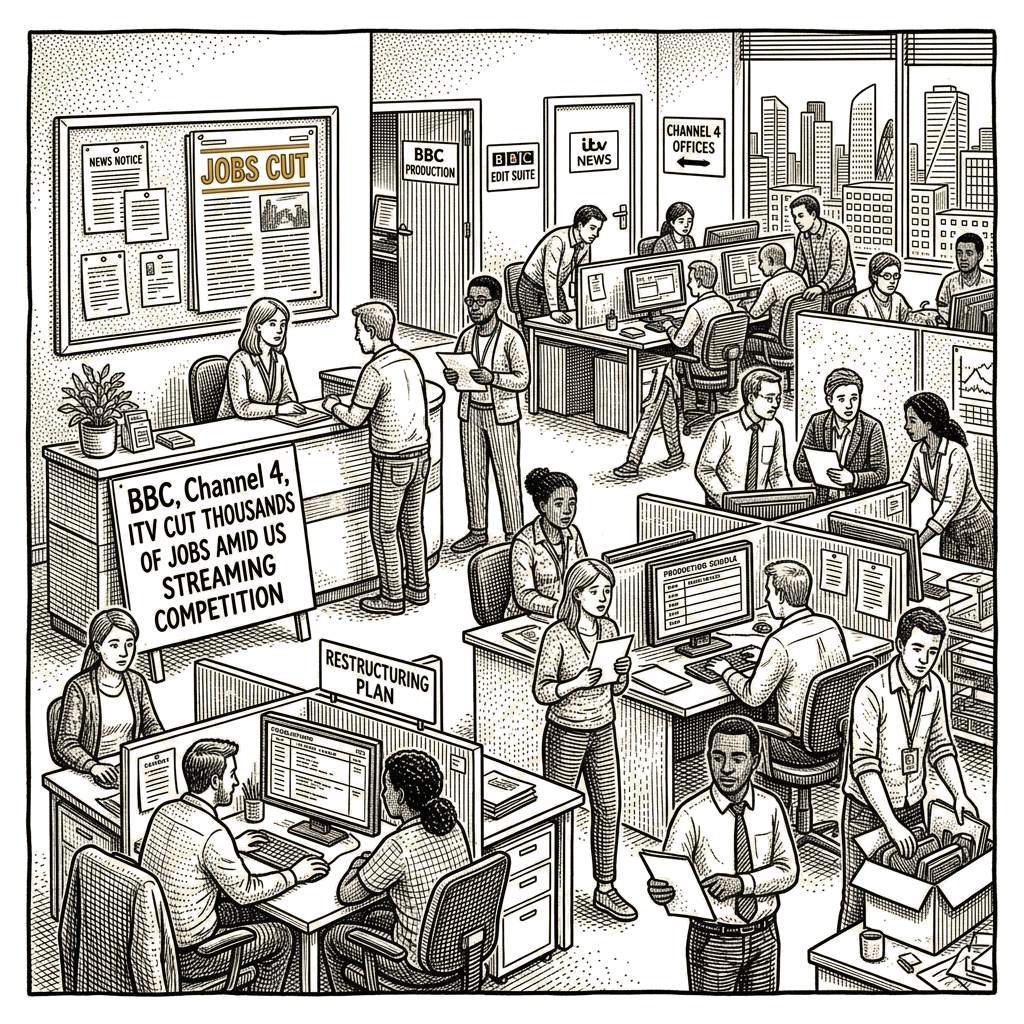
BBC, Channel 4 and ITV have announced deep job cuts this summer as their business models face mounting competition from YouTube and Netflix.
BBC director general Matt Brittin, a former top Google executive, is pushing through up to 2,000 redundancies as he negotiates with the government over the terms of the BBC’s royal charter renewal next year. Brittin has called the licence fee model a “busted flush” and “insufficient to sustain a universal public service.”
Channel 4’s new chief executive, Priya Dogra, announced earlier this month that 28% of staff will be cut — the biggest round of redundancies in the broadcaster’s 43-year history — amid a slump in advertising and increasingly stretched finances. The broadcaster relies on advertising for 90% of its income.
Four years after ITV announced an £800m-plus plan to create a streaming “national champion” to take on Netflix, Disney+ and Amazon, chief executive Carolyn McCall has abandoned that plan, arguing that a cut-price £1.6bn sale of its broadcasting arm to Sky is the only way to survive. McCall has expressed frustration that talks to create a British streaming platform comprising the original three public service broadcasters failed because “we all have such different business models.”
US technology companies — YouTube owner Google, Facebook and Instagram parent Meta, and streamers including Netflix — are forecast by eMarketer to take almost $50bn (£38bn) in UK ad revenues by 2028, two-thirds of the $74bn total, at which point 90% of all ad spend will be digital. Traditional UK television advertising is forecast by WPP Media to shrink by 2031 to just £2.4bn, 60% down on 2015 levels.
The BBC’s licence fee income has fallen by 38% in real terms since 2010, owing to a combination of freezes or below-inflation increases to the licence fee and increasing non-payment. The corporation has lost 2.7 million payers of the £180 annual charge since the beginning of the decade; last year it lost a further 539,000, taking the total who still contribute to 23.3 million, the lowest level since 1999.
The increasingly financially stretched public service broadcasters face competitors with huge resources for programme-making. Netflix alone has a content budget of $20bn this year and enjoys a larger share of UK TV and streaming viewing than ITV, Sky, Channel 4 or Channel 5, while YouTube is close to overtaking the BBC to become the most popular platform in Britain on the same metric.
Sir Peter Bazalgette, the former ITV chair who has also sat on the board of the culture department, said: “I cannot see a future Europe where there are four or five domestic broadcasters in each country with viable financial models.”
“If you think about the shrinking money and budgets I feel we are heading toward a two-tier system,” said a senior executive at a leading TV production company. “It is great that the big US corporates like Netflix, Amazon and Disney have these mega-budgets and do produce great ‘British’ shows like Adolescence, Black Doves and Slow Horses but they are becoming in a class of their own. My fear is we end up with a system where the UK public service broadcasters will diminish to such an extent, while facing such big budgets wielded by rivals, they will become a bit like a cottage industry.”
Debate has renewed over whether those who advocated Channel 4 privatisation may have been right, or whether a tie-up with the BBC might build the scale needed to survive. A source at the broadcaster said: “Channel 4 has always punched above its weight and being a challenger is nothing new. But it was never meant to operate in isolation — it was designed to be part of the creative ecosystem. So partnerships will be a defining feature of the new era. They’re a way for the channel to compete on reach and scale while maintaining its independence.”
The UK’s public service broadcasters have a patchy record on collaboration, although notable successes include the development of Freeview, and have not been able to come together to map out a streaming future as viewing moves beyond linear TV. As the reality of the scale of the pressures facing the industry has become ever more apparent, however, a new wave of collaboration is taking place — some say helped by a change of top executives.
Brittin has said the BBC is in talks to enable Channel 4 content to run with ads on the iPlayer, having told MPs that the commercially funded broadcaster looked “very subscale” given ITV and Sky are merging. This week, Channel 4 made a significant move to address the scale issue by poaching the £300m-plus contract to sell television and digital ads for Paramount UK properties — including Channel 5, Nickelodeon and Comedy Central — from Sky. ITV, Channel 4 and Channel 5 now make a little over £1bn annually in revenues combined from their respective streaming services, which continue to grow at pace, but it is not fast enough to bridge the gap from lost legacy TV revenues in the short term.
Channel 5 president Reemah Sakaan said: “Despite the attention that video sharing platforms receive, public service streaming is the untold success story of the year so far, outpacing viewing growth to YouTube and subscription video-on-demand services. Audiences and advertisers alike still want trusted, relevant and distinctly British content, and they are choosing our platforms as go-to destinations.”
The UK’s public service broadcasters had realised as far back as 2009 that coming together was necessary to ultimately compete, but the British streaming platform, called Project Kangaroo, was blocked by the competition regulator. Three years later, Netflix led the US expansion of the international streaming era to the UK.
Brittin has warned that the issue of scale is now more acute than ever, saying UK broadcasters risk being “underweight” as global players dominate content creation and distribution to audiences.
“What is at stake? It is about the criticality of local content, and independent impartial news about our country,” Bazalgette said. “Content made for us, by us about us. There are some marvellous programmes [made by the global streamers] but that is not the same as an absolute commitment to sustained investment in local content.”
The quest for scale extends to working more with rivals, exemplified by the BBC’s recent deal to create bespoke content for YouTube to expand its reach with younger audiences. However, none of the UK’s public service broadcasters has yet pushed collaboration as far as France’s TF1, which has made all its channels available on Netflix.
Several industry figures said the long-term prospects for UK public service broadcasting remained uncertain. One of the thousands of TV staff at risk of redundancy said: “I wouldn’t be surprised if the BBC or Channel 4 disappeared.” Another added: “My generation grew up with Netflix and YouTube … Honestly, I feel like it is a losing battle.”
One television executive described the moment as a “watershed,” saying: “Our sector of the media industry has peaked, we are definitely in decline. If you are young enough your next job will most likely not be with another broadcaster. It is all about downsizing; it is where your skills and experience might fit into another industry. It is bleak, very bleak.”