Lamola warns US ICC sanctions could ‘fundamentally disrupt’ court operations
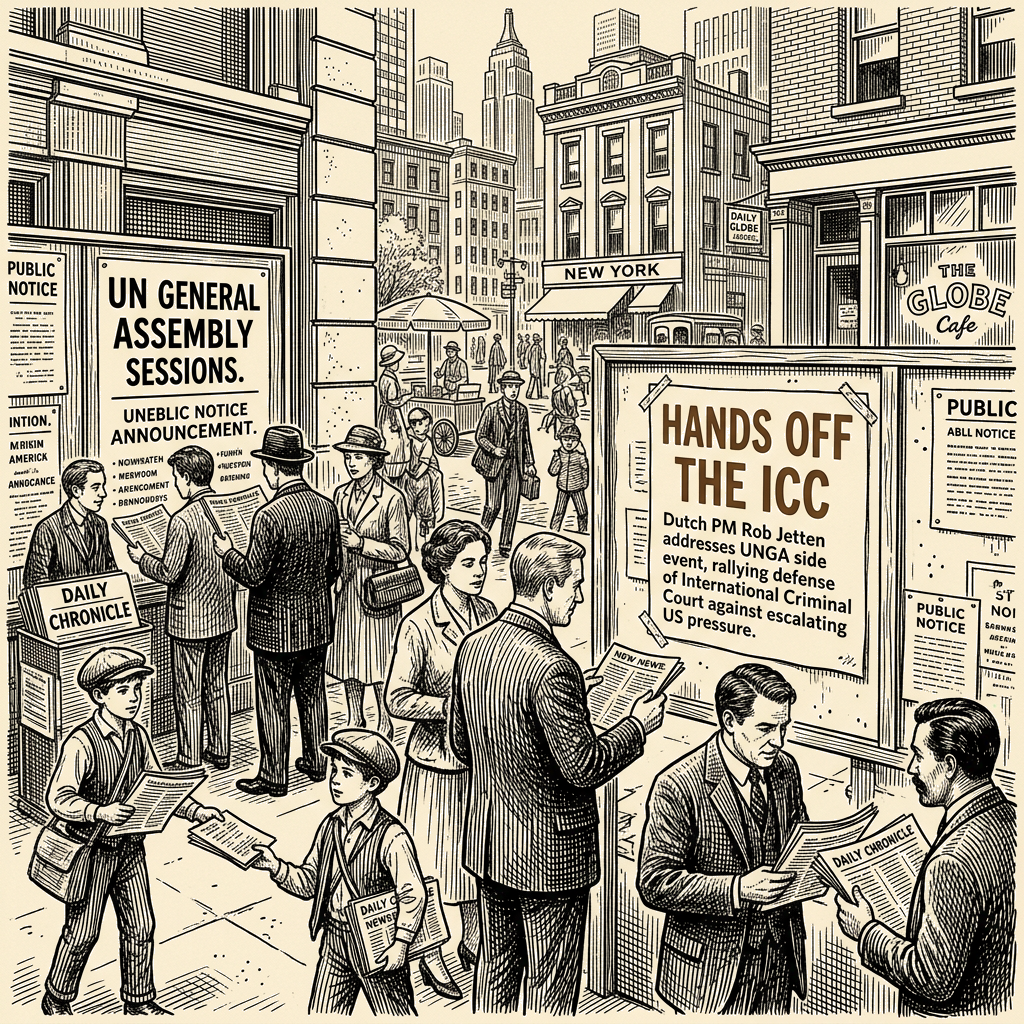
Dutch Prime Minister Rob Jetten told the United Nations General Assembly on Friday that the international community must “say, hands off the ICC and all those other institutions that protect the international legal order,” while Japanese Prime Minister Sanae Takaichi this week condemned the US sanctioning of the head of the ICC, Judge Tomoko Akane of Japan. The remarks came at a Hague Group side event on Friday where speakers from multiple countries rallied support for the International Criminal Court as the Trump administration expands its sanctions campaign against the institution.
The Hague Group convened the event, which The Guardian described as “called to protect the system of international law from a growing array of threats, including open flouting of its tenets and rulings by Israel.” South African Foreign Minister Ronald Lamola, co-chair of the Hague Group, told the gathering the US had already sanctioned ICC judges and prosecutors and was now planning sanctions against the ICC itself.
“If imposed, such measures could fundamentally disrupt its operations,” Lamola said. “An independent court remains independent only if judges and officials cannot be punished for carrying out their mandates.”
The head of the ICC, Judge Tomoko Akane of Japan, was sanctioned by the US in August along with senior trial lawyer Abdoulaye Seye of Senegal for engaging in the ICC’s efforts to “prosecute officials whose government has not consented to ICC jurisdiction.” Takaichi condemned the sanctioning of Akane.
The next likely US step would be to impose secondary sanctions on anyone who cooperates with the court, rather than sanctioning its senior judiciary, The Guardian reported. A designation of the whole institution would reach every European bank, insurer and technology supplier serving the court, which sits in the Netherlands.
The Dutch government, as the host of the ICC, is taking the lead in trying to warn the US away from any measure that would effectively immobilise the court. Jetten told the General Assembly: “International law either works for everyone or for no one. This court was established to protect us against impunity and it was built on the foundations of the Nuremberg and Tokyo trials. And now, with the ICC under attack, the writing is truly on the wall.” He added: “After all, how can you possibly be opposed to prosecuting the very worst crimes? And I believe there can be only one response: to say, hands off the ICC and all those other institutions that protect the international legal order.”
In his address to the General Assembly this week, Trump criticised the “out of control” court, which he called “an evil group of people” and urged other nations to reject. Secretary of State Marco Rubio has separately accused the court of being “a corrupt and fatally politicised supranational court that has maliciously abused its authority and exceeded its mandate. We will not tolerate its assault on state sovereignty.” The US has admitted it seeks to dismantle the Hague-based ICC.
William Schabas, a specialist in international law, noted to the meeting the irony that the resort to international law and courts was increasing dramatically even as the institutions themselves were under attack. He said nations needed to strengthen the ICC, including by ensuring positions are not traded and only the highest calibre judges are elected.
Diana Buttu, a prominent Palestinian lawyer, told the gathering: “The greatest threat to international law is not the state that openly defies it. The greatest threat is our selectivity – the quiet decision that is made in capitals and rooms that the rules don’t bind everybody, they only bind some. It is the belief that we can excuse some because they are our allies, our partners and our friends.”
The Hague Group was established in 2025 to defend international law and to call for the proper enforcement of rulings by the ICC and the International Court of Justice.