Global north, south split on equity conditions for shared data
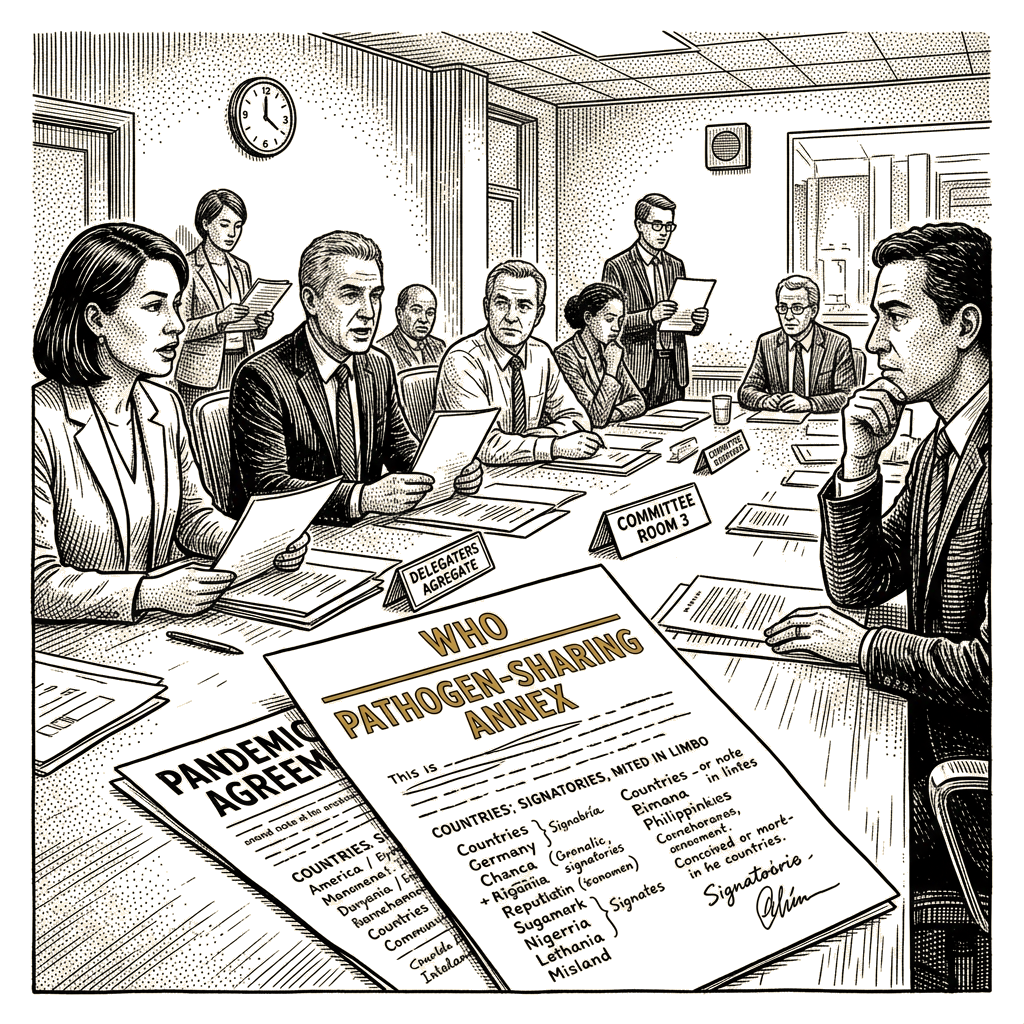
The World Health Organization’s pandemic agreement, adopted in May 2025 to prepare the world for the next global health crisis, remains in limbo more than a year after countries signed on. Negotiators concluded their eighth round of talks in Geneva last week without progress on the treaty’s most contentious piece — the Pathogen Access and Benefit Sharing annex, known as PABS.
“The pandemic agreement is really in a state of continued limbo,” Suerie Moon, co-director of the global health center at the Geneva Graduate Institute, told NPR. “The mood is somber, I think a lot of countries know we have to make progress, and yet the path forward is not obvious.”
The PABS annex sits at the center of the disagreement. It would set the rules for two linked questions: how quickly countries must share data on emerging pathogens with the international community, and what obligations attach to the vaccines, drugs, and diagnostic tests developed from that data.
“There was staggering inequity during COVID-19, where rich countries had access to vaccines almost immediately, and were able to procure it multiple times over for their population,” said Sangeeta Shashikant, a legal adviser for the nonprofit Third World Network. “The pandemic agreement is an attempt to bridge that gap.”
At the UN General Assembly on Friday, WHO Director-General Tedros Adhanom Ghebreyesus pressed member states to break the deadlock. “Although differences remain, I am confident that countries will find common ground, just as they did with the agreement itself,” he said. “So today, I leave you with just one request, just one: get [it] done, as soon as possible. Further delays are not just delays in procedure or process. They are delays that cost all countries dearly when the next pandemic arrives.”
The dispute maps broadly onto a global north versus global south split, according to Moon. Wealthy countries want a system that supports the rapid development of new products through open access to pathogen data. The existing arrangement has produced results: Chinese scientists uploaded the SARS-CoV-2 genome to a publicly available database in early January 2020, and that early access helped scientists develop vaccines quickly. “It worked incredibly well,” said David Reddy, director general of the International Federation of Pharmaceutical Manufacturers and Associations.
Lower-income countries remember the same period differently. “I think they have very bitter memories of what happened during COVID-19,” Moon said. Those countries want binding guarantees that sharing a sample or data today will produce access to the products developed from those materials tomorrow. Some are pushing to place all pathogen data in a closed database accessible only to parties who register and sign contracts with WHO — contracts that could require a share of resulting products to be delivered to lower-income countries at reduced cost. The model resembles WHO’s pandemic influenza preparedness network, where countries submit virus samples in exchange for more equitable vaccine access.
Wealthy countries have already committed to providing 20% of pandemic vaccines to WHO in an emergency, but they oppose attaching strings to data access. Amber Sholz, head of science policy at the Leibniz Institute, argued that constraining data access would impede the basic research needed to understand emerging threats. Putting limits on some data, she said, creates “a huge amount of friction that leaves us not super prepared for understanding pathogen biology.”
James Love, director of the nonprofit Knowledge Ecology International, has proposed a middle ground: keep the data open but attach equity conditions to any product developed from it. Scientists and companies could freely study the data, but to sell a resulting product in a given country they would need to sign a contract guaranteeing a degree of equity. “Our proposal gives you the best on equity and the best on open science,” Love said. Shashikant, however, argued that without conditions at the point of data access, lower-income countries lose their leverage. “If you have WHO chasing a company five years later, trying to get a contract, they can just say no,” she said.
The next scheduled opportunity for a deal is the World Health Assembly in May 2027. Alexandra Phelan, a global health law expert at Johns Hopkins University, said countries are approaching the talks in good faith but warned that good faith can erode. She views next May as a deadline for reaching agreement. “We need a breakthrough if we’re going to cross the finish line by next May,” Moon said.
The United States is no longer at the table. The country completed its withdrawal from WHO last year and is not participating in the negotiations. Moon said the U.S. is instead signing bilateral health aid agreements with individual countries — deals that exchange pathogen data for health aid outside the multilateral framework. Those bilateral arrangements, she warned, could undermine the PABS system the negotiators are trying to build. “They’re like termites in the wood of the house that we’re trying to build,” Moon said.