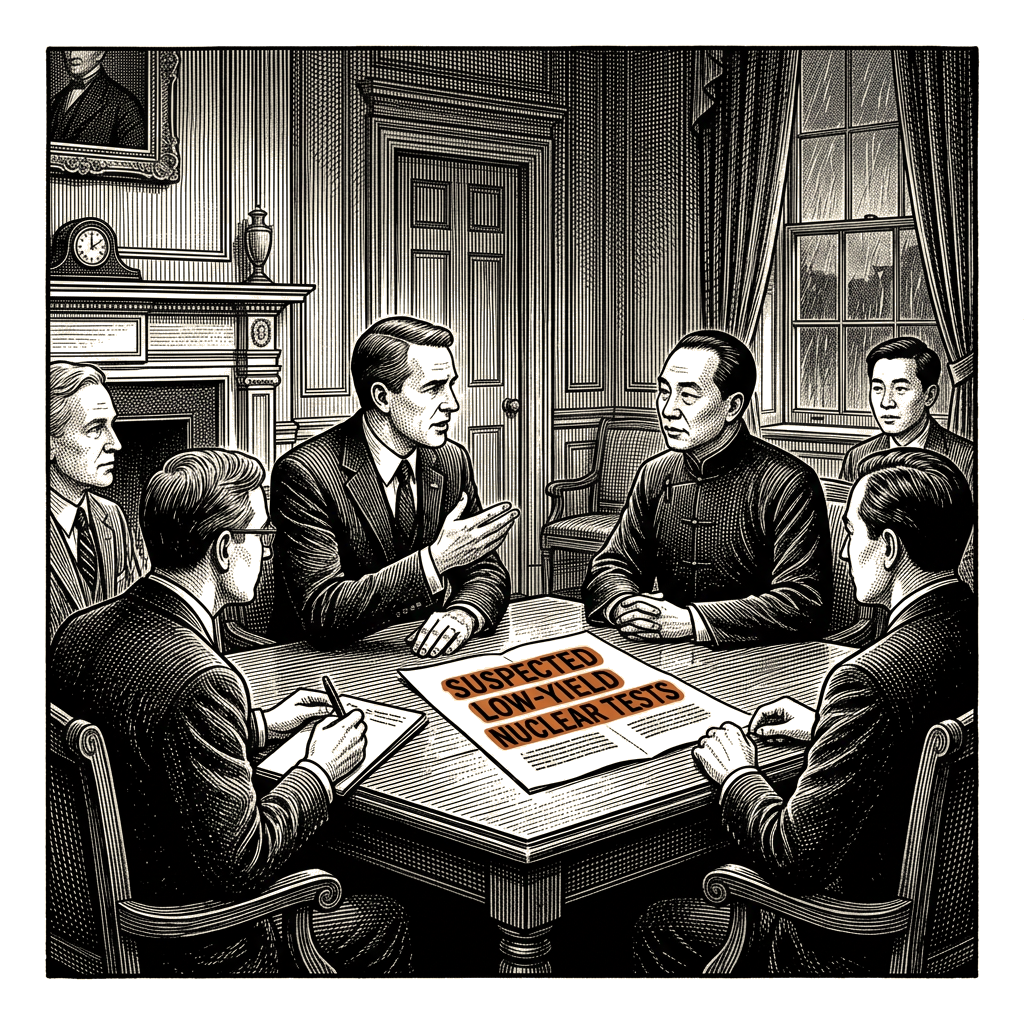
Discussions center on verification rather than a formal arms-control pact
The Trump administration’s confidential talks with China over suspected secret nuclear tests have taken place on the margins of multilateral meetings in Geneva, New York and Casablanca, Morocco, where U.S. officials have pressed their Chinese counterparts to address the testing allegations, according to people familiar with the discussions. Further talks are expected next month.
The nuclear dialogue is one component of a broader effort to stabilize U.S.-China ties as Trump prepares to meet Xi following this week’s United Nations General Assembly. The leaders’ summit is expected to focus on trade, artificial intelligence and potential business deals — issues Trump has sought to anchor in a strong personal rapport with Xi.
But Beijing’s rapidly expanding nuclear arsenal has cast a shadow over American policy toward its top geopolitical rival. The bilateral exchanges have centered on measures to reduce nuclear risks and have not been aimed at negotiating a formal arms-control pact, an effort Beijing has sharply rebuffed in the past.
A central point of friction has been U.S. allegations that China breached the Comprehensive Nuclear-Test-Ban Treaty of 1996, known as the CTBT. The treaty is not legally in force because not enough nations have ratified it, so its short-notice inspection provisions are not in effect. China, Russia and the United States all say they are abiding by its terms, which permit safety and reliability experiments involving fissile material as long as they do not produce a nuclear-explosive yield.
The Trump administration has alleged that China has gone further, carrying out secret very low-yield tests, including one at its Lop Nur site in northwest China in June 2020. Chinese officials have vociferously denied the accusation.
In October 2025, Trump said he would order the resumption of U.S. nuclear testing on an “equal basis” with China and Russia if those nations did not stop their suspected low-level tests. The warning followed a classified letter from three ranking Republican lawmakers — Senate Intelligence Committee Chairman Tom Cotton of Arkansas, Senate Armed Services Committee Chairman Roger Wicker of Mississippi and Senate Foreign Relations Committee Chairman Jim Risch of Idaho — alleging that China and Russia have been carrying out “supercritical tests,” as the low-level experiments are sometimes called.
Christopher Yeaw, a senior State Department arms-control official, said in an August speech at a conference hosted by U.S. Strategic Command in Omaha, Nebraska, that both Russia and China had shown initial openness to strategic-stability discussions. “Russia and China have expressed initial signs of openness to engage in strategic stability and arms control discussions,” Yeaw said. “We are far from discussing central limits, ceilings or caps.”
As the dispute has intensified, the administration has begun to highlight the possibility of new verification measures. “Perhaps there are diplomatic and technological options that could increase the confidence in each other’s behavior regarding nuclear explosive testing, including increasing the ability to detect ultralow-yield tests,” Yeaw said. He did not detail how monitoring might be improved, but independent experts have suggested placing seismic instruments on or near test sites or installing radiation-detection equipment — an approach floated during the Biden administration.
If new verification measures were agreed, they could potentially be adopted by the United States, Russia, Britain and France along with China. Those five are the nuclear powers that signed the CTBT and are permanent members of the U.N. Security Council. Such an arrangement would avoid the politically sensitive step of singling out Beijing while giving Washington a way to strengthen monitoring of Chinese and Russian nuclear activities.
Cotton has argued that the United States needs to “reverse the taboo” against testing so it can conduct the same low-yield blasts the Chinese and Russians have been accused of carrying out. A recent report from Cotton’s committee that accompanied annual intelligence legislation said: “China has expanded many facilities at Lop Nur, illustrating continued support for its testing activities and suggesting that designers will execute more complex test seasons in the future.”
The last U.S. nuclear test — an underground blast code-named “Divider” — was carried out in 1992. Officials from the Energy Department, which oversees maintenance of the U.S. nuclear-weapons stockpile, have since maintained that computer simulations and small nuclear experiments are sufficient to ensure the reliability of the arsenal.
Arms-control advocates argue that the moment calls for tightening verification and preserving the test ban rather than opening a new era of testing. “Rather than open the door to a new era of nuclear testing worldwide, the U.S. and others should work together on new technical measures to ensure no state is conducting clandestine low-yield nuclear explosions,” said Daryl Kimball, executive director of the Arms Control Association.
Another point of contention has been Washington’s insistence that Beijing provide more advance notice of its ballistic-missile tests. In July, the United States complained that China issued only a two-hour notice of a ballistic-missile launch from a submarine. The following month, the U.S. and 40 other countries urged all nations to provide at least 24 hours’ notice before test-firing ballistic missiles to minimize the risk of miscalculation. China has shown no willingness to sign on to that commitment and has accused Washington of “microphone diplomacy.”
The United States is also pressing China to provide transparency on its nuclear-force levels. China currently has over 600 nuclear weapons but is on track to have more than 1,000 by 2030, according to a Pentagon report on China’s military capabilities sent to Congress last year. Beijing has repeatedly rebuffed appeals to negotiate limits on its arsenal, noting that it has far fewer weapons than the United States. U.S. and Russian long-range nuclear arms were each capped at 1,550 warheads under the now-expired New Strategic Arms Reduction Treaty, and both countries hold thousands more shorter-range nuclear weapons.
“It’s hard to overstate the neuralgia that China has to any kind of meaningful discussion about arms control with the United States,” said Jonathan Czin of the Brookings Institution, a former senior U.S. intelligence official on China. “They really see it as a trap, and as a way for the United States, in their eyes, to contain and suppress China.”