Local officials warn Monday high tide could bring more flooding
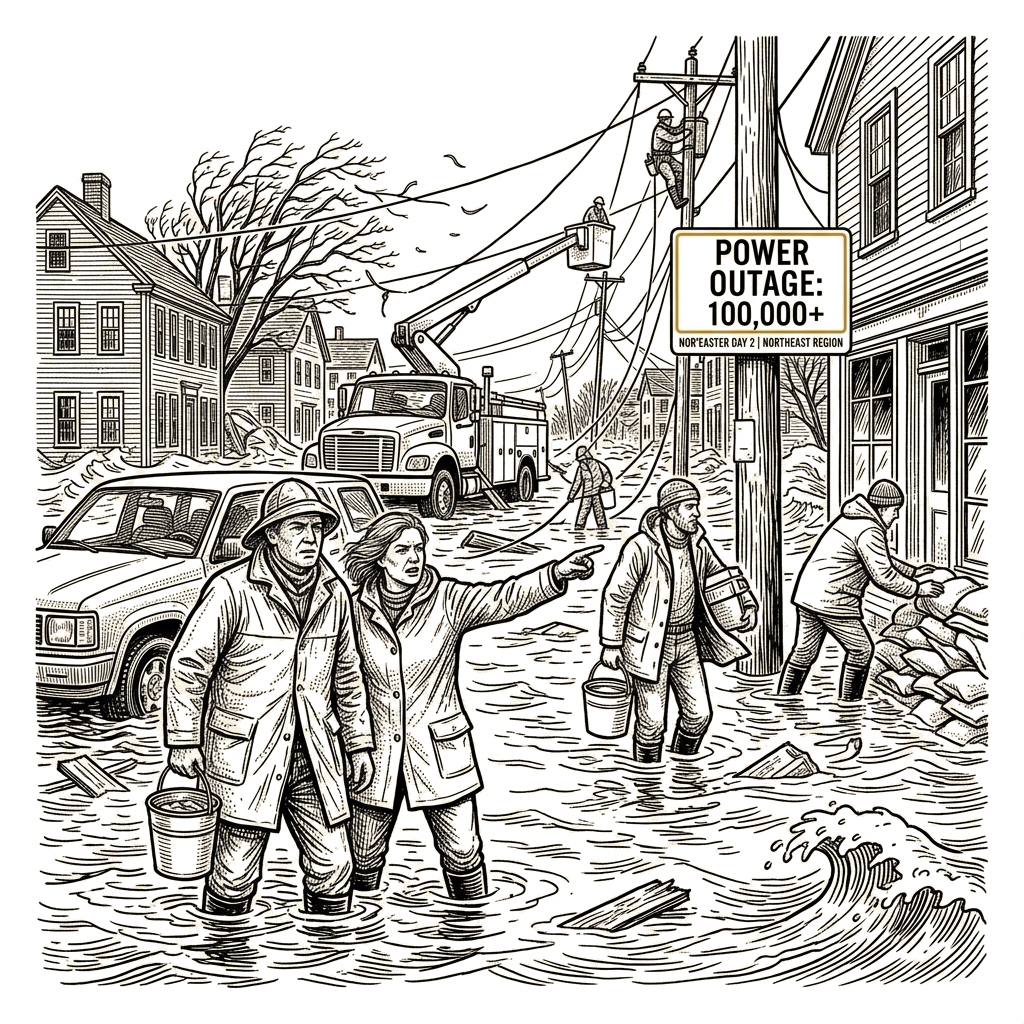
A slow-moving nor’easter pummeled the Northeast coast for a second consecutive day on Sunday, knocking out power to more than 100,000 customers and flooding coastal communities from New Jersey to New England.
The storm killed a New York City Housing Authority worker when a tree fell on Saturday. The system was expected to linger through Sunday with heavy rain, strong winds, and dangerous surf reaching New England.
The National Weather Service predicted the storm would weaken over Sunday night, with local heavy rain expected in parts of New England and the mid-Atlantic. The worst of the remaining rainfall was expected Sunday from northern New Jersey into southern New England. Bob Oravec, a lead forecaster with the NWS in College Park, Maryland, said the storm was gradually weakening but that tidal flooding would continue through high-tide cycles Sunday night.
Local officials in New Jersey and New York told residents that high tide late Monday could bring additional flooding. “There is another band of the storm, a weaker band, but still another band that could hit early this afternoon and later into the evening,” said Bruce Blakeman, the Nassau County executive.
More than four inches of rain had fallen in parts of New Jersey since Friday, the Guardian reported, with a surging ocean producing flooding amounts not seen in nearly a decade in some communities.
In the New Jersey beach town of Sea Bright, each high tide brought a new round of flooding. “It’s not like a one-time occurrence,” said Caroline Virenius, whose garage filled with about a foot of water. “It’s getting wet again and again.”
Tidal surges swamped low-lying neighborhoods in New Jersey, while wind gusts toppled trees on New York’s Long Island, damaging homes and bringing down utility poles. Well over 100,000 customers were without power across the Northeast and mid-Atlantic at times on Sunday, according to PowerOutage.us, with the most widespread outages in counties along the coast from New Jersey to Connecticut.
By Monday morning, the total number of customers without power across the US had fallen to about 55,000 — a figure that included more than 10,000 outages in Hawaii, where Hurricane Nolo was moving away after bringing heavy rain, flash flooding, and strong winds.
The storm disrupted air travel up and down the East Coast. More than 250 flights had been canceled at Boston Logan International Airport by late Sunday morning as wind gusts reached 40 mph, according to the Massachusetts Port Authority.
The nor’easter triggered memories of Superstorm Sandy, which left more than $60 billion in damage across the eastern US in 2012, the Guardian reported. While the current storm’s impact was described as far less severe, the outlet noted the system could be the first of several along the East Coast this fall because of an El Niño climate pattern disrupting this year’s weather. The Guardian also reported that images of waves crashing into sea walls and onto beaches raised concerns about coastal erosion.
Carole Ann Palmer, who owns Jingles Bait and Tackle in North Beach Haven, New Jersey, said this was the worst flooding she had seen in 10 years. “Yesterday, I was like, oh my God, it just keeps getting higher and higher,” said Palmer, who lives above the store. Her front step was swept away, and she saw neighbors kayaking through the streets on Saturday. On Sunday, her biggest problem was taking her two puppies outside to relieve themselves — she had to put on waders and carry them across the street to dry land. “I take one at a time, carry them across the street so they can do their business and then come back, dry them off and then do the other one. It’s a workout,” Palmer said.
Bernard Dowd waded through tidal water Sunday to get to his Sea Bright home, a day after he returned from work to find his basement “filled up like a swimming pool.” Dowd said the situation around his neighborhood would probably have been worse if not for new rules requiring homeowners to raise the height of their homes in the wake of Superstorm Sandy, which devastated the community. Many residents had lined their homes and businesses with sandbags. “I’m always thinking they are hyping the storm,” Dowd said.
In New York City, water a few inches deep filled streets in the Howard Beach neighborhood but did not deter residents from venturing out for coffee on Sunday morning.