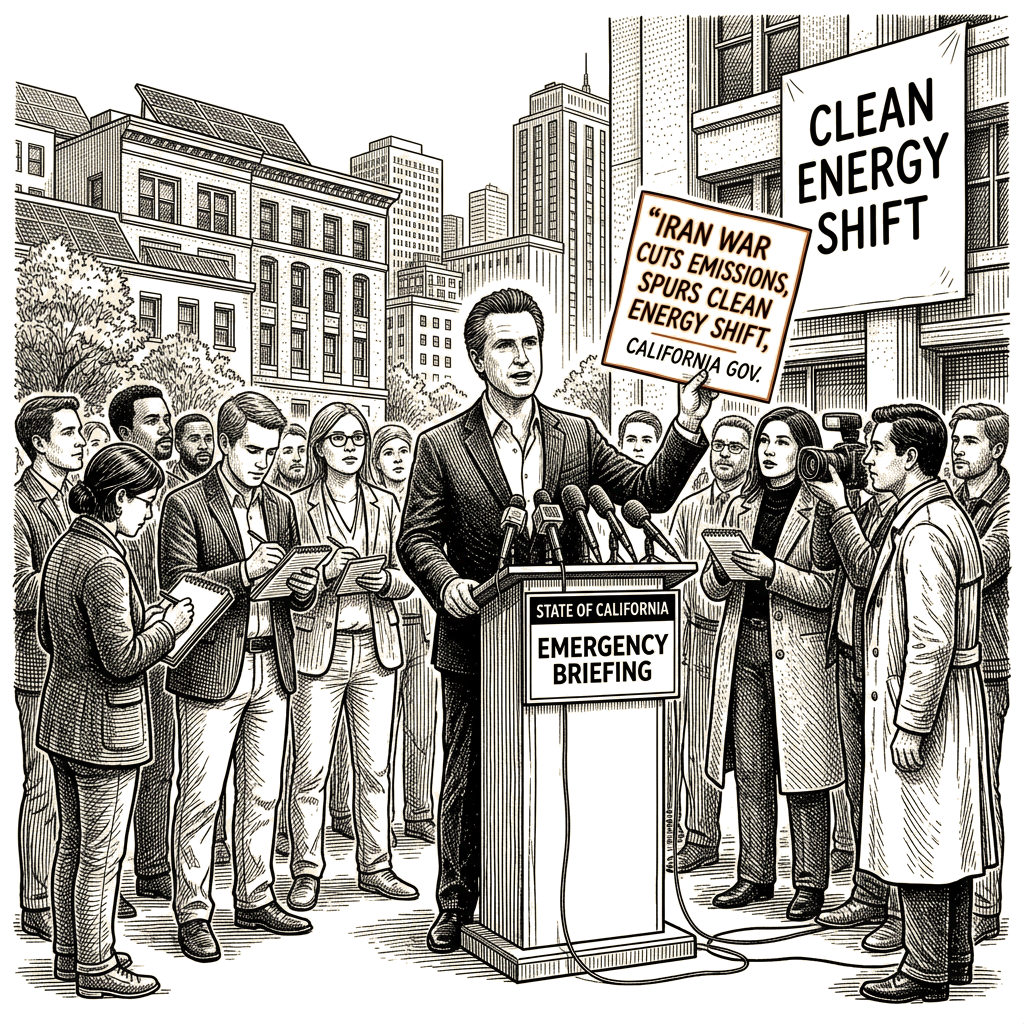
Newsom calls Trump ‘greatest gift’ to environmental movement
California Gov. Gavin Newsom has called President Trump the “greatest gift” to the environmental movement, arguing that the US-Israel war on Iran has exposed the fragility of fossil fuel energy security. Speaking to the Guardian during Climate Week in New York, Newsom — a potential contender for the Democratic presidential nomination — said the conflict is accelerating investment in clean energy.
“He’s woken the world up to how vulnerable we are to petro-dictatorships, how vulnerable we are to disruptions in the Middle East,” Newsom said. “This war has completely gutted any sort of romantic notions of energy security and it’s compelled folks to think differently. It’s accelerating investments and clean energy and renewables.”
The war’s toll on energy markets underpins the claim. The Strait of Hormuz, where a fifth of the world’s oil and gas exports usually flow, has been routinely snarled since the conflict began in February, sending fossil fuel costs soaring around the world, with oil hovering at about $100 a barrel for months. Countries have scrambled to cut their oil and gas use while turning to solar and wind, although there has also been a small uptick in coal, the dirtiest of fossil fuels.
Carbon Brief has estimated that global fossil fuel emissions will drop by 0.5% this year because of the crisis, and the International Energy Agency says the peak in oil consumption may have been sped up enough to arrive this year, rather than the previous estimate of 2029. An annual reduction in planet-warming emissions is something not seen outside global economic crashes or the Covid-19 pandemic, the Guardian reported. The president’s imposition of tariffs and importation of foreign ground beef may also end up hurting the US cattle industry, another major source of greenhouse gas emissions.
“It’s a curious thing to say, but I believe it,” Newsom said of the idea that Trump is an unintentional environmentalist. “This moment will mark how we can’t go back to our original form.”
The characterization sits uneasily against Trump’s record. His administration has eviscerated pollution limits on cars, trucks and power plants, funneled taxpayer money and favors to the fossil fuel industry and set about unilaterally cancelling renewable energy projects. Trump has called environmentalists “terrorists,” the climate crisis “a hoax,” and has slashed conservation rules to the point that a protected species can be killed as long as the killing was not provably intentional, according to the Guardian. Asked during the 2024 election campaign about his environmental credentials, Trump cited awards his Florida golf course received for “the way I built it, for the water, the way I use the water, the sand, the mixing of the sand and the water,” according to the report.
Rob Jackson, a climate scientist at Stanford University, said Newsom was guilty of “tunnel vision” in his framing of Trump. “Trump’s illegal attack on Iran may hasten clean energy in some countries, but he has gutted green tech in the United States and set us back decades,” Jackson said. “The notion that he is an accidental environmentalist is wishful thinking.”
The conflict has also enriched the industry it has disrupted: eight of the largest oil and gas companies netted more than $90bn in just the first three months of the war, the Guardian reported, and even Trump has complained that the major fossil fuel firms are “making too much money.” Exxon forecast last month that the world will still use 105m barrels of oil a day in 2050, up from 100m barrels last year, with oil, gas and coal still making up two-thirds of the global energy mix at mid-century, the company estimated.
Juan Carlos Navarro, Panama’s environment minister, said the industry’s trajectory is unchanged. “All of the oil that is produced will be burned – if they produce more, more will be used,” Navarro said. “The people who predict that there will be a reduction in the emission of greenhouse gases are simply lying or blind.” The only hope, he added, is that the world “can cap consumption and production at levels similar to the ones we have right now,” citing the enormous energy demand of artificial intelligence datacenters, which are largely being run on gas-fired power.
Climate advocates say the conflict will accelerate trends already swinging behind clean energy. Investment in renewables globally is now double that of fossil fuels, almost all new power being added to grids comes from clean sources, and one in four cars sold last year was electric, the Guardian reported. “There is one thing that all these events are making clear,” Ursula von der Leyen, president of the European Commission, said in April. “We are paying a very high price for our over-dependency on fossil fuels.”
Countries from the UK to India to Thailand have sought to speed up the transition to renewables as the price of fossil fuel dependency has spiraled, saving billions. Electric vehicle sales have surged, although not in the US. Trump has urged other countries to reject the “scam” of clean energy, but the market is increasingly favoring cheap wind, solar and batteries that have plummeted in cost in recent years, including in the US.
Sonia Dunlop, chief executive of the Global Solar Council, said demand has “massively spiked” for solar and battery storage. “We’re seeing that all over the world – the Philippines, across Europe, across Southeast Asia, Australia and beyond,” Dunlop said. “This Iran crisis, which was, in effect, started by president Trump, has led to a massive surge in demand for our technology … but actually it’s just building on a trend that was already there.”
Dunlop said the momentum will not end when the conflict does. “I don’t think the world is just going to go back to business-as-usual demand of fossil fuels once this crisis ends. Once someone decides to step off the fossil fuel rollercoaster, they’re off it.” Asked whether the record makes Trump an environmentalist, she said: “I wouldn’t say that. He certainly has his own ideas.”
Al Gore, the former US vice-president, pointed to the spread of cheap solar power in developing countries. “The price of solar has come down so quickly that there are now 100,000 solar panels installed every day in Africa,” Gore said last week. “In parts of Pakistan, a common bride’s dowry is now three panels and an inverter, instead of 10 or 12 goats. It’s beginning to kick into gear.”
The Iran war may not prove a fatal blow to fossil fuels, but it has starkly highlighted their inherent volatility, the Guardian concluded.
The energy-market fallout extends a conflict MSI has covered since March, when Trump began framing higher oil prices as an American advantage even as his administration struggled over access to the Strait of Hormuz (Trump touts higher oil prices as his team struggles over Hormuz access). By July, the war had entered its fifth month with diplomacy stalled, and a senior administration official described Trump as having entered “revenge mode” (Trump’s frustration grows as Iran war enters fifth month, diplomacy stalls).