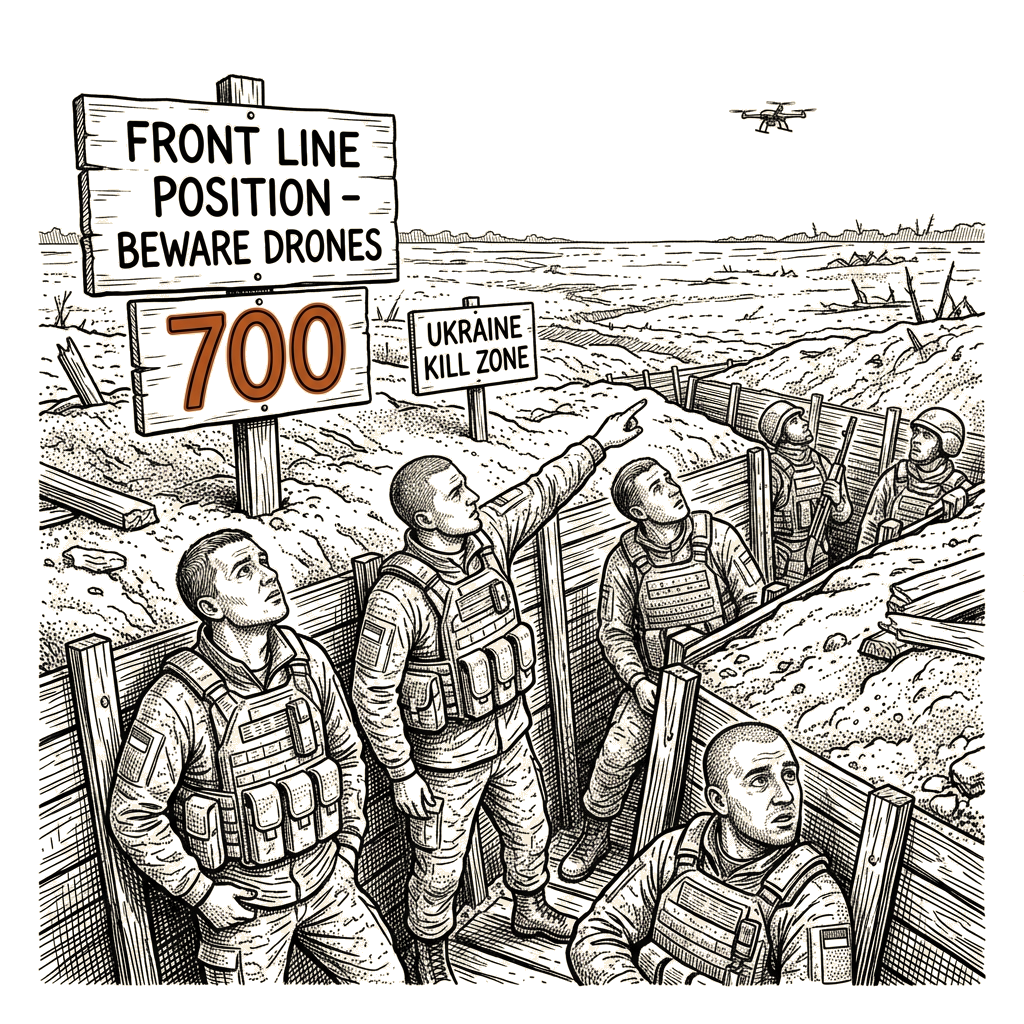
Troops walk four hours to cover a single kilometer in the kill zone
The Russia-Ukraine frontline, stretching the entire length of the country from north to south, has barely budged in four years and is sometimes compared to the static, deadlocked trench warfare of World War I. Straddling the line is a belt of territory that has come to be called the Kill Zone, dominated by constantly evolving drone technology that is defining the conflict and, in the view of military analysts, the future of warfare. “This Kill Zone is a belt of territory which is full of Russian drones, Russian mines, and also artillery. It’s nonstop reconnaissance and surveillance,” said Ukraine’s Sr. Lt. Taras Myshak, the spokesman for Ukraine’s 59th Separate Assault Brigade, who spoke with NPR on Zoom from a few miles behind the front in eastern Ukraine. Ukraine has a similar arsenal threatening the Russian forces that are dug in on the other side of the line.
The most important thing to know about the Kill Zone, Myshak said, is that any sign of movement — just sticking a head out of a foxhole for fresh air — can get a soldier noticed, and attacked, by the drones constantly buzzing overhead. Even routine operations like rotating troops in and out of the zone are a nightmare. “Not far from where we are talking today, we have a group that moved through the Kill Zone and they will they walk four hours just to go one kilometer,” Myshak said. “Because all the time they hear the drone and they have to hide and wait. Then the drone passes, and they can move.”
Nightfall offers no respite. The drones carry thermal cameras that detect body heat and make it harder to hide. “In the night, it’s even more dangerous,” Myshak said.
The static character of the front is a departure from the war’s opening phase. When Russia launched its full-scale invasion in February 2022, it advanced rapidly in conventional fashion with large columns of troops in armored vehicles. Later that fall, Ukraine’s counteroffensive drove the Russians back in some places. Since then, the two armies have settled in and the frontline has moved only incrementally, mostly with limited gains by Russia. The line now stretches more than 700 miles, with the Kill Zone forming a band roughly 10 to 20 miles wide on either side.
“The Kill Zone is basically a product of drone warfare,” said Rob Lee, a U.S. Marine veteran who now lives in Ukraine and monitors the war for the Foreign Policy Research Institute of Philadelphia. Because Ukraine has far fewer troops and relies heavily on drones, it maintains a remarkably small presence on the frontline. In many places, Lee said, Ukraine has fewer than 10 soldiers per mile, organized in small groups of two to four people, spaced hundreds of yards apart and dug in underground. Rather than trying to hold back advancing Russian forces directly, these troops act more as spotters, relaying enemy movements to Ukrainian drone operators behind the lines, who then track intruders from the air.
The frontline is so saturated with drones, Lee added, that it is virtually impossible for either side to pull together a large ground force without being detected and drawing fire. Military vehicles like tanks and armored personnel carriers are even easier to spot and attack. “Because of such a high density of drones, it became very difficult to bring vehicles near the frontline at all,” he said.
Neither side planned to fight this way. Ukraine had no real drone industry at the start of the full-scale invasion in 2022; President Volodymyr Zelenskyy says the country will make 10 million drones this year. Russia has ramped up its own production and is expected to make more than 7 million, including jet-powered aircraft that frequently evade Ukrainian defenses.
When Dima Putiata joined Ukraine’s military four years ago, he knew nothing about drones and did not think this was a manly way to wage war. “When I saw that we have drones, I was not smart enough. I said, ‘No, we don’t need to have it. Let’s fight like men.’ I was a little bit maybe romantic in this way,” Putiata said. Few Ukrainian troops were trained to use the new weapons. “No one had drone operators,” he recalled. “It’s just, ‘Oh, you’re a driver? You can use it.’ Or, ‘Oh, can I use a drone? You can try.’” By the time he left the military in May, Putiata, a sergeant, was commanding 26 drone crews in and around the Kill Zone in northeastern Ukraine. Both sides have rapidly embraced the technology even as they struggle to anticipate where it goes next. “They understand how to use it here and right now, maybe not really understanding how to use it in the future,” he said. “My point is, you just need to keep going and adapting.”
Two years ago, Ukraine became the first country to establish drones as an independent branch of its military. The innovation now extends to ground drones — robotic vehicles resembling trolleys that deliver food, medicine and ammunition to the front, carry machine guns for regular attacks, and evacuate wounded soldiers from the Kill Zone. But the two skill sets required — drone operation and combat medicine — do not overlap. “The drone operator doesn’t know how to properly evacuate a wounded soldier, and the medic doesn’t know how to operate a ground robot,” said Lyuba Shipovich, a Ukrainian-American who heads Dignitas, a private group that trains troops on drones. “So now we’re trying to create combined program that will train both the medic and the robot operator.”
Media coverage tends to focus on long-range air strikes Russia and Ukraine are inflicting deep inside each other’s territory. But the vast majority of the fighting is in the Kill Zone, with drones now responsible for 80 percent of all casualties, according to Rob Lee and other military analysts.
Dima Putiata, the former Ukrainian soldier, says what started in this war has already spread to other conflicts. “With drones, this is the cheapest flying munition that can be massively produced. You can destroy a lot of stuff,” he said. “It’s much cheaper than it used to be to have a war, unfortunately.” A kind of war, he predicted, that the world will see more often.
NPR’s Hanna Palamarenko contributed to this story.