Wall Street hits records while Asian shares decline and oil tops $100
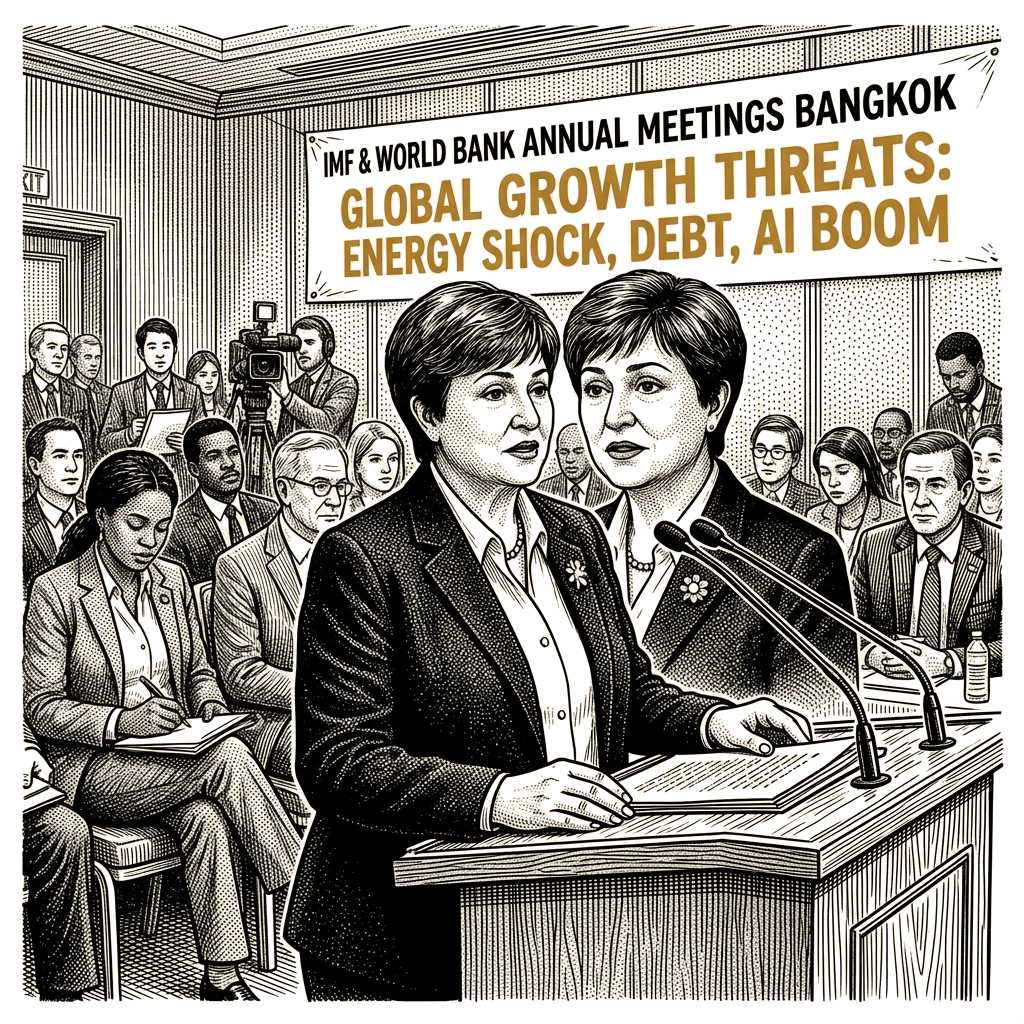
Kristalina Georgieva, the managing director of the International Monetary Fund, said the world is being pulled in two directions: a negative energy supply shock tied to the Middle East war and a positive demand shock from artificial intelligence investment that is also driving inflation higher. The IMF and World Bank will hold their annual meetings in Bangkok next week.
In a speech previewing those meetings, Georgieva identified three forces simultaneously threatening the global economy: an energy price shock, record public debt, and the AI investment boom. She described the combined impact of the energy and AI forces as “highly uneven” across the world, noting that the AI boom is bypassing many countries.
Georgieva singled out advanced economies — led by the United States — as the “worst offenders” on government debt, saying debt-to-GDP ratios in those economies are higher than in emerging markets and low-income countries. Her warnings arrive with U.S. 10-year Treasury yields at 5.31% and U.K. 10-year gilt yields at 5.37%, and after last week’s government bond selloff pushed the spread between French and German 10-year bonds to almost 160 basis points.
Investors are weighing the competing forces Georgieva identified. U.S. equity markets set fresh records: the S&P 500 rose nearly 0.6% to 7,818.93, and the Nasdaq closed at 27,599.886. The gains contrast with declines across Asia, where MSCI’s broadest index of Asia-Pacific shares excluding Japan fell 0.3%. Japan’s Nikkei lost 0.6%, Hong Kong’s Hang Seng fell 0.5%, Singapore’s market dropped 1.3%, and South Korea’s Kospi tumbled nearly 2%.
Oil prices have returned above $100 a barrel. Brent crude rose 0.66% to $101.19, and U.S. crude gained 0.5% to $89.86. Investors are weighing supply constraints from a storm heading for North American oil-producing regions and from Houthi attacks on Saudi Arabia, against higher shipments from the broader Middle East. According to commodities trading firm Vitol, as reported by Reuters, roughly 12 million barrels per day of crude and 2 million barrels per day of refined products have left the Middle East on tankers over the last seven to ten days.
After last week’s bond selloff, government bonds rallied on Tuesday, pushing yields lower. Ten-year French yields fell more than 11 basis points, and the spread between French and German bonds narrowed to 132 basis points. ANZ economists said: “A sense of calm returned to European bond markets with French, Italian and Greek bonds outperforming amid a broad rally.” The euro recovered from its declines over the past week and stabilized just above $1.1250.
Wednesday’s session saw yields tick back up. French 10-year yields rose nearly 5 basis points to 4.796%, while U.S. Treasury yields climbed 4.5 basis points to 5.31%. U.K. gilt yields were little changed at 5.37%. The week’s calendar includes the U.K. Treasury’s 2028 gilt auction on Wednesday and the release of U.S. Federal Reserve minutes from the last policy meeting on Wednesday evening, both of which will be parsed for signals on the path of borrowing costs ahead of the Bangkok meetings.