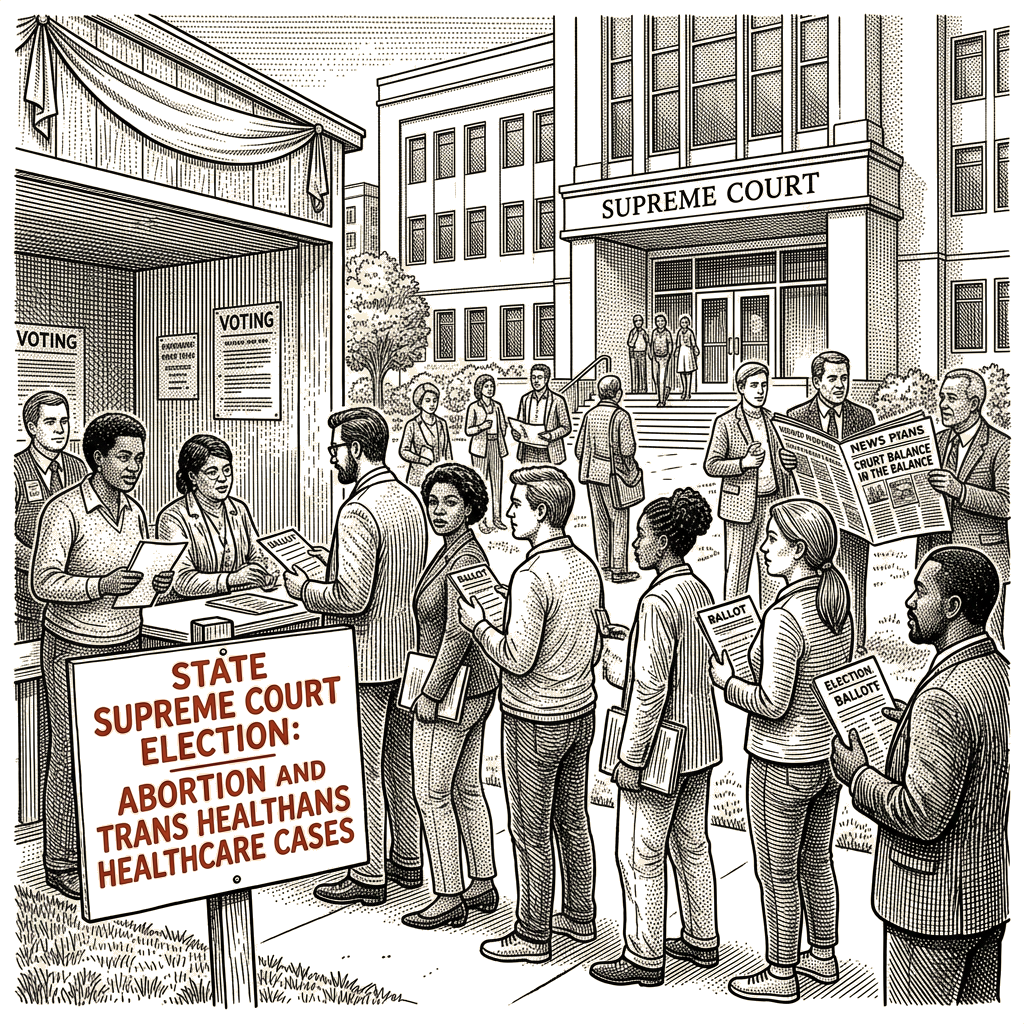
State high courts gain authority over reproductive rights after Dobbs, Skrmetti
“When the U.S. Supreme Court overturned Roe v. Wade in 2022, ending a half-century of federal constitutional protection for abortion, it handed this major issue back to the states,” Rebouché wrote. “As a result, in addition to prompting ballot initiatives, the court’s decision in Dobbs v. Jackson Women’s Health Organization has also spurred litigation in state courts.”
These cases ask judges to discern whether state constitutions create a right to abortion — or, at least, prohibit restrictions on abortion access — Rebouché wrote. State supreme courts have already begun weighing consequential questions on these issues. Idaho’s high court recently approved Republican officials’ rewritten wording for a ballot initiative that would repeal the state’s abortion ban; advocates for the initiative argue the language misrepresents the law, Rebouché reported. In Indiana, the state Supreme Court recently heard arguments over whether a religious freedom law creates an exception to the state’s near-total abortion ban; plaintiffs in that case argued that their faiths allowed or required the procedure in circumstances the ban currently forbids.
The U.S. Supreme Court has increasingly handed questions concerning transgender rights back to states as well, Rebouché wrote.
In June 2025, the U.S. Supreme Court ruled 6-3 in United States v. Skrmetti that Tennessee’s ban on puberty blockers and hormone therapy for transgender minors does not constitute sex discrimination under the U.S. Constitution, according to Rebouché. Consequently, she wrote, that and similar bans only need to pass the lowest level of judicial review, rather than the higher “strict scrutiny” standard. The decision cleared the way for the roughly two dozen states with similar bans to continue enforcing them. The Skrmetti ruling did not require any state to pass such a law, and it does not address how far the ruling extends to adults or whether it applies to other aspects of gender-affirming care, such as insurance coverage, Rebouché wrote.
Several specific 2026 races could shift the ideological composition of state high courts, Rebouché reported.
In Ohio, where Republicans hold a 6-1 majority on the state Supreme Court — a dominant position built over successive election cycles in 2022 and 2024 — the only Democratic justice, Jennifer Brunner, is defending her seat against a Republican challenger. If Brunner loses, Ohio’s highest court could become a unanimous conservative bench — one that will likely determine the outcome of high-profile cases related to both abortion access and gender-affirming care, according to Rebouché. Ohio voters approved a constitutional amendment in 2023 protecting abortion access; the amendment establishes that individuals have the right to make their own reproductive decisions, and its language covers contraception, fertility treatment, continuing a pregnancy, miscarriage care and abortion up to fetal viability, asserting that the state generally cannot interfere with these decisions. Lower courts are now litigating whether restrictions on abortion access — including a 24-hour waiting period and a ban on telehealth for medication abortion — can survive scrutiny under that amendment. The Ohio Supreme Court may eventually decide that case, and in Rebouché’s assessment, an even more conservative Ohio court might be inclined to read the voter-approved abortion amendment as narrowly as possible. Ohio’s Supreme Court is similarly poised to make major decisions on trans rights. For example, it could uphold the state’s ban on gender-affirming care for transgender minors. That would reverse a 2025 appellate ruling that had struck down the law, which was passed over the veto of Republican Gov. Mike DeWine.
In North Carolina, where the high court leans heavily conservative, one of just two Democrats on the seven-judge panel — incumbent Democrat Anita Earls — is up for reelection. If she loses, Republicans would gain a near-total supermajority on the state’s Supreme Court, according to Rebouché. That outcome would likely cement the party’s edge on key political matters for years to come.
Michigan presents the mirror image. All justices there are officially nonpartisan, but Democrat-backed justices hold a 6-1 majority on the seven-member court. Chief Justice Megan Cavanagh and Justice Noah Hood — both Democrats — are up for reelection this fall. Democrats are hoping to retain their edge, in part to keep abortion protected; voters enshrined abortion rights directly into Michigan’s Constitution in 2022, and the state’s highest court has already interpreted that amendment to dismiss abortion-related restrictions.
In Montana, judicial races could change the ideological bent of the state’s top court, Rebouché wrote. Judicial elections in the state are technically nonpartisan, but Republicans see a chance to retake a state Supreme Court where, in 2023, a Democrat-endorsed majority ruled that the state constitution protects abortion rights and that attempts to stop advanced practice registered nurses from performing abortions violated those rights.
Judges who upheld restrictions affecting residents’ reproductive rights will face voters this fall in Alabama, Arizona, Florida, North Dakota, Oklahoma and Texas. In some of these races, abortion is a live — and legally dynamic — issue, Rebouché reported.
Even if they do not change the partisan makeup of these courts, elections for state supreme court seats in places such as Ohio may matter for the scope and breadth of rulings that claw back individual rights, Rebouché wrote. Or they may foretell how a conservative near-supermajority might lock in abortion and trans restrictions for a generation.
“Whoever wins these judicial races in November will not just be interpreting the law,” Rebouché wrote. “In a real sense, they will be writing the next chapter of it.”
The article was originally published in The Conversation under a Creative Commons license.