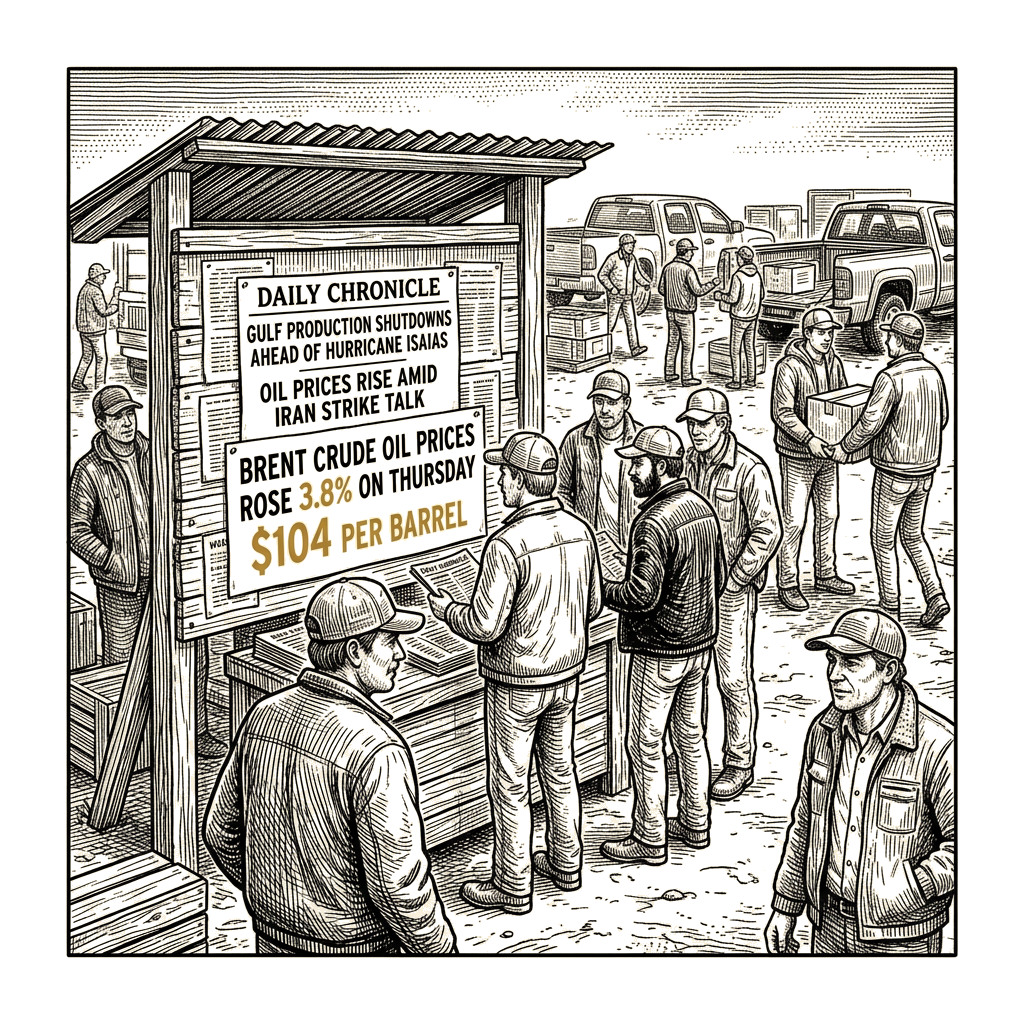
Bond sell-off continues as Brent tops $104 a barrel
Brent crude, the international benchmark, rose 3.8% to $104 a barrel on Thursday, triggering a broad wave of selling across global bond and equity markets. The move followed two simultaneous supply threats: a report that the White House has asked the Pentagon to draw up strike options against Iran, and the first hurricane of the Atlantic season prompting companies in the Gulf of Mexico to halt output.
The Atlantic reported Thursday that the White House has asked the Pentagon to draw up options for strikes against Iran before the US midterm elections. Citing unnamed Trump administration officials, the report said the size and targets of potential strikes — and whether the operation will proceed — remain under debate. The story has weakened hopes that President Donald Trump would refrain from escalating the conflict with Iran ahead of the November polls. A “limited operation” could be followed by more substantial action after the midterms, the report said.
The US-Israeli war against Tehran has entered its eighth month, and attacks on tankers in the Strait of Hormuz have reached their highest levels of the war, cutting traffic through the waterway and amplifying supply fears. The latest attack came on Wednesday, when a tanker was struck by multiple projectiles off the north coast of Qatar, causing casualties, according to the United Kingdom Maritime Trade Operations.
Separately, Tropical Storm Isaias strengthened into the first hurricane of the Atlantic season on Thursday, and Shell and Chevron said they are shutting down production in the Gulf of Mexico ahead of the storm, which is forecast to make landfall on Friday or Saturday. The shutdowns add a domestic production squeeze to the Middle East supply risks already pushing prices higher.
The supply risks have begun to spread to shipping costs. Maersk, the Danish shipping group, said Thursday it is increasing its emergency fuel surcharge on all its export collections and import deliveries. Rising energy prices have reinforced expectations that central banks will raise interest rates to control rising prices, and a sell-off in global bond markets continued on Thursday.
The yield on the US 10-year Treasury, widely considered the benchmark for the highest-quality government debt, rose 5 basis points to 5.331%. France’s 10-year yield, pressured by concerns about rising debt and growing spending, climbed 6 basis points to 4.931%, just below the 24-year high of 4.994% touched last week. The German 10-year yield, the European benchmark, added 2 basis points to 3.504%. Yields rise when bond prices fall.
Global stocks fell alongside the bond sell-off. Japan’s Nikkei share index dropped 1.4%, and the South Korean Kospi lost 2.6%. In Europe, the Stoxx Europe 600, which tracks the continent’s largest companies, slipped 1%. The UK’s FTSE 100 was down 0.6% in early Thursday trading.