Anthropic targets November IPO, OpenAI likely next year
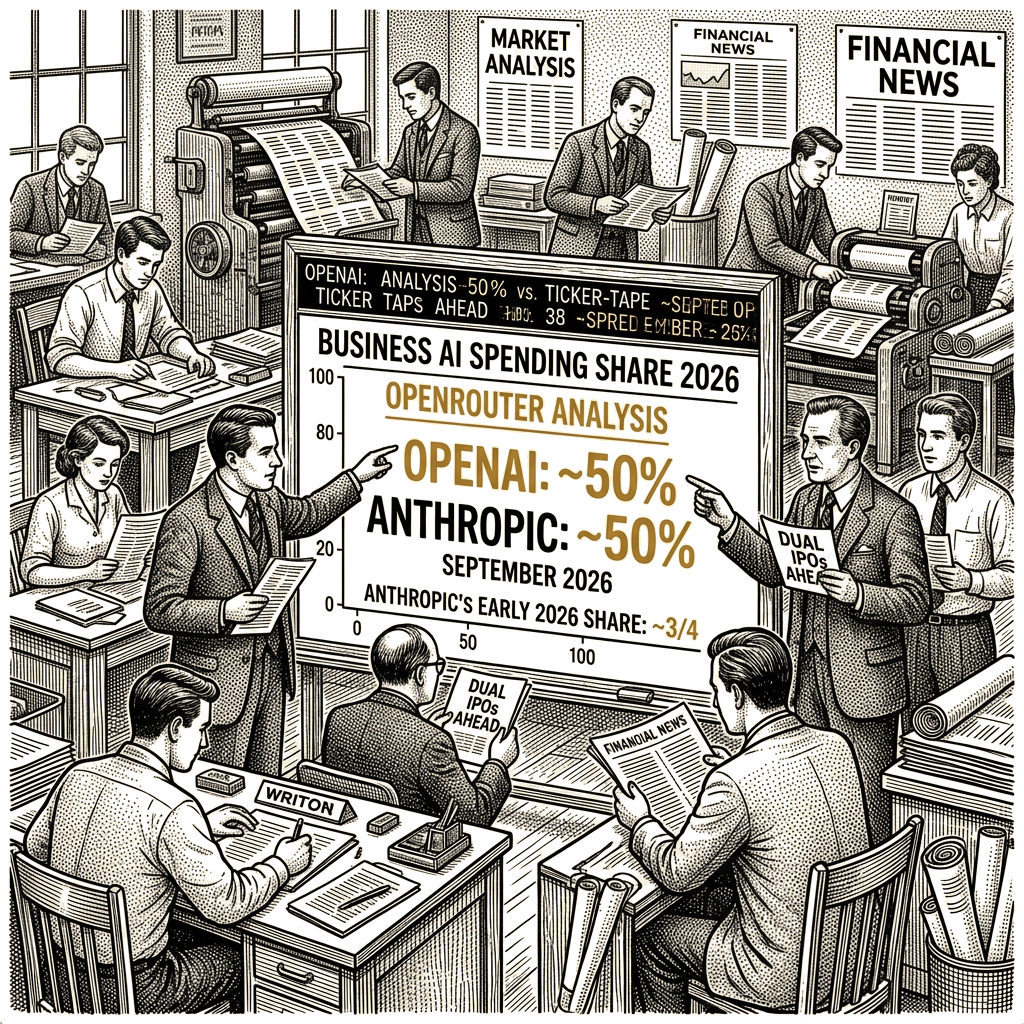
An analysis from OpenRouter, a startup that allows developers to access different AI models, found that among roughly 120,000 companies that use Anthropic and OpenAI tools, the share of spending was roughly even between the two companies in September 2026, down from Anthropic’s three-quarters share at the start of the year. OpenRouter said its data largely represents spending by AI-native startups as well as some slightly older tech companies and large enterprises. Chart data from the analysis begins with the first Monday in January.
The Wall Street Journal reported that “Anthropic edged to the front of the AI race earlier this year with cutting-edge models and a coding tool that corporate America loved,” and that “by some measures, OpenAI is now hot on its heels.” Demand for Anthropic’s Claude Code was so strong in the spring that the company faced frequent outages and a computing crunch, the Journal reported.
The same reporting described a subsequent shift in business attitudes: as employees at more companies experimented with AI, many businesses concluded that the most advanced models were not always needed for most tasks. Some companies turned to low-cost, open-weight models from China for some tasks, the Journal reported. The newspaper also reported that some Claude users objected to the guardrails Anthropic placed on its Fable 5 model when it was released in early June.
OpenAI “stoked the price war” this summer with the release of its GPT-5.6 lineup — Sol, Terra, and Luna — giving customers access to models with varying capabilities, including some that are less expensive to run, the Journal reported. Its Codex coding product and other business tools are now gaining ground, and the company has released additional iterations of its cost-efficient models. Shortly after the models launched, OpenAI lowered the price of GPT-5.6 Luna by 80% and GPT-5.6 Terra by 20%. OpenAI has said 2.5 million businesses now use its products. Many founders and industry analysts point to the GPT-5.6 release as a turning point, according to the Journal.
“The GPT-5.6 opened up this new lane for OpenAI in a way that the Anthropic family of models doesn’t really have,” said Peter Walker, head of insights at OpenRouter, which is owned by fintech company Stripe.
Business customers interviewed cited cost and a desire for diversification as the primary motivations for shifting toward OpenAI. David Hsu, founder and CEO of software-development platform Retool, said his company moved back and forth between OpenAI and Anthropic models at the start of the year, but the release of the GPT-5.6 models was “the main catalyst” for why Retool now mostly uses OpenAI models. Hsu estimated he spends about 20% less using OpenAI’s models than models from Anthropic. “We want to find the cheapest models because our revenue goes up the cheaper the models are,” Hsu said.
David Zhu, co-founder and CEO of AI sales-platform startup Reevo, said his company’s AI use is shifting away from Anthropic to OpenAI for two reasons: cost and a desire to be less reliant on any one model maker. “The honeymoon phase of being tied to one model maker is gone,” Zhu said. He added that his preference could shift again: “Things change so quickly.”
A separate factor pushing some business customers away from Anthropic was the company’s announcement that with its Fable 5 model, released in early June, it would retain user data for 30 days for what it said were trust and safety purposes, a problem for companies in industries that handle sensitive data, the Journal reported. Hsu of Retool said: “Pretty much all the contracts we’ve signed, the default is all data is deleted. But we could not attest to that if we had used Fable, so we just never used it.” Anthropic has since tried to address the issue with some customers by giving them control of the stored data.
Ara Kharazian, an economist at finance startup Ramp, said he looked at data from his employer’s 70,000 customers in mid-September and observed that businesses were spending more on OpenAI’s models than Anthropic’s for the first time since December. The lead was short-lived; by the end of the week, Anthropic was back on top by a slim margin. Ramp said its data set skews toward high-growth, tech-forward companies of varying sizes, with some Fortune 500 companies included, and omits spending by individual developers.
The convergence comes as Anthropic works toward an IPO as soon as November, while OpenAI is likely to go public next year, the Journal reported. Both companies have skyrocketing capital expenditures, and the coming months are critical in showing Wall Street they have sustainable businesses and revenue streams to back up trillion-plus-dollar valuations.
In late September, Anthropic started releasing its new Claude 5.5 family of models, touting lower cost and better efficiency. On Wednesday morning, a line of people snaked around a downtown warehouse in San Francisco, where attendees waited to enter the Claude Founder House, an Anthropic-hosted networking event. Founders and developers began lining up an hour before the event’s start time. An event staffer at one point shouted, “You need to have a ticket. If you are on the wait list, we will not be approving you.” A day earlier, some people waited for three hours, only to be turned away because the networking event reached capacity, with the large crowd drawing comparisons on social media to lines outside the Coachella music festival.
Michael Szklarski, co-founder of videogaming startup ReadyM, who waited in line for Claude Founder House on Wednesday, said his company often needs the most cutting-edge models and prefers Anthropic’s Fable 5.1 model. But he hoped to meet with Anthropic engineers to discuss, among other things, how to bring down the cost.