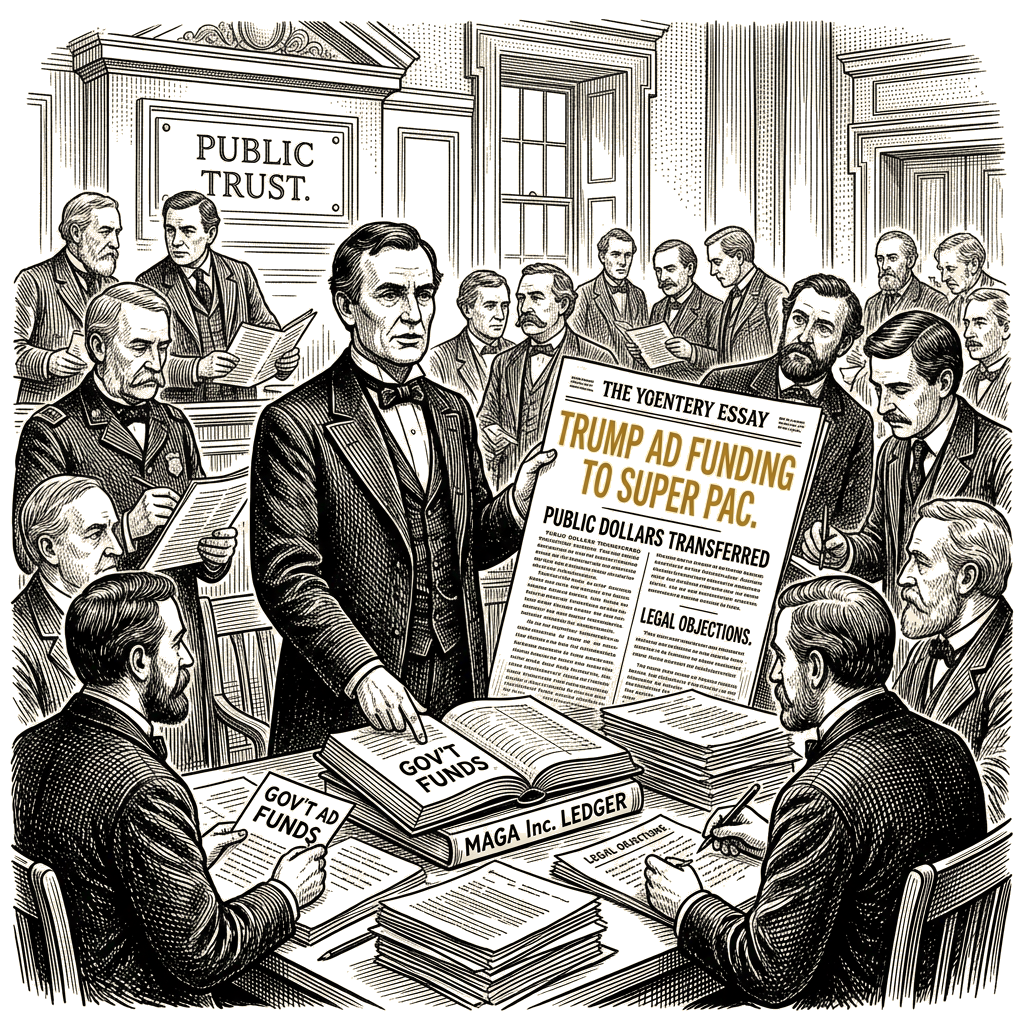
About $20 million in DHS funds paid for original Trump ads
The Trump administration’s reversal to super PAC funding for the ads drew fresh corruption allegations from ethics groups concerned about a sitting federal officeholder directing outside political spending. The shift followed objections from Democrats, some Republicans, and government ethics groups to the legal framework around the taxpayer-funded self-promotional advertisements. As of Wednesday morning, the ads were still airing with the disclaimer “Paid for by the U.S. government,” United Press International reported.
Trump defended the original taxpayer funding as “a rather standard thing to do,” even as he moved future costs to MAGA Inc.
The advertisements, broadcast in black and white during primetime programs, news broadcasts, and football games, feature Trump’s voiceover describing a “final battle” with the “sick political class that hates our country.” The voiceover references the “deep state” and “fake news media” and promises to “liberate America from these villains once and for all.”
A White House release described the ads as “very clearly not campaign ads” because “President Trump is not on the ballot and there is no call to action,” and said the announcements are “a reminder for Americans to love their country and know why it’s worth defending — at home, at the border and abroad.” The release called criticism of the advertisements “highly dishonest.” Vice President JD Vance has made similar statements.
Trump, meanwhile, has told crowds at several political rallies for Republican candidates to vote like he is on the ballot. He has been hitting the campaign trail across the country urging voters to vote Republican with the same rhetoric featured in these commercials.
To support the claim that taxpayer-funded presidential advertising is standard, the White House pointed to PSAs from prior administrations, including the George W. Bush administration ads explaining the Medicare Prescription Drug, Improvement, and Modernization Act; the Obama administration’s Affordable Care Act awareness campaign; and the Biden administration’s “We Can Do This” COVID-19 vaccination effort.
Margaret Dylus-Yukins, senior legal counsel for ethics at the Campaign Legal Center, told UPI that the historical examples undercut the administration’s argument. “The White House’s own examples do not align with their own messaging, saying these are public messages to remind Americans to love their country,” she said. “They use examples that are clearly, historically, tied to public health messaging and federal programs regarding healthcare for American citizens. These advertisements clearly do not fit the description that the White House is using to describe them.”
The “Paid for by the U.S. government” disclaimer implies that federal employees, working in their official capacities, produced and distributed the ads at the direction of senior officials including Office of Management and Budget Director Russell Vought. The New York Times reported last week that Trump ordered Vought to find funding for the advertisements, and that Vought allocated roughly $20 million from funds marked for the Department of Homeland Security.
The Department of Homeland Security was at the center of two partial government shutdowns this year as the Trump administration sought funding for U.S. Customs and Border Protection following the January killings of civilians and U.S. citizens Renee Good and Alex Pretti. In April, more than 20 Democrats joined a majority of Republicans to pass a funding bill covering most of the department.
The Hatch Act, enacted in 1939, restricts political activity by federal employees and bars them from using their official positions to engage in political activities or to coerce others to do so. Using government funds, employees, and resources to produce and distribute political advertising could violate the statute. The Trump administration has previously been accused of running ads blaming Democrats during last fall’s partial government shutdown; a Common Cause lawsuit alleging Hatch Act and other federal-law violations remains unresolved.
The shift to PAC funding carries its own legal exposure. The Campaign Legal Center filed a complaint with the Federal Election Commission last month alleging that Trump has violated campaign finance law by raising and spending super PAC money while serving as a federal officeholder. The complaint focuses on what the group calls Trump’s use of soft money — funds that do not comply with federal contribution limits, prohibitions on certain sources of contributions, and FEC reporting requirements.
The 2010 Supreme Court decision in Citizens United v. FEC lifted limits on corporate and union spending through super PACs, while preserving the legal distinction between independent PACs and the candidates they support. Erin Choplak, the Campaign Legal Center’s senior director of campaign finance, told UPI that Trump’s repeated public statements establish his control of MAGA Inc. and raise recognized corruption concerns.
“When a particularly wealthy person can just hand over a big check to somebody in a position to reward them, that creates a clear appearance of corruption and may well create actual corruption,” Choplak said. “In this instance, when the president of the United States is controlling a fund that is receiving huge donations from wealthy donors, the very same donors that are seeking to extract benefits from the president himself, the corruption concerns that presents are obvious and it’s illegal.”
The Campaign Legal Center says MAGA Inc. has raised more than $400 million for Trump. In an Oval Office press conference last month, Trump told reporters he believes the PAC has raised nearly $1 billion and described his personal authority over how the funds are spent.
“How do I make it? I sit down and I say, ‘let’s do this, let’s do that,’” Trump said, according to UPI. “I’m going to spend whatever amount of money necessary to try to help us. And this is money from MAGA Inc. This is my money that I control.” He added: “So I’ll be spending. We’ll be spending. We’re going to spend a lot of money because we don’t want to lose our country.”